To prepare for the busy season and stay in control when the big event arrives, you need actionable strategies that are well-planned before November.
In this Black Friday marketing strategy guide, we'll outline six data-backed ways you can set up ahead of time to make the most of the busy holiday season.
First, what happened in BFCM 2025?
Triple Whale tracked $2.9 billion in revenue to bring you the full story of Black Friday Cyber Monday 2025 (November 28 – December 1, 2025). Get the complete BFCM Breakdown here.
This performance data draws from more than 33,000 active Triple Whale businesses across multiple industries. Here are three trends to understand when shaping your 2026 Black Friday strategy.
1. Almost $2B in revenue arrived before Black Friday
It’s time to start your campaigns earlier, folks; there’s a lot of market share to go around.
16.6 million orders were placed from November 24–27, 2025
Those orders generated $1.77 billion in revenue over the same four-day period
Roughly 65% of the spend was recorded from Black Friday through Cyber Monday
2. Returning customers generated 54.69% of $10M+ brand revenue
Where your revenue comes from depends on your business size. New and returning customers carry different weights as GMV grows.
$0–1M GMV: New customers generated 66.05% of revenue; returning customers generated 33.95%.
$1M–$10M GMV: New customers generated 55.61% of revenue; returning customers generated 44.39%.
$10M+ GMV: New customers generated 45.31% of revenue; returning customers generated 54.69%.
3. TikTok ROAS rose 28.42% while Google ROAS fell 21.09%
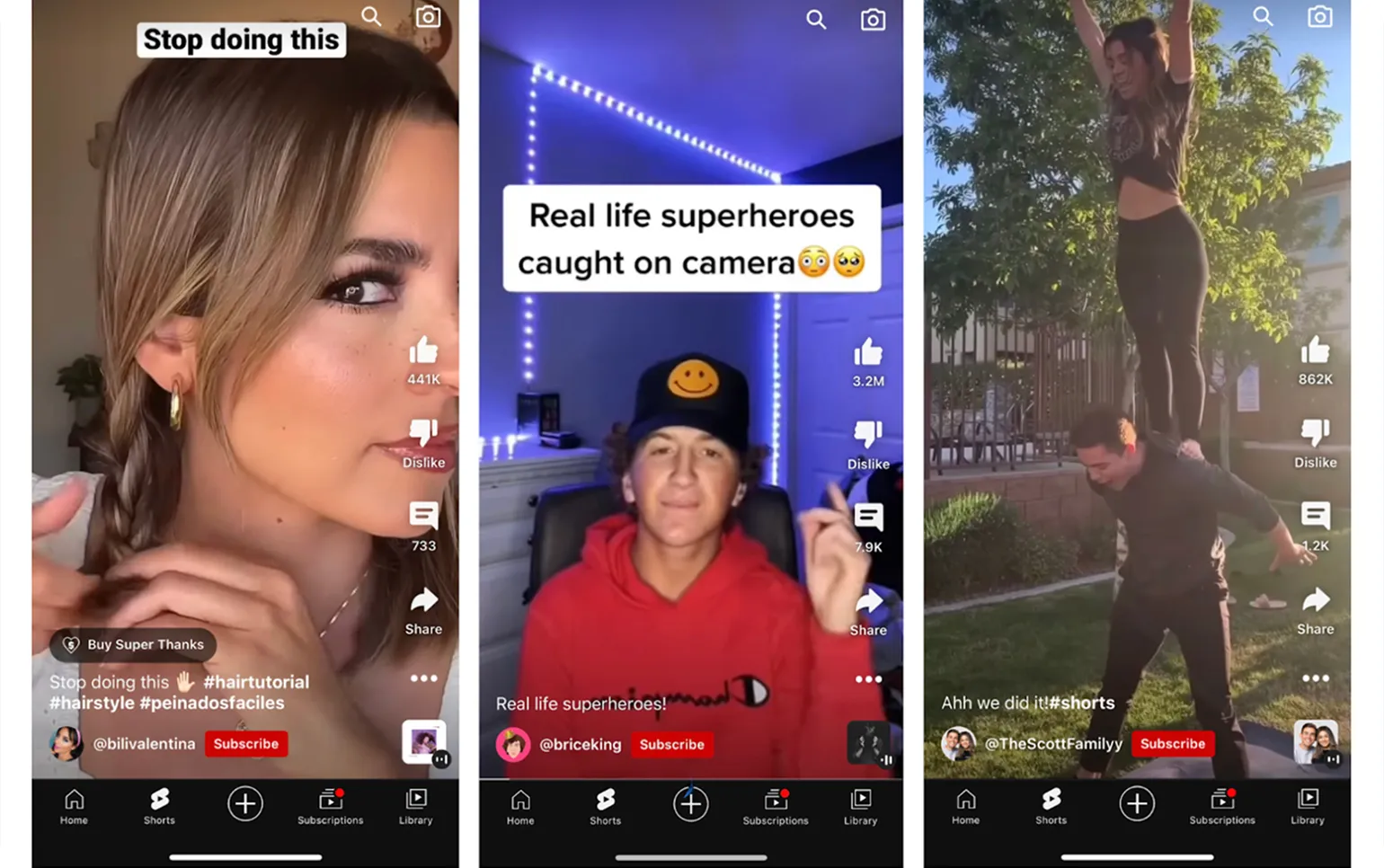
The previous holiday season saw TikTok ROAS jump 28.42% as the platform became a rapidly expanding channel for brands. Consider the right channel mix for your unique brand.
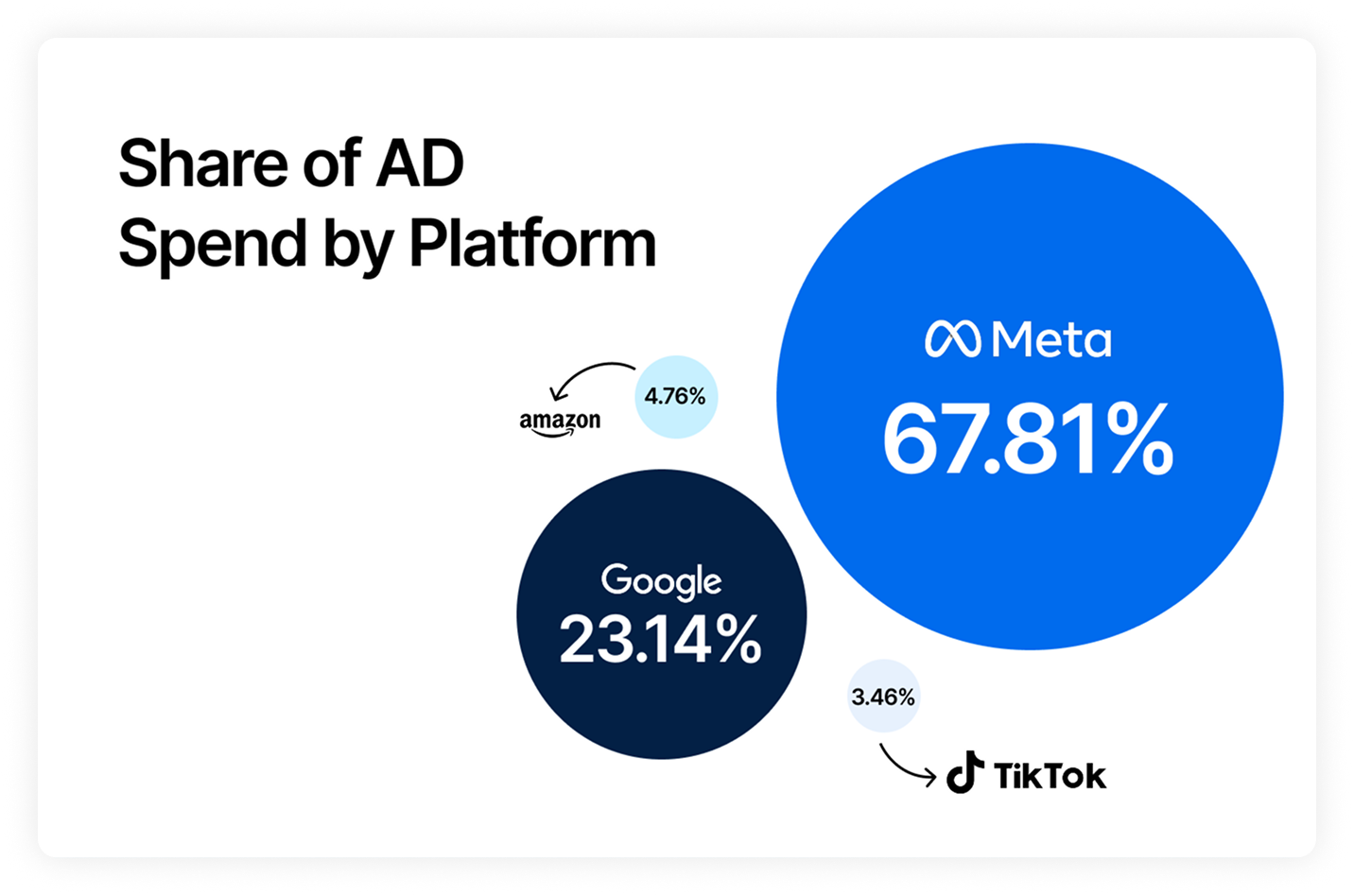
Meta Ads: 67.6% of spend; CPM increased 7.6% year over year; reported ROAS increased 3.18%.
Google Ads: 22.65% of spend; CPA increased 34.18% year over year; reported ROAS fell 21.09%.
TikTok Ads: 3.66% of spend; CPM fell 27.5% year over year; reported ROAS increased 28.42%.
Black Friday marketing strategy #1: Get to know your customers
Your customer data holds more signal than any market trend. Before you spend a dollar on new-customer acquisition, look at who already buys from you and why. That starting point shapes every offer, message, and product decision that follows.
Identify your loyal customers
Existing customers already know the product and have already crossed the hardest trust barrier. During a crowded promotional period, that familiarity can make them one of the most valuable audiences available.
The goal is not to send the same discount to the entire customer file. It is to identify which customers are most likely to buy, what they are likely to want, and which experience gives them a reason to return.
Segment your most valuable customer groups
Start with recency, frequency, and monetary value, commonly called RFM analysis:
Recency: How recently did the customer purchase?
Frequency: How often have they purchased?
Monetary value: How much have they spent?
Use those signals to separate customers who need different treatment. For example, a recent first-time customer may need a complementary product recommendation. A lapsed high-value customer may respond to early access. A frequent buyer may value exclusivity more than a deeper discount.
See which customer cohorts drive the most long-term value
Review the products loyal customers buy, the order in which they buy them, and the combinations that appear repeatedly.
That analysis can inform:
Product bundles that raise average order value
Gift sets built around a proven hero product
Cross-sells based on a customer’s previous purchase
Creative that shows products in the combinations customers already prefer
Inventory planning for products that are commonly purchased together
Black Friday marketing strategy #2: Set your customer strategy by preferences
Purchase history and customer feedback should determine how acquisition and retention work together for your brand. Use customer value, buying behavior, and stated preferences to decide who should receive each offer and message.
Use zero-party data to make the offer more relevant
Purchase history shows what customers did. Zero-party data — the information customers intentionally share — can help explain what they want next.
Ask focused questions before BFCM:
Which incentive would make you more likely to purchase: early access, free shipping, a gift, a bundle, or a discount?
What matters most in your online shopping experience?
Which products or categories are you shopping for this holiday season?
Are you buying for yourself, for someone else, or both?
Which content, event, or community experience would you participate in?
Personalize products and messages
Use purchase history and stated preferences to recommend relevant products instead of showing the same catalog to every customer.
Personalization should make the decision easier for the customer, not advertise how much data the brand has collected.
The personalization can extend across:
Paid retargeting
Email and SMS
On-site recommendations
Bundles and upsells
Loyalty or membership communication
Reuse proven creative with a BFCM angle
You do not need to rebuild every ad from scratch for BFCM. Start with evergreen ads and concepts that already drove strong customer outcomes, then adapt the offer, urgency, product framing, and seasonal context. Preserve what made the original work — whether it was the hook, format, message, or proof — rather than changing everything at once.
Black Friday marketing strategy #3: Choose the products and offers worth scaling
BFCM brings deal-ready shoppers into the market, but discounted orders do not automatically create valuable customers. Choose products and offers that can convert demand without sacrificing margin, inventory health, or the post-purchase opportunity.
Identify the right hero products
A hero product gives a new customer a clear reason to choose the brand. It may be the best-known product, the product with the strongest margin, the item that creates the best repeat-purchase path, or the product that most clearly communicates what makes the brand different.
Useful measures include:
Revenue and units sold
Contribution margin
Return rate
New-customer conversion
Repeat-purchase behavior
Ad spend and attributed return
Inventory depth
Black Friday marketing strategy #4: Give every channel a defined role
The spend mix that we saw in the 2025 trends provides useful insights. Just keep in mind that these are aggregate, ad-platform-reported benchmarks. Use them to challenge your ad spend plan:
Is Meta expected to create demand, capture demand, or both?
Which Google campaigns are protecting branded demand versus finding new customers?
Has TikTok earned a structured test based on the brand’s audience and creative supply?
Which channel is being judged on new-customer acquisition, and which is being judged on total return?
What evidence would justify moving the next dollar?
Set those expectations before the event so your team does not switch measurement models or success criteria simply because one view produces a better number.
Black Friday marketing strategy #5: Measure performance while there’s still time to act
BFCM performance can change quickly as competition, inventory, creative, and customer behavior shift. A useful operating view should connect media delivery to business outcomes.
Monitor the measures that match the decision being made, such as:
Revenue and order pace
Ad spend and MER
New-customer CPA and new-customer revenue
Contribution margin and profit
Conversion rate and average order value
Product and inventory performance
Campaign and creative performance
Use Triple Whale dashboards and Moby, Triple Whale’s AI operator for ecommerce, to reduce the manual work of checking separate systems and rebuilding the same report.
It’s simple — you get performance analytics at the click of a button:
Moby analyzes your performance using real-time data. “Analyze today’s channel performance. For every channel with spend, show ad spend, share of total spend, attributed revenue, ROAS, CPA, CPM, CPC, and CTR. Flag the largest changes from the comparable period and explain which changes require action versus monitoring.”
Black Friday marketing strategy #6: Turn BFCM buyers into future revenue
The first order should begin the next customer experience, not end the BFCM campaign.
Build the post-purchase plan before the event:
Set clear delivery and returns expectations
Make the unboxing experience consistent with the brand promise
Ask for reviews and useful product feedback
Recommend the most logical next product
Introduce loyalty, referral, membership, or community programs where they fit
Separate customers who purchased only for a discount from those showing stronger long-term intent
Use a post-purchase survey to understand discovery, motivation, and intended use
Build Your BFCM 2026 Strategy with Triple Whale
You now know what worked in 2025 and what to do differently this year. Now it’s time to put your Black Friday checklist to work — identify your best customers, give every channel a clear job, and pick the products that deserve the spotlight.
Need help getting to where you want to be? Triple Whale brings your data, measurement, and next steps together so you can make smarter decisions faster. Book a demo today.
Component Sales
5.32K
Benchmark your ecommerce brand against industry leaders
To prepare for the busy season and stay in control when the big event arrives, you need actionable strategies that are well-planned before November.
In this Black Friday marketing strategy guide, we'll outline six data-backed ways you can set up ahead of time to make the most of the busy holiday season.
First, what happened in BFCM 2025?
Triple Whale tracked $2.9 billion in revenue to bring you the full story of Black Friday Cyber Monday 2025 (November 28 – December 1, 2025). Get the complete BFCM Breakdown here.
This performance data draws from more than 33,000 active Triple Whale businesses across multiple industries. Here are three trends to understand when shaping your 2026 Black Friday strategy.
1. Almost $2B in revenue arrived before Black Friday
It’s time to start your campaigns earlier, folks; there’s a lot of market share to go around.
16.6 million orders were placed from November 24–27, 2025
Those orders generated $1.77 billion in revenue over the same four-day period
Roughly 65% of the spend was recorded from Black Friday through Cyber Monday
2. Returning customers generated 54.69% of $10M+ brand revenue
Where your revenue comes from depends on your business size. New and returning customers carry different weights as GMV grows.
$0–1M GMV: New customers generated 66.05% of revenue; returning customers generated 33.95%.
$1M–$10M GMV: New customers generated 55.61% of revenue; returning customers generated 44.39%.
$10M+ GMV: New customers generated 45.31% of revenue; returning customers generated 54.69%.
3. TikTok ROAS rose 28.42% while Google ROAS fell 21.09%
The previous holiday season saw TikTok ROAS jump 28.42% as the platform became a rapidly expanding channel for brands. Consider the right channel mix for your unique brand.
Meta Ads: 67.6% of spend; CPM increased 7.6% year over year; reported ROAS increased 3.18%.
Google Ads: 22.65% of spend; CPA increased 34.18% year over year; reported ROAS fell 21.09%.
TikTok Ads: 3.66% of spend; CPM fell 27.5% year over year; reported ROAS increased 28.42%.
Black Friday marketing strategy #1: Get to know your customers
Your customer data holds more signal than any market trend. Before you spend a dollar on new-customer acquisition, look at who already buys from you and why. That starting point shapes every offer, message, and product decision that follows.
Identify your loyal customers
Existing customers already know the product and have already crossed the hardest trust barrier. During a crowded promotional period, that familiarity can make them one of the most valuable audiences available.
The goal is not to send the same discount to the entire customer file. It is to identify which customers are most likely to buy, what they are likely to want, and which experience gives them a reason to return.
Segment your most valuable customer groups
Start with recency, frequency, and monetary value, commonly called RFM analysis:
Recency: How recently did the customer purchase?
Frequency: How often have they purchased?
Monetary value: How much have they spent?
Use those signals to separate customers who need different treatment. For example, a recent first-time customer may need a complementary product recommendation. A lapsed high-value customer may respond to early access. A frequent buyer may value exclusivity more than a deeper discount.
See which customer cohorts drive the most long-term value
Review the products loyal customers buy, the order in which they buy them, and the combinations that appear repeatedly.
That analysis can inform:
Product bundles that raise average order value
Gift sets built around a proven hero product
Cross-sells based on a customer’s previous purchase
Creative that shows products in the combinations customers already prefer
Inventory planning for products that are commonly purchased together
Black Friday marketing strategy #2: Set your customer strategy by preferences
Purchase history and customer feedback should determine how acquisition and retention work together for your brand. Use customer value, buying behavior, and stated preferences to decide who should receive each offer and message.
Use zero-party data to make the offer more relevant
Purchase history shows what customers did. Zero-party data — the information customers intentionally share — can help explain what they want next.
Ask focused questions before BFCM:
Which incentive would make you more likely to purchase: early access, free shipping, a gift, a bundle, or a discount?
What matters most in your online shopping experience?
Which products or categories are you shopping for this holiday season?
Are you buying for yourself, for someone else, or both?
Which content, event, or community experience would you participate in?
Personalize products and messages
Use purchase history and stated preferences to recommend relevant products instead of showing the same catalog to every customer.
Personalization should make the decision easier for the customer, not advertise how much data the brand has collected.
The personalization can extend across:
Paid retargeting
Email and SMS
On-site recommendations
Bundles and upsells
Loyalty or membership communication
Reuse proven creative with a BFCM angle
You do not need to rebuild every ad from scratch for BFCM. Start with evergreen ads and concepts that already drove strong customer outcomes, then adapt the offer, urgency, product framing, and seasonal context. Preserve what made the original work — whether it was the hook, format, message, or proof — rather than changing everything at once.
Black Friday marketing strategy #3: Choose the products and offers worth scaling
BFCM brings deal-ready shoppers into the market, but discounted orders do not automatically create valuable customers. Choose products and offers that can convert demand without sacrificing margin, inventory health, or the post-purchase opportunity.
Identify the right hero products
A hero product gives a new customer a clear reason to choose the brand. It may be the best-known product, the product with the strongest margin, the item that creates the best repeat-purchase path, or the product that most clearly communicates what makes the brand different.
Useful measures include:
Revenue and units sold
Contribution margin
Return rate
New-customer conversion
Repeat-purchase behavior
Ad spend and attributed return
Inventory depth
Black Friday marketing strategy #4: Give every channel a defined role
The spend mix that we saw in the 2025 trends provides useful insights. Just keep in mind that these are aggregate, ad-platform-reported benchmarks. Use them to challenge your ad spend plan:
Is Meta expected to create demand, capture demand, or both?
Which Google campaigns are protecting branded demand versus finding new customers?
Has TikTok earned a structured test based on the brand’s audience and creative supply?
Which channel is being judged on new-customer acquisition, and which is being judged on total return?
What evidence would justify moving the next dollar?
Set those expectations before the event so your team does not switch measurement models or success criteria simply because one view produces a better number.
Black Friday marketing strategy #5: Measure performance while there’s still time to act
BFCM performance can change quickly as competition, inventory, creative, and customer behavior shift. A useful operating view should connect media delivery to business outcomes.
Monitor the measures that match the decision being made, such as:
Revenue and order pace
Ad spend and MER
New-customer CPA and new-customer revenue
Contribution margin and profit
Conversion rate and average order value
Product and inventory performance
Campaign and creative performance
Use Triple Whale dashboards and Moby, Triple Whale’s AI operator for ecommerce, to reduce the manual work of checking separate systems and rebuilding the same report.
It’s simple — you get performance analytics at the click of a button:
Moby analyzes your performance using real-time data. “Analyze today’s channel performance. For every channel with spend, show ad spend, share of total spend, attributed revenue, ROAS, CPA, CPM, CPC, and CTR. Flag the largest changes from the comparable period and explain which changes require action versus monitoring.”
Black Friday marketing strategy #6: Turn BFCM buyers into future revenue
The first order should begin the next customer experience, not end the BFCM campaign.
Build the post-purchase plan before the event:
Set clear delivery and returns expectations
Make the unboxing experience consistent with the brand promise
Ask for reviews and useful product feedback
Recommend the most logical next product
Introduce loyalty, referral, membership, or community programs where they fit
Separate customers who purchased only for a discount from those showing stronger long-term intent
Use a post-purchase survey to understand discovery, motivation, and intended use
Build Your BFCM 2026 Strategy with Triple Whale
You now know what worked in 2025 and what to do differently this year. Now it’s time to put your Black Friday checklist to work — identify your best customers, give every channel a clear job, and pick the products that deserve the spotlight.
Need help getting to where you want to be? Triple Whale brings your data, measurement, and next steps together so you can make smarter decisions faster. Book a demo today.
Share
Kaleena Stroud
Kaleena Stroud is a copywriter for SaaS and DTC businesses.
Kaleena Stroud
Kaleena Stroud is a content writer at Triple Whale, bringing data stories to life. She spent many years running an online copywriting business, where she helped brands launch and revamp their Shopify stores. Her work has been featured in Practical Ecommerce, Convert, and Create & Cultivate.
Body Copy: The following benchmarks compare advertising metrics from April 1-17 to the previous period. Considering President Trump first unveiled his tariffs on April 2, the timing corresponds with potential changes in advertising behavior among ecommerce brands (though it isn’t necessarily correlated).


 Moby AIAsk questions, analyze performance, and work with your business context.
 ActionsTake governed action across the tools that run your business.
 AutomationsSchedule recurring analysis and work that runs on your terms.
 Landing PagesCreative conversion-focused ecommerce pages with Moby.
 Creative StudioGenerate and refine creative grounded in your brand.











.webp)

.webp)
