A customer has a laptop in their cart. You could point them to a version with more storage, or to a case that fits the one they picked. Both can raise the order value. The question is which one do you show first?
For ecommerce stores, the choice often comes down to upselling or cross-selling. Both aim to boost average order value (AOV), but they work differently and don’t always deliver the same results.
We’ll explain what you need to know about upselling and cross-selling, strategies to consider implementing, and which one has a greater impact on AOV.
Key Takeaways
- Upselling means offering a better version of the same product at a higher price. This approach tends to work best for expensive items and subscriptions.
- Cross-selling involves suggesting related products to add to the order. Each cross-sell may add less to the order value, but it can be used with nearly any product.
- Most brands focused on increasing AOV use both upselling and cross-selling, along with tactics like free-shipping minimums and product bundles.
Why upselling and cross-selling matter for ecommerce businesses
Growing an ecommerce business takes more than just bringing new people to your website. You have to make the most of the visits you already get. That’s where upgrades or related add-ons come in.
A useful recommendation can help someone decide. Maybe they’re buying a laptop but didn’t realize they needed a separate power cord or extra storage. Your offer can save them from having a purchase that falls short.
Offering customers a chance to try more of your products can help your business too. Someone who likes your face wash might be interested in a moisturizer to go well with it. If the product works well for them, they may come back later for additional items.
For both the business and customer, the extra sale needs to be worth it. A useful offer should help the customer and leave you with enough profit to make it worthwhile.
What is upselling?
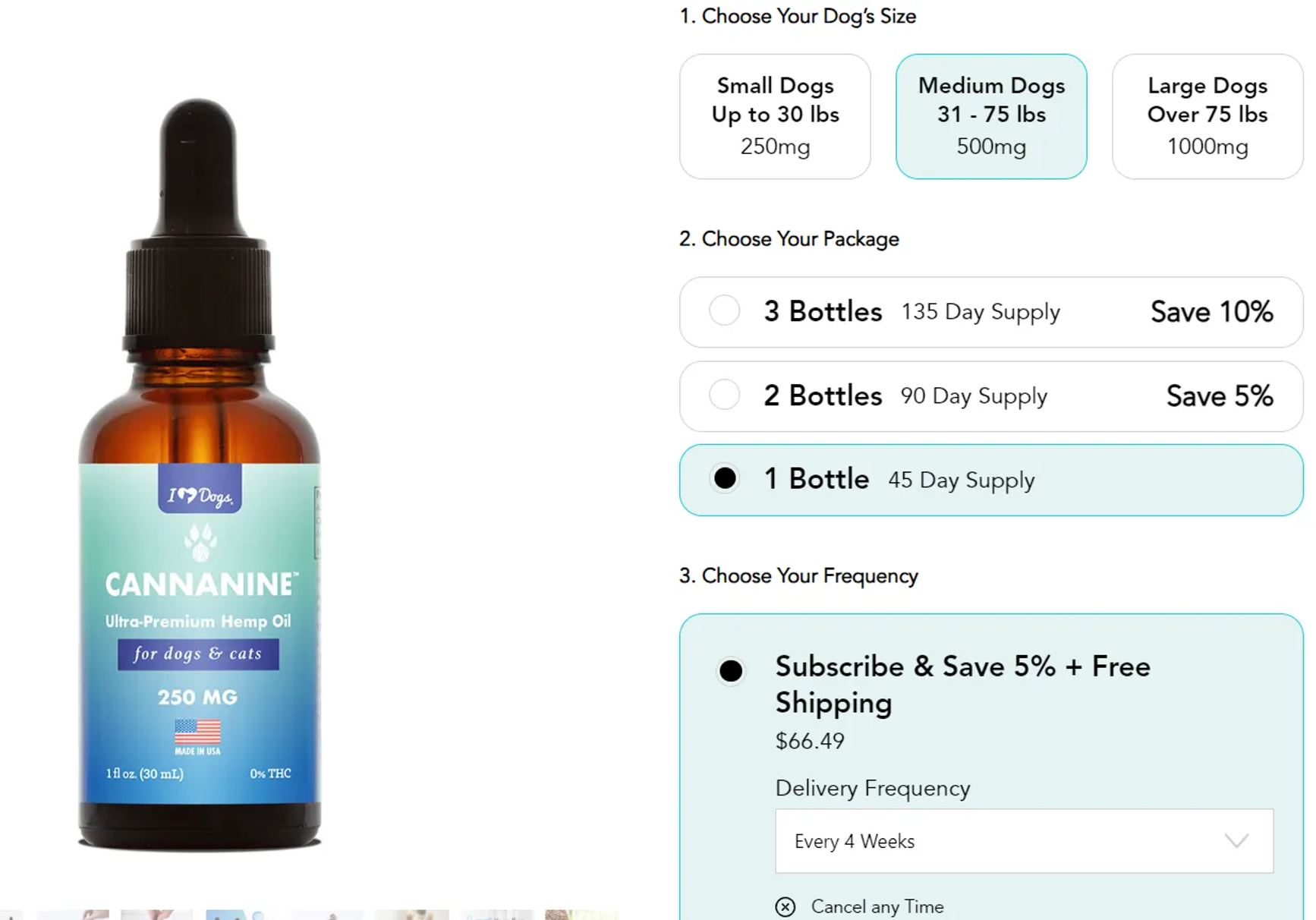
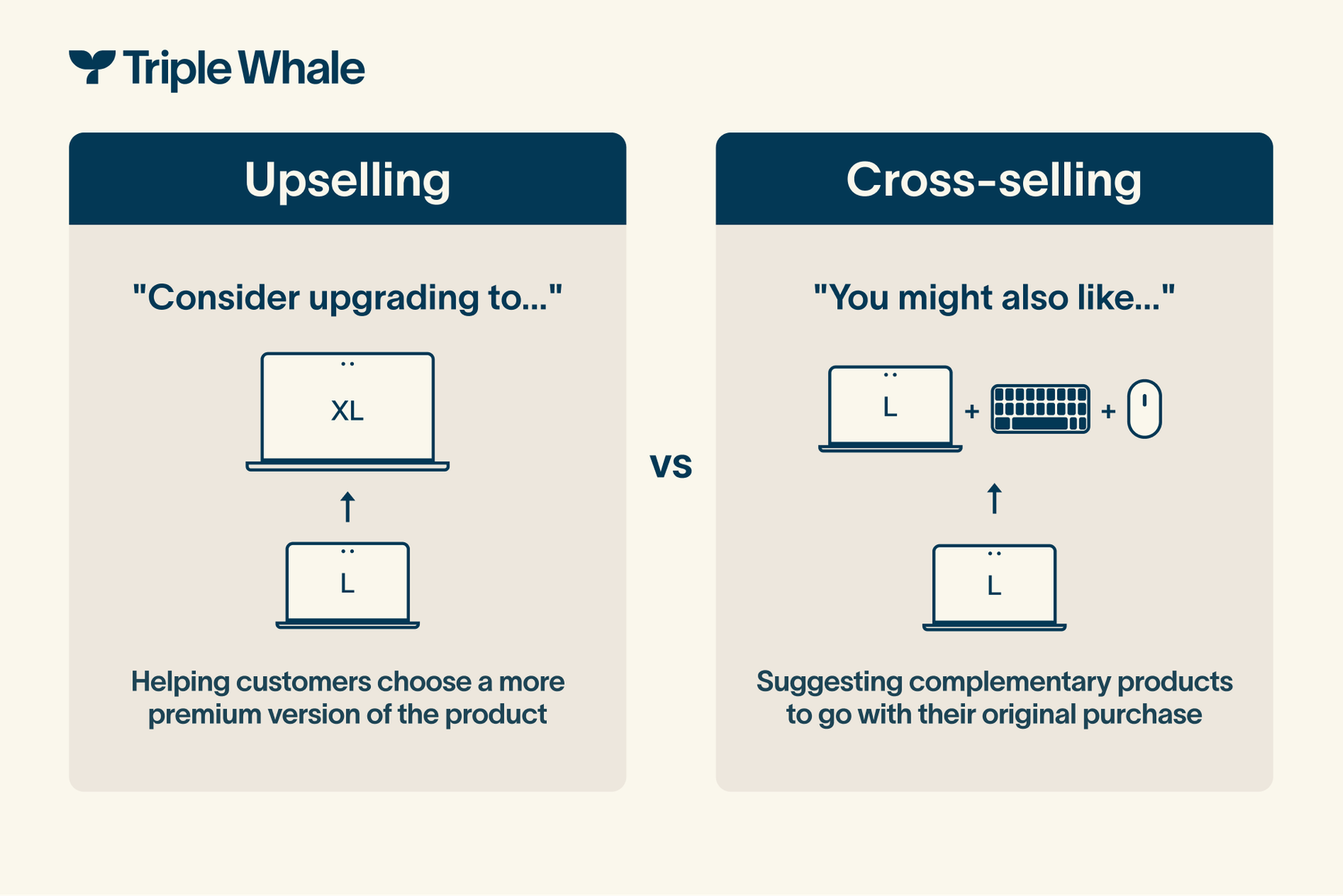
Upselling is when you offer a customer a better version of the exact product they’re already looking at. The item stays the same, but the price and what’s included go up.
Think about the last time you bought a laptop from an online store. If the site suggested a model with more storage for an extra $150, that was an upsell. It’s the same product, upgraded, at a higher price.
Where upselling works best
Upselling shows up at three main points in the shopper’s journey:
- On the product page. Show a side-by-side comparison between the version the shopper is viewing and the upgraded version.
- At checkout. Offer the upgrade one last time, right before the customer pays.
- In post-purchase emails. If a customer just bought the base plan or model, a follow-up message can offer an upgrade while they can still change their plan or order.
Upselling strategies that work
Before you implement an upsell, think about what would make someone choose it. Here are some strategies to work through:
1. Lead with the benefit, not the price tag.
A higher price alone isn’t enough to convince people. Customers upgrade when they see the value, such as longer battery life, faster shipping, or an extra year of warranty coverage.
2. Try three pricing tiers.
A “good, better, best” lineup often pushes people toward the middle option because it can feel like a good balance. Retail and SaaS companies rely on this because it seems like a natural choice.
3. Keep the gap small and specific.
“$10 more for double storage” is more effective than a vague upgrade without a clear price. People decide faster when they know exactly what they’re getting.
4. Use urgency carefully.
“Upgrade today and save 20%” can encourage hesitant buyers. But fake countdowns or always showing “only 2 left” lose their effect once shoppers realize the stock never runs out. Trust is hard to regain once you lose it.
5. Use social proof, but only if it’s accurate.
A line like “Most customers choose this model” tells shoppers the upgrade isn’t just a money grab. It answers the question on their mind, which is whether it’s actually worth it.
Upselling examples
Upselling is an effective sales tactic that ecommerce businesses can use. One example of upselling is going to a cellphone store and wanting to purchase a basic cell phone model. But the sales representative tells you about the advanced models instead.
Another example is purchasing a new laptop at an electronics store. You want to buy a basic laptop that’s on sale, but the salesperson convinces you to buy one with more features and storage.
What is cross-selling?
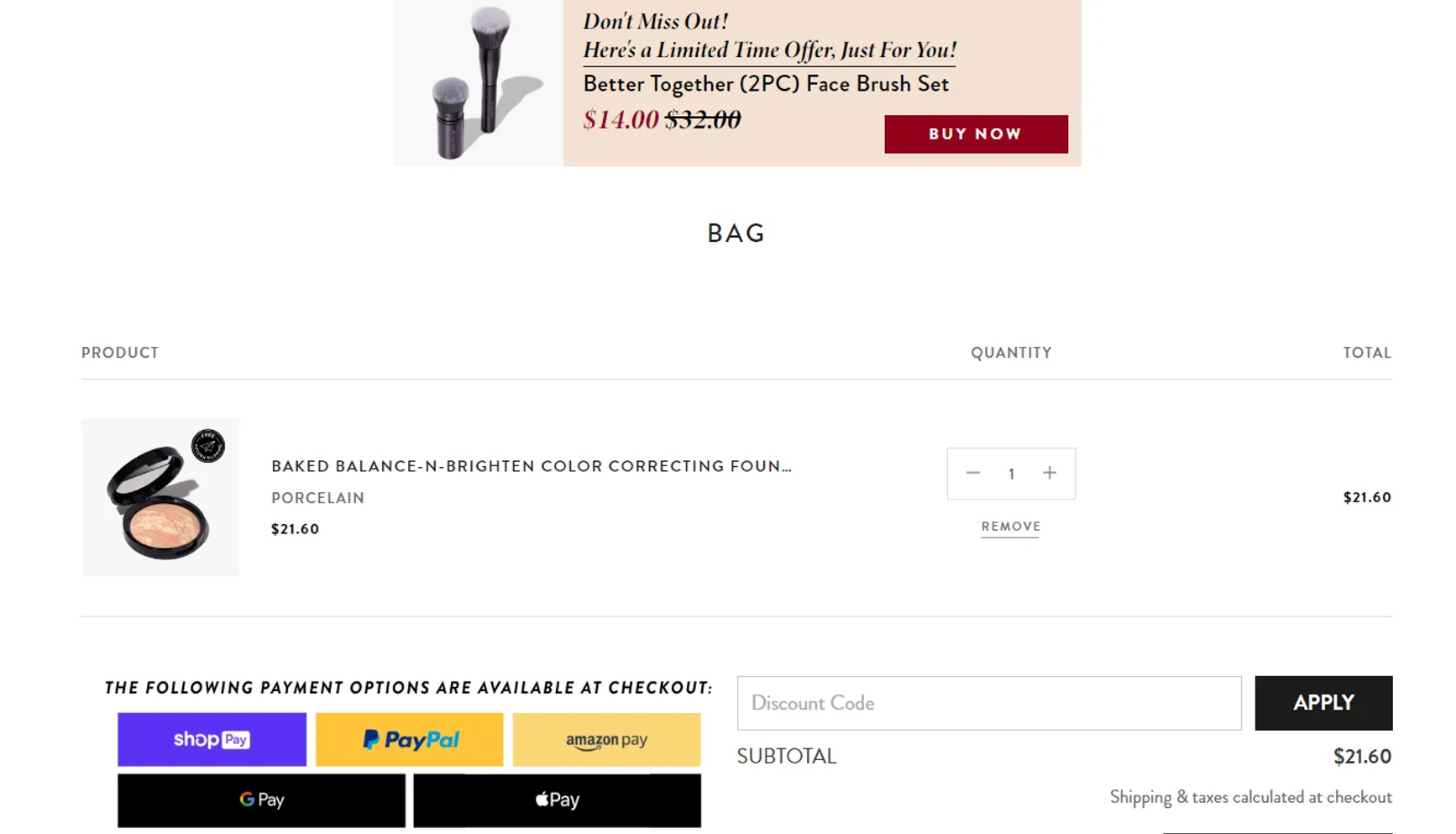
Cross-selling is suggesting a different but related product to go with whatever the customer’s already buying. Instead of a better version of one item, the customer adds more items to the same order.
Buy a camera, and a site suggests a memory card and a case. That’s cross-selling. The camera you picked doesn’t change. Your cart just gets bigger.
Where cross-selling works best
Cross-selling has three strong moments, too:
- On the product page, as “frequently bought together” or “complete the look” sections.
- In the cart or at checkout, as small, low-cost add-ons before the customer pays.
- In post-purchase emails, recommending accessories or refills based on what a customer just bought.
Cross-selling strategies for ecommerce businesses
Placement gets the offer in front of the shopper. These tactics get it into the cart.
1. Anchor the add-on to a bigger purchase.
Once someone commits to a $500 camera, a $30 accessory feels small in comparison. This is called anchor pricing. AppleCare is another example of an add-on offered alongside a bigger purchase.
2. Bundle for a discount.
A slight discount on a bundle can make the offer feel like better value and help clear slow-moving inventory. Keep the products relevant to each other.
3. Time your post-purchase emails.
Send the first cross-sell email within a few days of the original purchase, while the customer is still using and thinking about what they bought. A camera buyer may be more open to a tripod recommendation three days after checkout than three months later.
4. Use a free sample to open the door.
For consumables and beauty products especially, including a deluxe sample of a related item lowers the risk of trying something new. If the customer likes it, they may come back for the full-size product.
5. Keep the cross-sell relevant.
A cross-sell only works if the second product genuinely fits the first. An irrelevant recommendation doesn't just fail to convert. It can make the whole store feel less trustworthy.
Cross-selling examples
Cross-selling is all about adding on to your original order. For example, if you visit a fast food restaurant and order a cheeseburger, the worker asks if you want fries and a drink. Or if you go to purchase a laptop and are shown a case and memory card to go with it.
Risks of upselling and cross-selling
Both upselling and cross-selling are effective, but each has its drawbacks. If you know the possible problems, you can avoid making customers click away.
| Upselling Risk | Cross-Selling Risk | |
|---|---|---|
| What Goes Wrong | Feels like a hard sell or a price jump feels unjustified | Feels cluttered, irrelevant, or like decision fatigue |
| Customer Reaction | Hesitation, cart abandonment, distrust of future orders | Skips the offer, or worse, abandons the original purchase |
| Business Impact | Lost sale entirely, a bigger loss than a missed upgrade | Lower conversion rate storewide if repeated too often |
| How to Avoid It | Justify the price gap with a clear, specific benefit | Cap offers at one or two, and keep them relevant |
A simple gut check works for both: would you enjoy this offer if you were the customer? If the answer is "only if it's the first one I've seen this order," that's your cue to cap it and move on.
A single, well-placed offer at each checkout stage is more effective than stacking three offers on top of each other. Because if a customer feels they are being upsold on everything, they’ll stop trusting it.
The same logic holds true when it comes to margin. A bigger cart at a steep discount can raise AOV while quietly shrinking profit. Always check the impact on contribution margin, or what’s left after the variable costs of a sale, alongside order value.
Upselling vs. cross-selling: Which really increases AOV?
Here’s where the two tactics really separate:
| Upselling | Cross-Selling | |
|---|---|---|
| What Changes in the Cart | One item at a higher price | More items added to the order |
| AOV Impact | One upgrade can add a large dollar amount | Smaller add-ons can add up across many orders |
| Works Best For | High-ticket items, subscriptions, tiered plans | Everyday products, accessories, bundles |
| Customer Mindset | "I want the better version" | "I might as well add this too" |
| Typical Take Rate | Depends on the offer, price, and audience | Depends on the offer, price, and audience |
| Risk if Overdone | Feels pushy or expensive | Feels cluttered or irrelevant |
The math shows how an upsell can quickly lift AOV. Say your average order is $60, and 15% of buyers accept a $20 upsell to a premium version. If every buyer sees the offer and nothing else changes, that’s a $3 lift in blended AOV from one offer alone. A cross-sell would need far more shoppers adding a $5 accessory to match that lift.
But cross-selling has a wider net. It doesn't need a premium tier, and you can use it across many products. The lift may be smaller per order, but you can test it across your catalog instead of one product line.
The short answer: if you have a clear upgrade on a specific product line, test an upsell. If you have useful add-ons across your catalog, try cross-selling. Most brands serious about growing AOV don’t pick just one. They run both at different points in the checkout flow.
How to choose the right strategy for your business
The right mix depends on what you sell and how your store is set up.
- You sell high-ticket or tiered products (electronics, furniture, SaaS plans). Lead with upselling. The extra revenue per upgrade may justify the extra design work on comparison pages and tiered pricing.
- You sell everyday, lower-cost items (apparel, beauty, snacks, home goods). Lead with cross-selling. There's rarely a meaningful "upgrade" to sell, but there's almost always a complementary item.
- You sell replenishable or consumable products. Consider subscriptions and related cross-sells. Subscriptions can grow customer lifetime value, but that’s different from raising AOV.
- You run a lean team with limited dev resources. Start with post-purchase email cross-sells before touching on-site upsell widgets. Email can be faster to set up and doesn't require checkout changes.
- You're not sure where you currently stand. Check your current AOV and how it compares to category benchmarks before deciding where to focus. A brand already near the top of its category benchmark gets less from squeezing AOV further and more from protecting contribution margin instead.
The action plan for ecommerce businesses
You don't need a full roadmap to get started today. Here’s a quick action plan:
- Pull your top 10 best-selling products and check whether they have an upsell (a pricier version) or a cross-sell (a complementary product) already linked to them.
- For products with neither, tag an obvious upsell and cross-sell where it fits. Keep it simple: a bigger size, a better material, a matching accessory.
- Add the cross-sell to the product page or cart, and the upsell to the product page or checkout. Don't stack both in the same spot.
- Test a follow-up email 3 to 5 days after purchase, offering a relevant cross-sell based on what the customer bought.
- Track the change in AOV and contribution margin over the next two weeks. Watching both together helps you see whether higher order values come at the cost of profit.
Let Moby help you choose what to test
Deciding whether to lead with upsells or cross-sells shouldn't be a matter of chance. Moby, Triple Whale's AI operator for ecommerce, can use your connected order data to help you compare AOV and spot opportunities for better offers.
Ask Moby, “Compare AOV for orders with my upsell offers versus my cross-sell offers over the last 90 days.” To do this, Moby needs data that identifies each offer, such as an export from your upsell tool. Where the data supports it, Moby can break the answer down by product, channel, and customer segment, and suggest what to test next.
Ready to see what's really moving your AOV? Book a demo and put Moby to work on your store's data.
Upselling vs. cross-selling: FAQs
Can I use upselling and cross-selling at the same time?
Yes, most established ecommerce companies use both at the same time. The key is in how they show up. Show the upsell first on the product page before the customer commits, and the cross-sell for the checkout.
Which one is better for a small or new store?
Cross-selling is usually the easier place to start. You don't need tiered pricing or a premium version of every product. "Frequently bought together" style suggestions are also simple to set up on most ecommerce platforms.
Do upsells hurt my conversion rate?
They can, if the offer feels forced or the price jump isn't justified. A well-designed upsell that clearly explains the added value tends to have a minimal effect on conversion rate. The risk goes up when you repeat the same upsell too aggressively at every step of checkout.
How do I know if my upsell or cross-sell strategy is actually working?
Watch AOV alongside contribution margin, not AOV alone. A tactic that raises AOV but requires a steep discount can quietly shrink your profit per order even as the top-line number looks better.