
Blog
How to Increase Average Order Value: 17 Strategies That Actually Drive Profitable Growth

How to Increase Average Order Value: 17 Strategies That Actually Drive Profitable Growth

Last Updated:  
February 24, 2026

Here’s a common problem for ecommerce platforms: Your traffic is looking good, your conversion rate is solid, but your revenue per order is stuck in the mud.

If you’re looking to increase revenue, you’re going to have to boost your basket size. That’s right: Simply adding more customers isn’t the only way to grow.

Figuring out how to increase average order value (AOV) is one of the most important steps you can take to bolster your business.

Here, learn the most effective ways to improve average order value, common AOV traps and why they backfire, and how to pick the best strategy to increase AOV for your brand.

Key Takeaways
  • Average order value (AOV) is your total revenue divided by your total number of orders, which tells you how much your average customer spends per order.
  • Increasing this number helps drive profits among your existing customer base without the additional expense to acquire new customers.
  • Tactics to increase average order value can include pricing and threshold strategies, personalization, offers, and upselling.
  • When choosing a strategy to improve AOV for your brand, consider your goals, margins, business model, and customer acquisition cost.

What is Average Order Value (AOV)?

Average order value is the average amount of money a customer spends when shopping with your business.

It’s typically calculated by dividing your total revenue by your total number of orders:

AOV = your total revenue / your total number of orders
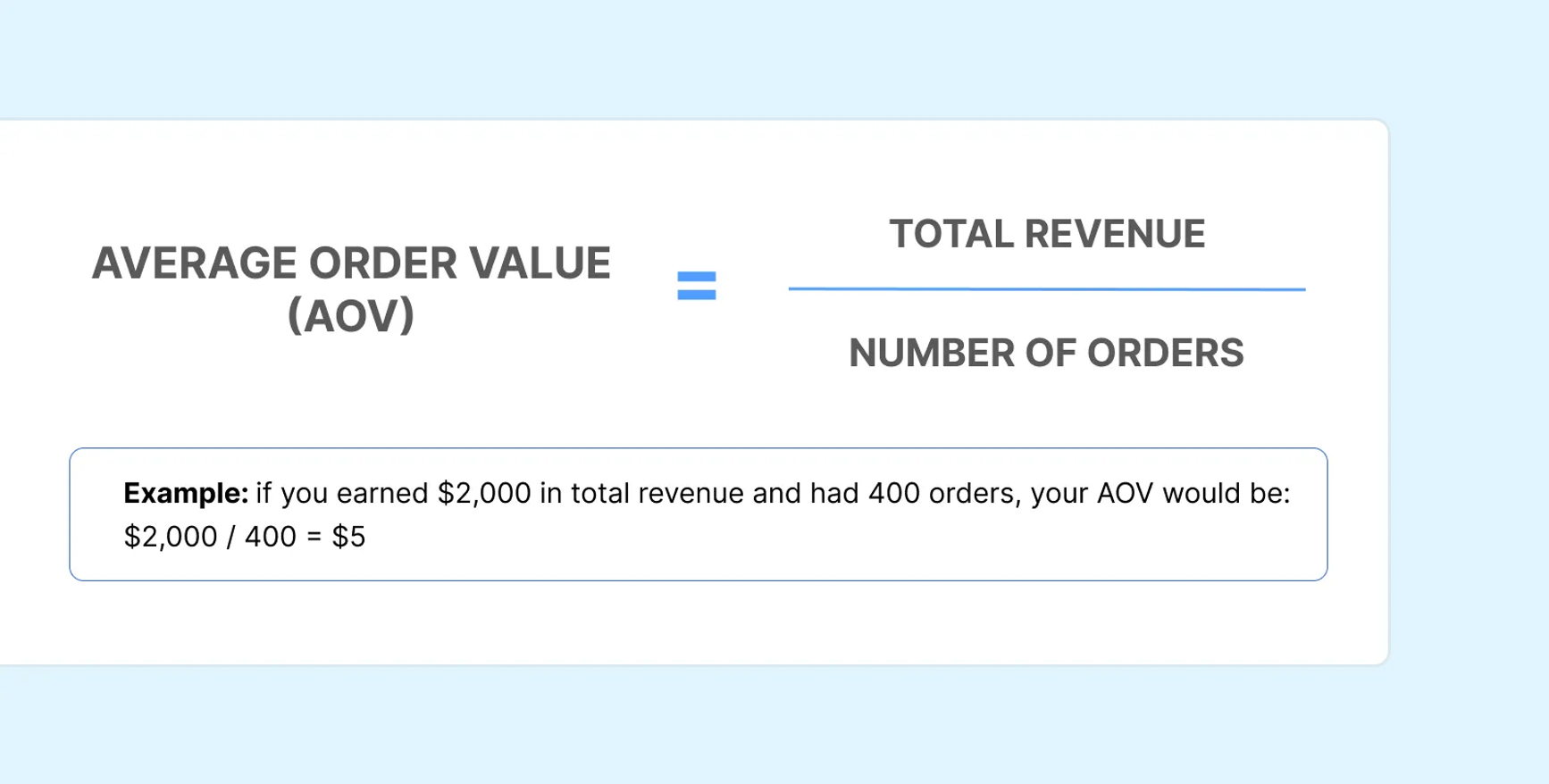
Formula for Average Order Value. AOV = Total Revenue / Number of Orders

Simple, right? Just keep in mind only looking at AOV can be a little misleading. You’ll want to consider your AOV in the context of other important ecommerce metrics to get a broader perspective on your performance, such as return on ad spend (ROAS) and customer lifetime value

Why Does Increasing AOV Matter?

In general, the higher your AOV, the more revenue you generate from your existing customers. That means more money is coming in, without increasing spending on customer service, delivery, or conversion.

In other words, you didn’t have to spend money on customer acquisition to drive that increase in revenue. Ideally, your AOV should be higher than your customer acquisition cost (CAC) so you’re maximizing the revenue you make from your marketing spend.

If your store's AOV is increasing, your shoppers could be buying more expensive products or adding more items to their cart (aka improving your average cart value). Tracking this information helps you understand your average customer’s purchasing habits and can help you figure out how to get more from every sale.

That said, a higher AOV doesn’t necessarily mean your business is a success. For example, AOV ignores purchase frequency and customer engagement. You might have high AOV but customers who rarely make additional purchases. And some tactics for increasing AOV, like offering free shipping, cut into your profits. The goal is to increase AOV responsibly, not just inflate it.

Industry Median Average Order Value (USD)
Apparel & Accessories 85.45
Health & Beauty 60.29
Home & Garden 110.24
Food & Beverage 61.99
Health & Wellness 60.87
Sports & Outdoors 108.81
Toys, Art & Collectibles 70.45
Consumer Electronics 106.05
Pets & Animals 58.85
Lifestyle & Boutique 62.76
Baby 73.90
Automotive 111.51
Media 47.17
Books & Music 51.68
Travel & Luggage 126.19

The 17 Most Effective Ways to Increase AOV

There are quite a few marketing tactics that can up your AOV. A lot of them will help you improve conversion rates and customer lifetime value, too.

But because there are so many approaches, the sheer volume can feel overwhelming and haphazard. That’s why we’ve broken down these ways to increase AOV into broader categories. You can find the category that makes the most sense for your brand and start there. (And keep reading for more information on how to choose the right strategy for your business!)

Here are some of our top tips on how to increase average order value.

Pricing and Threshold Strategies

Free shipping thresholds

A free shipping threshold encourages your customers to increase their order size to meet the requirement for free shipping. You can set this threshold slightly higher than your current AOV to help boost that number.

For example, let's say your AOV is $100, and you want to increase it by 30%. Offering free shipping on orders above $130 is a smart way to increase the AOV for your brand. 

Set up your ecommerce store to notify customers at checkout if their order doesn’t meet this threshold and encourage them to add more to their cart.

Minimum spend discounts

Discounts in general can encourage customers to add more to their orders, but it can also undercut your profits if you’re not careful. So, consider a minimum spend discount. For example, you might offer $5 off for every order over $75 or $10 off an order of four products or more.

Flexible payment options

Offering financing options such as paying in installments for pricier items can help make your products more accessible to a wider range of customers and encourage higher AOV.

Pricing tweaks

One of the most intuitive ways to increase AOV in ecommerce is to raise the price of your products: If your product costs more, your AOV will generally be higher. But while this strategy seems simple, it isn’t always. A price hike can hurt conversions, which would ultimately bring AOV down.

All of these pricing and threshold strategies can help lift AOV, but they’re not without limitations. For example, if customers add just enough to their carts to meet free shipping and minimum spend thresholds, you might actually be lowering your margins.

Plus, savvy customers may try to game your thresholds by splitting or delaying their purchases until they can unlock various benefits, which increases AOV on paper but doesn’t reflect any tangible changes in loyalty or demand.

Lastly, these strategies optimize for transactions, not necessarily long-term signs of customer engagement that are crucial for ongoing success, such as repeat purchases or brand loyalty.

Bundling, Upsells, and Cross-sells

Products bundles

Bundling products help nudge customers to a higher AOV while ensuring they get better value. Identify complementary offerings from your inventory and promote them to shoppers at a slightly discounted rate than if they bought all of these items separately. You might do this by a theme or a need, for example a beginner’s bundle of your four introductory online courses or a curly-hair bundle of your shampoos, conditioners, and styling products.

This is a strategy that worked for creatine supplement brand Create. Bundling two and three months’ supplies of their creatine gummies simplified logistics and increased AOV in one year. Triple Whale’s conversion insights can help you pinpoint the most successful products to bundle together.

Upsells

Upselling involves encouraging customers to buy a higher-priced product to increase AOV. When you’re upselling, it’s crucial to highlight the bonuses of buying this more expensive version of what shoppers were looking for. Share these details with clear images, titles, descriptions, and prices on product and checkout pages for prepurchase upsells.

But don’t forget about post-purchase upsells, either. Install an app that automatically contacts shoppers after a transaction and offers them a reward for upgrading their order. For example, they might get a 15 percent discount if they change their one-month supply of your laundry detergent to a three-month supply within the next 15 minutes.

Cross-sells

Cross-selling involves recommending a related product to your customer based on what they were looking for. Make sure these items are relevant to your customer, or your attempts at cross-selling won’t affect your AOV. For example, if they have dog food in their cart, they might also like to buy a bowl — but perhaps less likely to buy cat food.

Like with upselling, make sure the details of your cross-sells are clear, prominently displayed, and enticing.

Down-sell add-ons

Don’t neglect your less expensive items in your efforts to increase average order value. Down-selling involves recommending a cheaper item from your shop after a customer makes a purchase, like a $15 case that goes with the $80 headphones they just bought. Like with upselling and cross-selling, down-sell add-ons should deliver clear value to customers to entice them. 

Bundling and up-, cross-, or down-selling can still hit bumps in the road. For example, if your bundles aren’t immediately relevant to your audience, they may actually reduce conversion instead of increase AOV. If you’re constantly suggesting items that don’t add value to an order, your marketing efforts may come off as pushy and ultimately hurt sales.

Plus, these strategies take a bit more operational attention on your end: If you don’t have the inventory for one specific item, your ability to sell the whole bundle breaks. And if enough of your customers get in a long-term habit of buying items together at a lower price, you may actually see reduced profitability despite a higher AOV. 

Personalization and Merchandizing

Personalized recommendations

Offering personalized product recommendations helps keep your customers engaged and encourages repeat purchases. Use customer data such as individual preferences and purchase history to showcase products your shoppers are most interested in and entice them to add more of your offerings to their carts. Triple Whale’s customer retention tools can help you visualize this.

New Zealand-based fashion brand Shine On personalized product recommendations based on their most profitable offerings, with the help of Triple Whale's product analytics. Then, they featured these hero products in their campaigns aimed at new customers to maximize ROAS, increase AOV by 12 percent, and boost profits.

AI-driven merchandising

Artificial intelligence can help you analyze large amounts of customer data to inform which products you promote and display and how. AI can prioritize the most relevant products based on a customer's preferences and real-time behavior, encouraging them to buy more per order with personalized recommendations. AI may also be able to make real-time dynamic pricing adjustments. Learn more about how Triple Whale’s Moby AI can help you solve your trickiest merchandising questions.

Customer support through live chat

Sometimes a shopper needs a little help before they make a purchase. Offering real-time, exceptional customer service through a live chat option can help nudge them to add to cart, increasing order value. Consumers who use a live chat feature are 2.8 times more likely to make a purchase than those who don’t, according to Forrester. A memorable positive experience with your customer support team or chat agent may also make a customer more likely to shop with you again. 

Flexible returns policy

When a customer’s feeling a bit unsure about adding that second or third item to their cart, a clear, flexible return policy can help convince them it’s worth it. On the other hand, a negative return experience might make someone less likely to shop with you again. Make topline return policy details clear on your product and checkout pages, and link to your full return policy. 

Optimize product pages

Some tried-and-true conversion rate optimization techniques can also help improve AOV, because they encourage purchases in general. If you’re hoping to incentivize customers with, say, an upsell, you’re going to need the product page for the upsell to be very convincing. This might involve regularly updating imagery, revising descriptions, and A/B testing the placement of your “add to cart” and other purchase buttons.

Consider using extensions and apps that allow you place testimonials, customer ratings, real-time purchases, and inventory visibility directly on product pages to encourage purchases.

As you can see, personalization and merchandising strategies to increase AOV require access to robust, accurate customer data. If you have incomplete or missing customer data or a lot of new customers, these techniques might not be as effective. Plus, personalization has to strike the right balance: Go too far or communicate too often, and your customers might find personalization intrusive, predictable, or inauthentic, ultimately hurting engagement and AOV.

Offers, Urgency, and Promotions

Time-sensitive offers

Time-sensitive deals create a sense of urgency. Customers won’t want to miss out on a sale that’s only available for a short period of time, so they’ll be more likely to add discounted items to their cart, raising AOV.

One example of a time-sensitive offer is an end-of-season sale. You can let your customers know that until a certain date, last season’s merchandise is available at a specific discounted price. Time-bound deals can even be more urgent, such as a single-day flash sale that drives excitement around your brand. 

Gift-with-purchase

These types of promotions can increase your AOV by offering a free gift for shoppers who meet a certain spend threshold. For example, maybe you throw in a free sample with any purchase over $50. The free gift can entice a shopper to add something additional to their cart to tip them over said threshold. 

Loyalty programs

A loyalty program builds lasting relationships and encourages shoppers to continue buying from you. If you offer a tiered rewards system, you’ll nudge shoppers toward a higher AOV to attain the next level of perks. You’ll also create more personalized ties between these customers and your brand, which makes them more likely to be repeat customers without as much advertising spend.

Contests and giveaways

Apps and extensions can help you add a contest or giveaway to your site where customers can win a prize if they make a purchase by a certain date or of a certain amount. This can encourage them to add more to their order to qualify to be entered into the contest or giveaway.

Offers, urgency, and promotions can lead to short-term AOV wins, but over time, the effects of these tactics might not last. Your customers might come to feel like full-price purchases are “overpriced,” making it harder to sell to them without a promotion. If you run too many time-sensitive promotions, you risk your customers becoming desensitized to this manufactured urgency. And if you’re offering too many discounts, you may eat into your profits if your customers would have made a purchase anyway.

Common AOV Traps (and Why They Backfire)

All of the tactics above can help you increase average order value, but they can still go wrong.

Perhaps most commonly, if you fall into the trap of offering more and more sales to keep your customers engaged, you risk training them to never pay full price. This can lower the perceived value of your brand and hurt your margins, over time. 

Broadly speaking, it’s important to keep track of how much your deals, offers, free gifts, bundles, and other AOV-increasing ideas cut into your profits. If you’re not staying aware of the costs of these tactics, your AOV gains can simultaneously reduce your contribution margin (aka how much you profit from a sale after subtracting costs). 

In environments where customers are already cutting back on spending due to inflation, it can feel even more tempting to offer discounted prices to encourage these budget-conscious buyers to shop from your brand. But this contributes to what’s called discount inflation and keeps you in a cycle of constantly discounting your inventory to keep price-sensitive shoppers on board. 

Brands may also fall into the trap of free shipping thresholds that are too low and don’t tip the purchase into profit. Make sure your free shipping threshold works for you by setting your threshold about 5 to 15 percent higher than your current AOV, according to MarTech.

Lastly, think about how you’re handling data attribution and whether or not that’s skewing your perception of your AOV. If you’re giving credit to your final touchpoint only in a last-click attribution model, you’re ignoring the channels that helped shape each customer’s cart composition earlier in the funnel. This might cause you to come to some conclusions about what’s driving higher AOV that aren’t really giving you the whole picture. That’s why here at Triple Whale, we use a Total Impact Attribution Model to show you the effects of your investments across all channels using first-party data, zero-party data, and a proprietary algorithm.

How to Measure AOV the Right Way

Focusing solely on increasing AOV without paying attention to other ecommerce analytics won’t give you the entire picture of your brand’s success. That means it’s important to measure AOV properly and with context from other metrics.

Various analytics platforms, extensions, and plug-ins can help you measure and track your average order value at regular intervals. Monthly is typical, but some brands monitor AOV weekly or daily to spot trends to capitalize on or dips to correct as soon as possible.

To help heed off the AOV traps above, it also helps to consider other metrics, such as:

  • AOV vs. conversion rate: Conversion rate is a measure of how many shoppers actually make a purchase on your ecommerce site. Ideally, you want both a high AOV and a good conversion rate. Otherwise, your AOV may be inflated due to free shipping thresholds or limited-time offers and not reflective of long-term, sustainable customer engagement. 
  • AOV vs. ROAS: ROAS, or return on ad spend, measures the effectiveness of your advertising campaigns. When AOV is high, this usually helps you achieve a good ROAS. But if your ROAS is low when your AOV is high, you may be spending more to acquire those customers than it’s worth. 
  • AOV vs. contribution margin: Put simply, AOV ignores costs. Your contribution margin, on the other hand, tells you how much money you make from your sales after deducting costs, such as shipping. If you’re only increasing your AOV and not managing your costs, your order value ultimately might not make any difference to your bottom line.  

Incrementality matters here, too. It’s important to distinguish between the conversions that would have happened anyway and the conversions that happened specifically because of the various AOV-increasing tactics you implemented. Otherwise, you could be giving away free gifts or offering discounts that aren’t good for business. Attribution modeling, including Triple Whale’s Total Impact Attribution Model, can help.

As you can see, it’s crucial to make sure your AOV growth is balanced, sustainable, and real. This requires consistent evaluation of your AOV and the metrics above, as well as other key players like LTV. Ideally, you want to see multiple signs of real growth, such as an increase in LTV, repeat purchase rate, and profit margin with a steady or improving conversion rate. 

How to Choose the Right AOV Strategy for Your Business

Remember, what works for another brand may not be right for your business. When you’re thinking about increasing your average order value, start by considering your margins. If your margins are already low, every dollar you spend to improve AOV matters, so you’re going to want to try tactics like bundling rather than discounting. If your margins are already high, you have a little more wiggle room to experiment with upsells, cross-sells, and post-purchase offers.

Then, consider your customer acquisition cost, or CAC. If you’re already spending a lot to acquire new customers, you should lean toward AOV-improving techniques that help ASAP, like free shipping thresholds. If your CAC is low, you don’t have to rely on AOV as much to improve your bottom line.

Your business model matters, too. If you only run on subscriptions, any major changes you make to try to boost AOV could end up hurting your odds that customers will convert to a paid plan after a free trial, for example. Focus on first-order incentives and add-ons to current subscriptions. If you’re purely DTC, focus on cart-level bundles, cross-sells, upsells, and downsells that typically don’t slow checkout. Hybrid models have the most room for experimentation, and you can decide which AOV strategies to focus on based on your goals: Do you want to maximize first orders, subscribers, or hybrid customers?

No matter what, start by testing low-risk strategies to increase AOV — typically bundles with existing inventory, free shipping thresholds, and post-purchase upsells. Avoid anything too complex or expensive that you may need to undo later or that hides true performance.

Conclusion

If you want to boost your bottom line and build a healthier and more successful business model, you need to increase your AOV. Getting more out of the shoppers who are already purchasing from you is more efficient and cost-effective than acquiring more customers.

But how you increase your AOV matters. The strategies above are starting points to consider, but the best ways to improve order value differs for every brand and business model. With Triple Whale, you’ll get access to our suite of retention tools and pre-built dashboards to help you make informed decisions about boosting your AOV without risking slips in other crucial ecommerce metrics. Book a demo today!

FAQs

How is AOV calculated?

Average order value is calculated by dividing your total revenue by your total number of orders.

What is a good AOV?

There is no one universal “good” AOV. But averages for certain industries can help put your AOV into context. According to our platform data, the top five median AOVs in ecommerce over the last year are:

  • Computers: $130
  • Home & Garden: $113
  • Sporting goods: $112
  • Electronics: $108
  • Shoes: $104

Why is AOV important for ecommerce brands?

AOV is important for ecommerce brands because it’s generally linked to higher profits. If you can increase how much money an existing customer spends with your business, you may not need to spend as much to acquire new customers to remain successful.

What are common mistakes brands make when trying to increase AOV?

Brands commonly give away too much when trying to increase AOV. Strategies like free shipping, free gifts, and limited-time discounts can cut into profits, if you’re not careful. Plus, if you’re constantly offering lower-than-normal prices, you may accidentally train your customers never to pay full price.

Component Sales
5.32K
Ecommerce Metrics

How to Increase Average Order Value: 17 Strategies That Actually Drive Profitable Growth

Last Updated: 
February 24, 2026

Here’s a common problem for ecommerce platforms: Your traffic is looking good, your conversion rate is solid, but your revenue per order is stuck in the mud.

If you’re looking to increase revenue, you’re going to have to boost your basket size. That’s right: Simply adding more customers isn’t the only way to grow.

Figuring out how to increase average order value (AOV) is one of the most important steps you can take to bolster your business.

Here, learn the most effective ways to improve average order value, common AOV traps and why they backfire, and how to pick the best strategy to increase AOV for your brand.

Key Takeaways
  • Average order value (AOV) is your total revenue divided by your total number of orders, which tells you how much your average customer spends per order.
  • Increasing this number helps drive profits among your existing customer base without the additional expense to acquire new customers.
  • Tactics to increase average order value can include pricing and threshold strategies, personalization, offers, and upselling.
  • When choosing a strategy to improve AOV for your brand, consider your goals, margins, business model, and customer acquisition cost.

What is Average Order Value (AOV)?

Average order value is the average amount of money a customer spends when shopping with your business.

It’s typically calculated by dividing your total revenue by your total number of orders:

AOV = your total revenue / your total number of orders

Formula for Average Order Value. AOV = Total Revenue / Number of Orders

Simple, right? Just keep in mind only looking at AOV can be a little misleading. You’ll want to consider your AOV in the context of other important ecommerce metrics to get a broader perspective on your performance, such as return on ad spend (ROAS) and customer lifetime value

Why Does Increasing AOV Matter?

In general, the higher your AOV, the more revenue you generate from your existing customers. That means more money is coming in, without increasing spending on customer service, delivery, or conversion.

In other words, you didn’t have to spend money on customer acquisition to drive that increase in revenue. Ideally, your AOV should be higher than your customer acquisition cost (CAC) so you’re maximizing the revenue you make from your marketing spend.

If your store's AOV is increasing, your shoppers could be buying more expensive products or adding more items to their cart (aka improving your average cart value). Tracking this information helps you understand your average customer’s purchasing habits and can help you figure out how to get more from every sale.

That said, a higher AOV doesn’t necessarily mean your business is a success. For example, AOV ignores purchase frequency and customer engagement. You might have high AOV but customers who rarely make additional purchases. And some tactics for increasing AOV, like offering free shipping, cut into your profits. The goal is to increase AOV responsibly, not just inflate it.

Industry Median Average Order Value (USD)
Apparel & Accessories 85.45
Health & Beauty 60.29
Home & Garden 110.24
Food & Beverage 61.99
Health & Wellness 60.87
Sports & Outdoors 108.81
Toys, Art & Collectibles 70.45
Consumer Electronics 106.05
Pets & Animals 58.85
Lifestyle & Boutique 62.76
Baby 73.90
Automotive 111.51
Media 47.17
Books & Music 51.68
Travel & Luggage 126.19

The 17 Most Effective Ways to Increase AOV

There are quite a few marketing tactics that can up your AOV. A lot of them will help you improve conversion rates and customer lifetime value, too.

But because there are so many approaches, the sheer volume can feel overwhelming and haphazard. That’s why we’ve broken down these ways to increase AOV into broader categories. You can find the category that makes the most sense for your brand and start there. (And keep reading for more information on how to choose the right strategy for your business!)

Here are some of our top tips on how to increase average order value.

Pricing and Threshold Strategies

Free shipping thresholds

A free shipping threshold encourages your customers to increase their order size to meet the requirement for free shipping. You can set this threshold slightly higher than your current AOV to help boost that number.

For example, let's say your AOV is $100, and you want to increase it by 30%. Offering free shipping on orders above $130 is a smart way to increase the AOV for your brand. 

Set up your ecommerce store to notify customers at checkout if their order doesn’t meet this threshold and encourage them to add more to their cart.

Minimum spend discounts

Discounts in general can encourage customers to add more to their orders, but it can also undercut your profits if you’re not careful. So, consider a minimum spend discount. For example, you might offer $5 off for every order over $75 or $10 off an order of four products or more.

Flexible payment options

Offering financing options such as paying in installments for pricier items can help make your products more accessible to a wider range of customers and encourage higher AOV.

Pricing tweaks

One of the most intuitive ways to increase AOV in ecommerce is to raise the price of your products: If your product costs more, your AOV will generally be higher. But while this strategy seems simple, it isn’t always. A price hike can hurt conversions, which would ultimately bring AOV down.

All of these pricing and threshold strategies can help lift AOV, but they’re not without limitations. For example, if customers add just enough to their carts to meet free shipping and minimum spend thresholds, you might actually be lowering your margins.

Plus, savvy customers may try to game your thresholds by splitting or delaying their purchases until they can unlock various benefits, which increases AOV on paper but doesn’t reflect any tangible changes in loyalty or demand.

Lastly, these strategies optimize for transactions, not necessarily long-term signs of customer engagement that are crucial for ongoing success, such as repeat purchases or brand loyalty.

Bundling, Upsells, and Cross-sells

Products bundles

Bundling products help nudge customers to a higher AOV while ensuring they get better value. Identify complementary offerings from your inventory and promote them to shoppers at a slightly discounted rate than if they bought all of these items separately. You might do this by a theme or a need, for example a beginner’s bundle of your four introductory online courses or a curly-hair bundle of your shampoos, conditioners, and styling products.

This is a strategy that worked for creatine supplement brand Create. Bundling two and three months’ supplies of their creatine gummies simplified logistics and increased AOV in one year. Triple Whale’s conversion insights can help you pinpoint the most successful products to bundle together.

Upsells

Upselling involves encouraging customers to buy a higher-priced product to increase AOV. When you’re upselling, it’s crucial to highlight the bonuses of buying this more expensive version of what shoppers were looking for. Share these details with clear images, titles, descriptions, and prices on product and checkout pages for prepurchase upsells.

But don’t forget about post-purchase upsells, either. Install an app that automatically contacts shoppers after a transaction and offers them a reward for upgrading their order. For example, they might get a 15 percent discount if they change their one-month supply of your laundry detergent to a three-month supply within the next 15 minutes.

Cross-sells

Cross-selling involves recommending a related product to your customer based on what they were looking for. Make sure these items are relevant to your customer, or your attempts at cross-selling won’t affect your AOV. For example, if they have dog food in their cart, they might also like to buy a bowl — but perhaps less likely to buy cat food.

Like with upselling, make sure the details of your cross-sells are clear, prominently displayed, and enticing.

Down-sell add-ons

Don’t neglect your less expensive items in your efforts to increase average order value. Down-selling involves recommending a cheaper item from your shop after a customer makes a purchase, like a $15 case that goes with the $80 headphones they just bought. Like with upselling and cross-selling, down-sell add-ons should deliver clear value to customers to entice them. 

Bundling and up-, cross-, or down-selling can still hit bumps in the road. For example, if your bundles aren’t immediately relevant to your audience, they may actually reduce conversion instead of increase AOV. If you’re constantly suggesting items that don’t add value to an order, your marketing efforts may come off as pushy and ultimately hurt sales.

Plus, these strategies take a bit more operational attention on your end: If you don’t have the inventory for one specific item, your ability to sell the whole bundle breaks. And if enough of your customers get in a long-term habit of buying items together at a lower price, you may actually see reduced profitability despite a higher AOV. 

Personalization and Merchandizing

Personalized recommendations

Offering personalized product recommendations helps keep your customers engaged and encourages repeat purchases. Use customer data such as individual preferences and purchase history to showcase products your shoppers are most interested in and entice them to add more of your offerings to their carts. Triple Whale’s customer retention tools can help you visualize this.

New Zealand-based fashion brand Shine On personalized product recommendations based on their most profitable offerings, with the help of Triple Whale's product analytics. Then, they featured these hero products in their campaigns aimed at new customers to maximize ROAS, increase AOV by 12 percent, and boost profits.

AI-driven merchandising

Artificial intelligence can help you analyze large amounts of customer data to inform which products you promote and display and how. AI can prioritize the most relevant products based on a customer's preferences and real-time behavior, encouraging them to buy more per order with personalized recommendations. AI may also be able to make real-time dynamic pricing adjustments. Learn more about how Triple Whale’s Moby AI can help you solve your trickiest merchandising questions.

Customer support through live chat

Sometimes a shopper needs a little help before they make a purchase. Offering real-time, exceptional customer service through a live chat option can help nudge them to add to cart, increasing order value. Consumers who use a live chat feature are 2.8 times more likely to make a purchase than those who don’t, according to Forrester. A memorable positive experience with your customer support team or chat agent may also make a customer more likely to shop with you again. 

Flexible returns policy

When a customer’s feeling a bit unsure about adding that second or third item to their cart, a clear, flexible return policy can help convince them it’s worth it. On the other hand, a negative return experience might make someone less likely to shop with you again. Make topline return policy details clear on your product and checkout pages, and link to your full return policy. 

Optimize product pages

Some tried-and-true conversion rate optimization techniques can also help improve AOV, because they encourage purchases in general. If you’re hoping to incentivize customers with, say, an upsell, you’re going to need the product page for the upsell to be very convincing. This might involve regularly updating imagery, revising descriptions, and A/B testing the placement of your “add to cart” and other purchase buttons.

Consider using extensions and apps that allow you place testimonials, customer ratings, real-time purchases, and inventory visibility directly on product pages to encourage purchases.

As you can see, personalization and merchandising strategies to increase AOV require access to robust, accurate customer data. If you have incomplete or missing customer data or a lot of new customers, these techniques might not be as effective. Plus, personalization has to strike the right balance: Go too far or communicate too often, and your customers might find personalization intrusive, predictable, or inauthentic, ultimately hurting engagement and AOV.

Offers, Urgency, and Promotions

Time-sensitive offers

Time-sensitive deals create a sense of urgency. Customers won’t want to miss out on a sale that’s only available for a short period of time, so they’ll be more likely to add discounted items to their cart, raising AOV.

One example of a time-sensitive offer is an end-of-season sale. You can let your customers know that until a certain date, last season’s merchandise is available at a specific discounted price. Time-bound deals can even be more urgent, such as a single-day flash sale that drives excitement around your brand. 

Gift-with-purchase

These types of promotions can increase your AOV by offering a free gift for shoppers who meet a certain spend threshold. For example, maybe you throw in a free sample with any purchase over $50. The free gift can entice a shopper to add something additional to their cart to tip them over said threshold. 

Loyalty programs

A loyalty program builds lasting relationships and encourages shoppers to continue buying from you. If you offer a tiered rewards system, you’ll nudge shoppers toward a higher AOV to attain the next level of perks. You’ll also create more personalized ties between these customers and your brand, which makes them more likely to be repeat customers without as much advertising spend.

Contests and giveaways

Apps and extensions can help you add a contest or giveaway to your site where customers can win a prize if they make a purchase by a certain date or of a certain amount. This can encourage them to add more to their order to qualify to be entered into the contest or giveaway.

Offers, urgency, and promotions can lead to short-term AOV wins, but over time, the effects of these tactics might not last. Your customers might come to feel like full-price purchases are “overpriced,” making it harder to sell to them without a promotion. If you run too many time-sensitive promotions, you risk your customers becoming desensitized to this manufactured urgency. And if you’re offering too many discounts, you may eat into your profits if your customers would have made a purchase anyway.

Common AOV Traps (and Why They Backfire)

All of the tactics above can help you increase average order value, but they can still go wrong.

Perhaps most commonly, if you fall into the trap of offering more and more sales to keep your customers engaged, you risk training them to never pay full price. This can lower the perceived value of your brand and hurt your margins, over time. 

Broadly speaking, it’s important to keep track of how much your deals, offers, free gifts, bundles, and other AOV-increasing ideas cut into your profits. If you’re not staying aware of the costs of these tactics, your AOV gains can simultaneously reduce your contribution margin (aka how much you profit from a sale after subtracting costs). 

In environments where customers are already cutting back on spending due to inflation, it can feel even more tempting to offer discounted prices to encourage these budget-conscious buyers to shop from your brand. But this contributes to what’s called discount inflation and keeps you in a cycle of constantly discounting your inventory to keep price-sensitive shoppers on board. 

Brands may also fall into the trap of free shipping thresholds that are too low and don’t tip the purchase into profit. Make sure your free shipping threshold works for you by setting your threshold about 5 to 15 percent higher than your current AOV, according to MarTech.

Lastly, think about how you’re handling data attribution and whether or not that’s skewing your perception of your AOV. If you’re giving credit to your final touchpoint only in a last-click attribution model, you’re ignoring the channels that helped shape each customer’s cart composition earlier in the funnel. This might cause you to come to some conclusions about what’s driving higher AOV that aren’t really giving you the whole picture. That’s why here at Triple Whale, we use a Total Impact Attribution Model to show you the effects of your investments across all channels using first-party data, zero-party data, and a proprietary algorithm.

How to Measure AOV the Right Way

Focusing solely on increasing AOV without paying attention to other ecommerce analytics won’t give you the entire picture of your brand’s success. That means it’s important to measure AOV properly and with context from other metrics.

Various analytics platforms, extensions, and plug-ins can help you measure and track your average order value at regular intervals. Monthly is typical, but some brands monitor AOV weekly or daily to spot trends to capitalize on or dips to correct as soon as possible.

To help heed off the AOV traps above, it also helps to consider other metrics, such as:

  • AOV vs. conversion rate: Conversion rate is a measure of how many shoppers actually make a purchase on your ecommerce site. Ideally, you want both a high AOV and a good conversion rate. Otherwise, your AOV may be inflated due to free shipping thresholds or limited-time offers and not reflective of long-term, sustainable customer engagement. 
  • AOV vs. ROAS: ROAS, or return on ad spend, measures the effectiveness of your advertising campaigns. When AOV is high, this usually helps you achieve a good ROAS. But if your ROAS is low when your AOV is high, you may be spending more to acquire those customers than it’s worth. 
  • AOV vs. contribution margin: Put simply, AOV ignores costs. Your contribution margin, on the other hand, tells you how much money you make from your sales after deducting costs, such as shipping. If you’re only increasing your AOV and not managing your costs, your order value ultimately might not make any difference to your bottom line.  

Incrementality matters here, too. It’s important to distinguish between the conversions that would have happened anyway and the conversions that happened specifically because of the various AOV-increasing tactics you implemented. Otherwise, you could be giving away free gifts or offering discounts that aren’t good for business. Attribution modeling, including Triple Whale’s Total Impact Attribution Model, can help.

As you can see, it’s crucial to make sure your AOV growth is balanced, sustainable, and real. This requires consistent evaluation of your AOV and the metrics above, as well as other key players like LTV. Ideally, you want to see multiple signs of real growth, such as an increase in LTV, repeat purchase rate, and profit margin with a steady or improving conversion rate. 

How to Choose the Right AOV Strategy for Your Business

Remember, what works for another brand may not be right for your business. When you’re thinking about increasing your average order value, start by considering your margins. If your margins are already low, every dollar you spend to improve AOV matters, so you’re going to want to try tactics like bundling rather than discounting. If your margins are already high, you have a little more wiggle room to experiment with upsells, cross-sells, and post-purchase offers.

Then, consider your customer acquisition cost, or CAC. If you’re already spending a lot to acquire new customers, you should lean toward AOV-improving techniques that help ASAP, like free shipping thresholds. If your CAC is low, you don’t have to rely on AOV as much to improve your bottom line.

Your business model matters, too. If you only run on subscriptions, any major changes you make to try to boost AOV could end up hurting your odds that customers will convert to a paid plan after a free trial, for example. Focus on first-order incentives and add-ons to current subscriptions. If you’re purely DTC, focus on cart-level bundles, cross-sells, upsells, and downsells that typically don’t slow checkout. Hybrid models have the most room for experimentation, and you can decide which AOV strategies to focus on based on your goals: Do you want to maximize first orders, subscribers, or hybrid customers?

No matter what, start by testing low-risk strategies to increase AOV — typically bundles with existing inventory, free shipping thresholds, and post-purchase upsells. Avoid anything too complex or expensive that you may need to undo later or that hides true performance.

Conclusion

If you want to boost your bottom line and build a healthier and more successful business model, you need to increase your AOV. Getting more out of the shoppers who are already purchasing from you is more efficient and cost-effective than acquiring more customers.

But how you increase your AOV matters. The strategies above are starting points to consider, but the best ways to improve order value differs for every brand and business model. With Triple Whale, you’ll get access to our suite of retention tools and pre-built dashboards to help you make informed decisions about boosting your AOV without risking slips in other crucial ecommerce metrics. Book a demo today!

FAQs

How is AOV calculated?

Average order value is calculated by dividing your total revenue by your total number of orders.

What is a good AOV?

There is no one universal “good” AOV. But averages for certain industries can help put your AOV into context. According to our platform data, the top five median AOVs in ecommerce over the last year are:

  • Computers: $130
  • Home & Garden: $113
  • Sporting goods: $112
  • Electronics: $108
  • Shoes: $104

Why is AOV important for ecommerce brands?

AOV is important for ecommerce brands because it’s generally linked to higher profits. If you can increase how much money an existing customer spends with your business, you may not need to spend as much to acquire new customers to remain successful.

What are common mistakes brands make when trying to increase AOV?

Brands commonly give away too much when trying to increase AOV. Strategies like free shipping, free gifts, and limited-time discounts can cut into profits, if you’re not careful. Plus, if you’re constantly offering lower-than-normal prices, you may accidentally train your customers never to pay full price.
Jacob Lauing

Jacob Lauing is Triple Whale's Head of Content.

Jacob Lauing

Jacob Lauing is Triple Whale's Head of Content.

Body Copy: The following benchmarks compare advertising metrics from April 1-17 to the previous period. Considering President Trump first unveiled 
his tariffs on April 2, the timing corresponds with potential changes in advertising behavior among ecommerce brands (though it isn’t necessarily correlated).

Ready to make confident, data-driven decisions faster than ever?

Thank you! Your submission has been received!
Oops! Something went wrong while submitting the form.