Most purchases begin with attention. A shopper watches a video, notices a product in a feed, or scrolls past a brand a few times. They aren't ready to buy yet. When they are, the familiar option wins.
Video drives much of that attention. A recent study found that among shoppers, 43% said digital video played a role in sparking their interest in buying a product.
And that’s where the disconnect happens. Marketers are still making campaign decisions based on reporting that only capture clicks, overlooking the growing number of customers who viewed an ad, didn’t click immediately, and still converted later through another path.
This post covers how Triple Whale's Clicks & Deterministic Views (C&DV) attribution model closes that gap.
Click-only attribution misses upper-funnel impact
Single-touch models like first-click and last-click made sense when the path to purchase ran in a line. Shoppers today move between feeds, devices, and sessions before they buy.
"That's not how shopping works anymore," says Caitlin Hassinger, Customer & Field Marketing Director at Vibe. "No one watches an ad, clicks an ad, and purchases."
Attention accumulates instead. People absorb brands as they scroll and come back when they're ready. The touchpoints that built that familiarity rarely get credit.
TikTok sees this at scale. "Fifty-eight percent of users will delay visiting a website or app because they're engrossed in a stream of content," says Mohit Arora, Global Product Marketing Measurement at TikTok. "But does that mean they won't purchase? Quite the contrary — users exposed to TikTok ads are 1.5x more likely to make a purchase."
The ad platforms have already adjusted. Meta is prioritizing Reels, TikTok has trained shoppers to buy through discovery, and Pinterest runs on visual intent. Meta also updated its attribution to count engaged views and other non-click interactions.
Clicks & Deterministic Views is a more complete approach to attribution
Triple Whale's Clicks & Deterministic Views attribution model blends clicks and verified view-through data from ad platforms to provide a full view of how marketing channels contribute to conversions across the shopper journey.
By combining high-intent actions (clicks) with qualified exposures (views), the model more accurately distributes attribution credit across the touchpoints that influence a purchase.
The model unifies two signals:
- Clicks: First-party click data, captured in real time by Triple Pixel
- Views: Deterministic view-through data from supported platforms, refreshed daily
Supported platforms include Meta, TikTok, Pinterest, Vibe, MNTNm, AppLovin, and Snapchat, with more to come.
How Clicks & Deterministic Views works
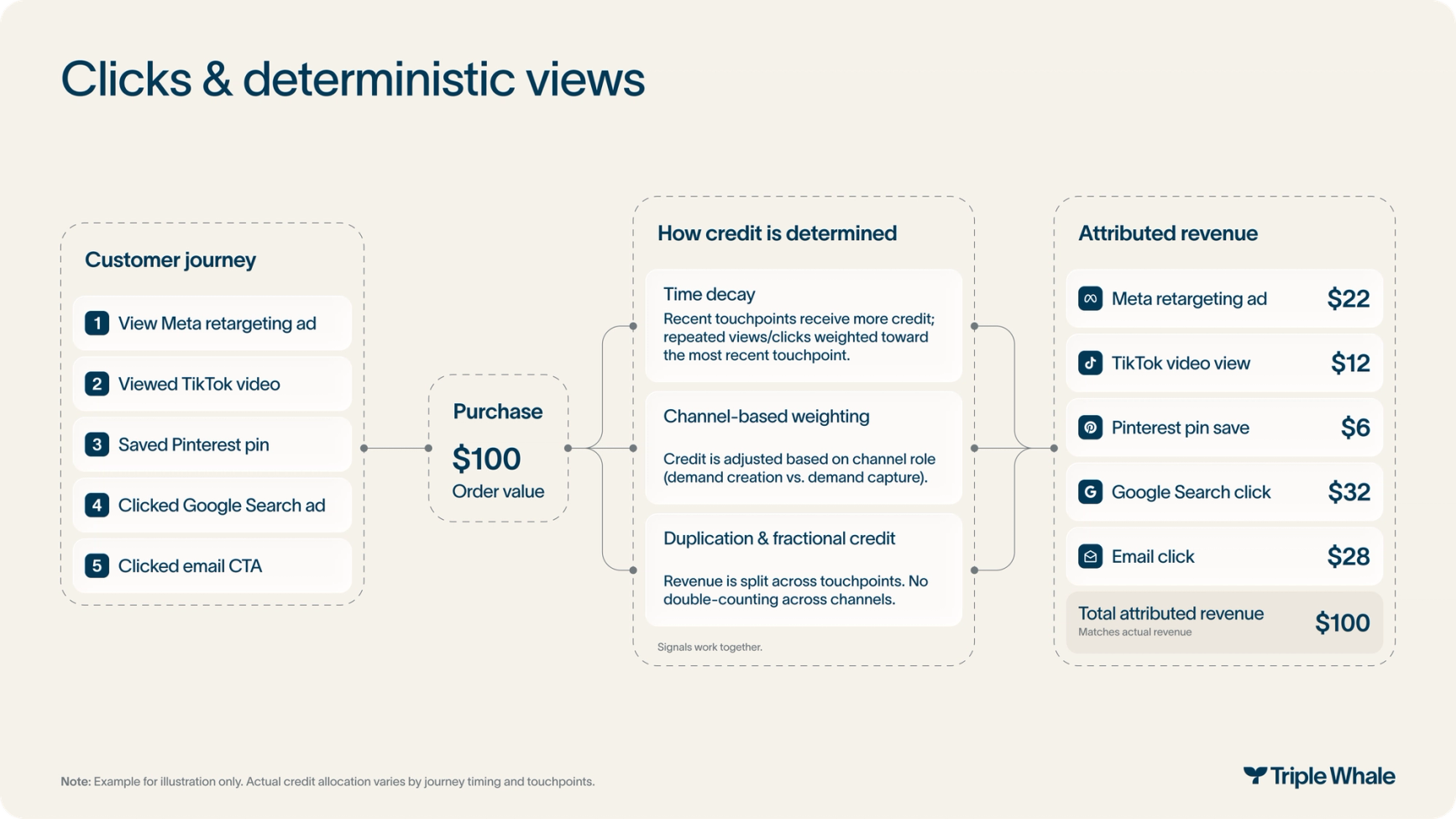
Triple Pixel is the foundation — an advanced identity graph backed by server-side technology that captures every customer interaction across devices and channels.
Once connected, the model runs a match-back against each ad channel to identify which devices saw an ad, then ties those exposures to purchases captured by Triple Pixel.
Credit is distributed based on proximity to conversion and touchpoint type, with clicks weighted higher than views to reflect stronger purchase intent.
Example: Cross-channel Pinterest view & Meta click
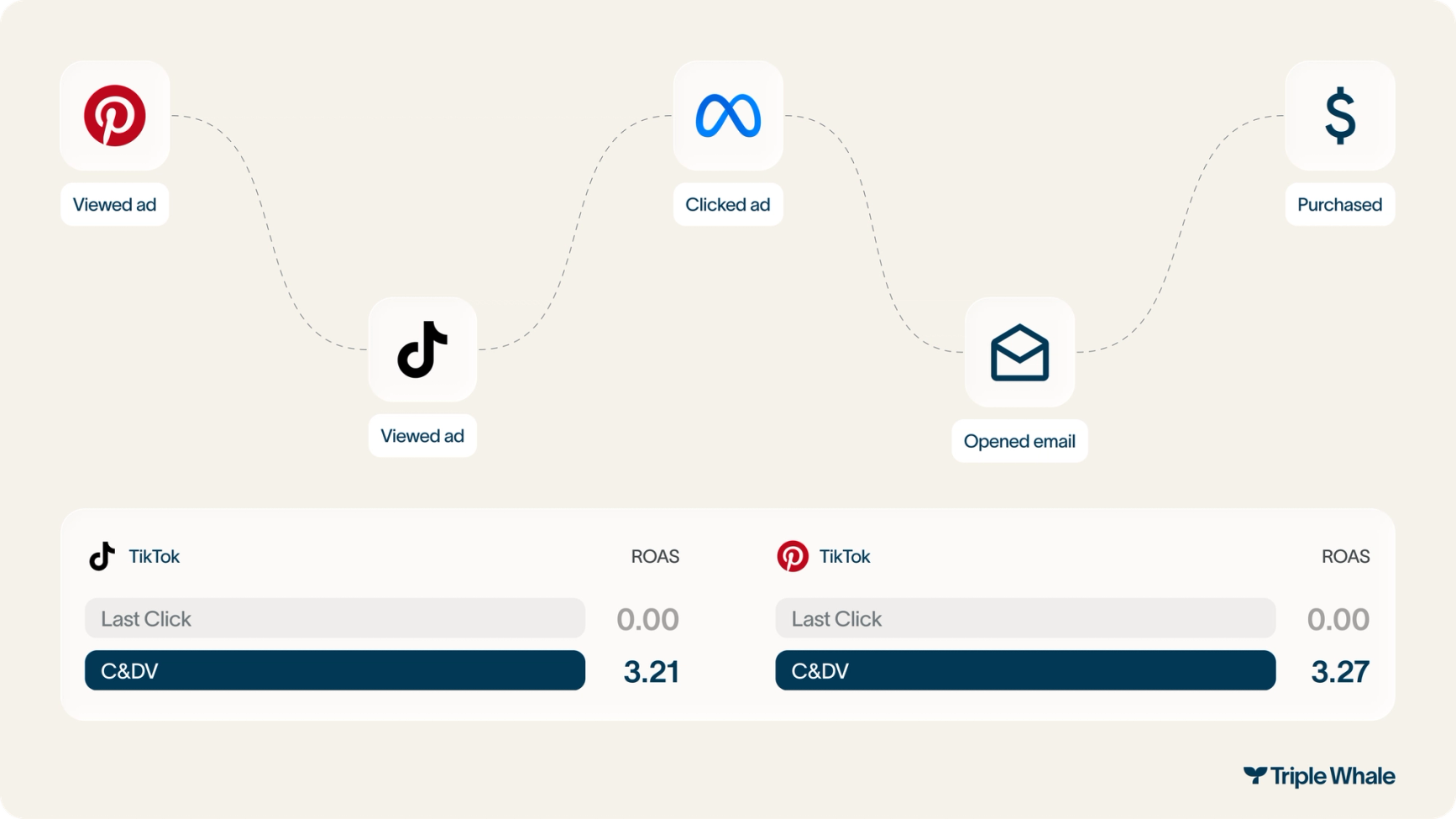
Let’s say Sarah sees a Pinterest ad for your skincare brand on Monday. On Tuesday, she scrolls past your TikTok ad. On Wednesday, she clicks your Meta ad and browses the site.
On Thursday, she opens your email and buys a $60 serum. Under Clicks & Deterministic Views, Pinterest and TikTok both get credit, because the platforms can confirm Sarah saw those ads before she bought.
Deterministic vs. platform-reported views
Ad platforms like Meta report view-through conversions using their own attribution data. These platform-reported views come from platforms grading their own work, so multiple platforms may take credit for the same purchase.
Meta tells you how many conversions followed a Meta ad view. TikTok does the same for TikTok. Each platform measures in its own silo, so a shopper who saw ads on both gets counted twice. Add the totals together, and you overstate your results.
Clicks & Deterministic Views start from the sale:
- Triple Pixel records the purchase on your site.
- Triple Whale matches that purchase against verified ad exposure data from each connected channel.
- Credit goes only to confirmed matches, split across every touchpoint in the journey.
Triple Whale also offers a Triple Attribution + Platform Views model, which incorporates platform-reported view-through data. You can compare results across models to better understand how platform-reported views differ from deterministic view-through attribution.
| Platform-reported views | Deterministic views | |
|---|---|---|
| Who measures | Individual ad platforms, about itself | Triple Whale, across all connected platforms |
| Starting point | The ad impression | The purchase Triple Pixel recorded |
| Cross-channel views | Each platform in isolation | One journey, every channel |
| Shared sales | Counted by every platform that touched them | Split once, totaling one purchase |
Who Clicks & Deterministic Views is for
C&DV pays off for any brand whose customer journey spans more than one platform or session, and these four in particular:
- Paid social-heavy advertisers on Meta video, TikTok, Pinterest, or AppLovin. You capture influence from impressions that never get a click.
- Multi-channel marketers. Email and direct stop claiming credit for sales your paid ads set up.
- Brands investing in awareness. You can attribute the new customers your upper-funnel campaigns bring in.
- Creative and video-focused advertisers. You measure campaigns where engagement is visual.
- CTV advertisers on MNTN, Vibe, or AppLovin. Understand how TV ads contribute to conversions when viewers don’t click after seeing the ad.
The model matters most when you have to defend a budget. Daniel Washburn, Director of Ecommerce at Pressed Juicery, runs 80+ stores alongside online sales and retail placements at Sprouts and Target. Connecting a social impression to a purchase takes measurement built for that.
"Having a data point that shows directionally what social is truly contributing is critical when explaining things to the CFO or CEO," says Daniel.
If you're asking any of these questions, C&DV is built for you:
- What's driving conversions?
- Are my upper-funnel campaigns working?
- Why do Meta, Pinterest, or TikTok feel under-credited?
What to do once you can see views
Better measurement only matters if it changes your decisions. Here's how brands put view-through data to work.
Measure the halo effect
View-through data shows how one channel lifts the others. In a head-to-head test at Vibe, turning on CTV and measuring its impact across channels cut overall retargeting CAC by 57%. Your spend stays the same. What changes is how you read what's working.
Match the model to the campaign type
A top-of-funnel awareness push and a retargeting campaign do different jobs, so judge them differently.
"Ask yourself: What is my new customer purchase percentage by campaign type?" says Zach Rego, Chief Revenue Officer at Triple Whale. "Leveraging not only different models per campaign type, but different signals of what performance looks like for those campaign types is key."
Optimize within channels
Use C&DV to compare campaigns inside a single platform. Awareness campaigns that look weak on clicks may be driving assisted conversions through views. Check before you cut them.
Sharpen your audiences
Sync segments back to your ad platforms and build exclusion audiences that update in real time. For example, exclude high-LTV customers from top-of-funnel campaigns. Platforms get cleaner targeting signals, NC-CAC drops, and your campaigns stop competing with each other.
How Hat Club uncovered a 413% lift in TikTok-attributed revenue
As Hat Club scaled its marketing mix, TikTok became an increasingly important — yet difficult-to-measure — channel. The platform was clearly driving engagement and top-of-funnel attention, but traditional click-based attribution consistently underrepresented its contribution to conversions. Layering in deterministic view-through data changed that.
"Clicks & Deterministic Views has caused us to see TikTok as an entirely separate emerging channel, instead of a similar audience to Instagram with a large amount of crossover," says Steve Berman, Director of Performance Marketing at Hat Club.
Get started with Clicks & Deterministic Views
Turning on Clicks & Deterministic Views takes only a few minutes. If you’ve already connected supported ad platforms and have the Triple Pixel installed, just select the model in Triple Whale to start seeing a clearer picture of your cross-channel performance. You’ll see click data in real-time and view-through data refreshed daily.
Clear, explainable measurement leads to smarter decisions. Better decisions lead to more efficient growth. And right now, that’s the only sustainable advantage that actually matters.
Clicks & Deterministic Views Attribution is generally available to all Triple Whale customers on a paid subscription plan.
“Clicks & Deterministic Views helped us see more of the halo effect from upper-funnel Meta and gave us more confidence in that strategy." – Paul Young, Head of Growth, Gorilla Mind
FAQ
What's the difference between click-through and view-through attribution?
Click-through attribution credits a conversion only when a shopper clicks an ad. View-through attribution credits an ad the shopper saw and later converted from without clicking. It captures influence that click-only models miss.
Is view-through attribution reliable?
Deterministic view-through is reliable because it's matched to observed device-level data. The reliability risk comes from modeled views, which platforms estimate. C&DV uses verified match-backs.
What's the difference between a modeled view and a deterministic view?
An ad platform estimates modeled views with statistical inference. A deterministic view is verified: Triple Whale confirms the device saw the ad and ties that exposure to a purchase Triple Pixel recorded.
How does Clicks & Deterministic Views assign credit?
It uses time decay. Clicks have a 7-day half-life and views have a 1-day half-life, so recent touchpoints and clicks carry more weight. Each purchase is then split across its touchpoints in proportion to those weights.
Does Clicks & Deterministic Views double-count conversions?
No. Each purchase is split across all eligible touchpoints, and the shares always add up to one sale. Adding up platform-reported conversions, by contrast, counts shared sales once per platform.
Why are my C&DV numbers different from what Meta reports?
Meta measures only Meta, and its view-through numbers may include modeled conversions. C&DV credits only confirmed matches and shares each sale with the other channels in the journey. Brands like EVRYJEWELS find C&DV lands closer to platform numbers than click-only attribution does.
Does it replace last-click?
It replaces last-click as your main decision-making model. Last-click data stays available, but optimizing on it alone underfunds the channels doing your awareness work.