It's BFCM season. The six-week gauntlet of calculating promos (do I protect margins or push for volume?), praying inventory holds through, and watching CPMs rise every time you refresh your dashboard.
In 2025, Triple Whale brands generated almost 3 billion in revenue, so we know a thing or two about helping ecommerce brands dominate the peak sales period of the year.
Here are our top 10 ecommerce tips to rule BFCM 2026 and beyond.
1. Extend the sales period beyond just BFCM weekend
Many brands have learned that extending the sale beyond just BFCM can bring great success. This can either mean starting a sale early or extending it beyond Cyber Monday. Whichever route you choose, you need to ensure you are advertising it accurately, clearly, and with enough time to generate the sales you’re hoping for.
In 2025, Triple Whale brands generated $1.77B in revenue and 16.6M orders during the pre-BFCM window. They also spent $396.6M on ads before the official weekend, equal to about 65% of actual BFCM weekend ad spend. Translation: shoppers are buying earlier, and brands can’t afford to wait until Black Friday morning to launch.
2. Reward your loyal customers
BFCM is a major acquisition moment, but the balance between new and returning customers changes as brands mature. In 2025, brands in the $0-1M GMV tier drove 66.05% of revenue from new customers, while $10M+ brands drove 54.69% of revenue from returning customers.
For larger brands, that means loyal audiences are a major BFCM advantage. Try tactics such as:
Early access
VIP offers
Loyalty points
Exclusive bundles
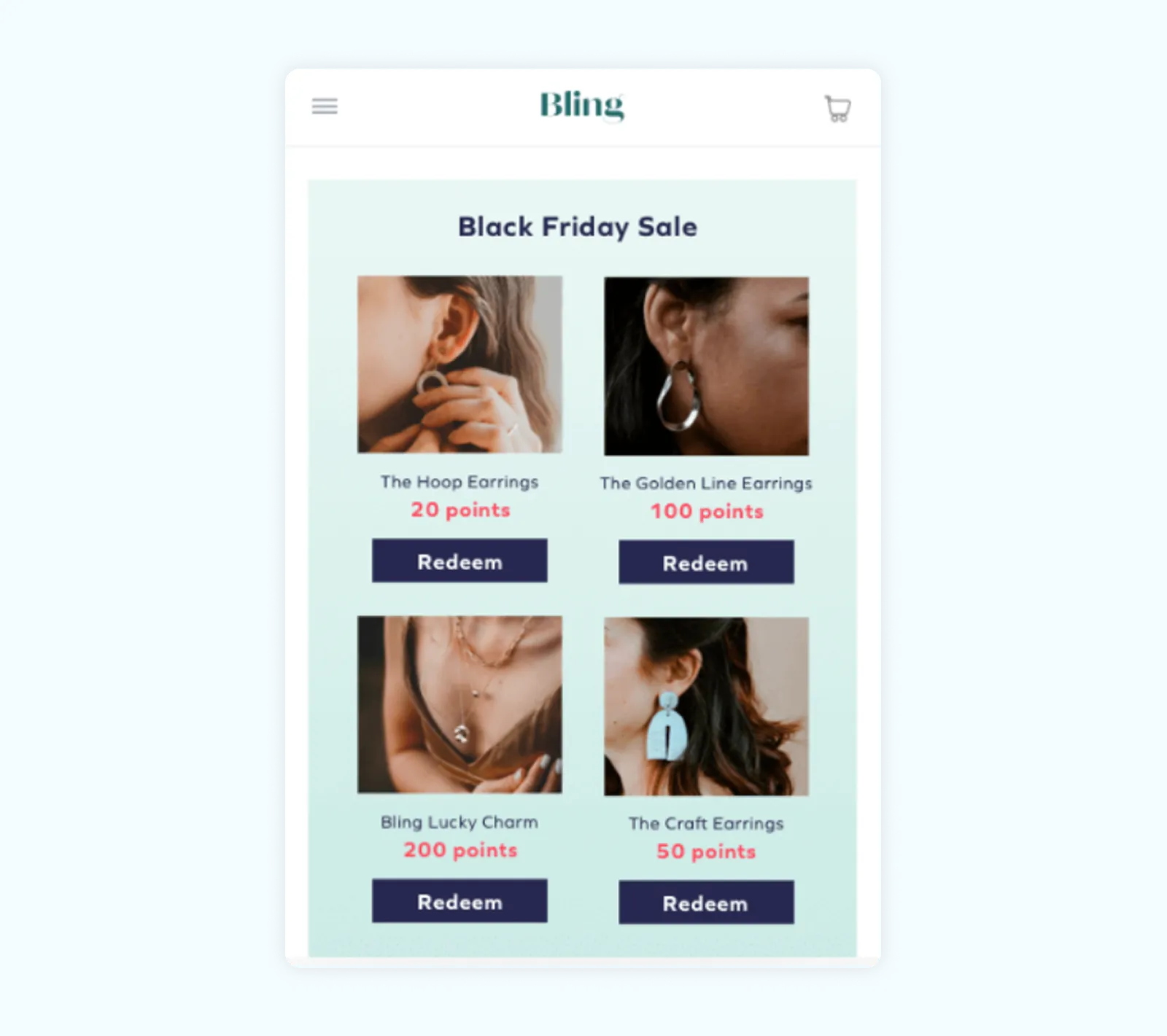
A loyalty program, set up with the help of platforms like Yotpo or Okendo, can help provide a vehicle for offering rewards points, perks for referrals, friends and family sales, and exclusive sales you can offer customers on your subscription list.
Additionally, creating an opportunity for loyal customers to use points to snag BFCM deals is a fantastic method for making them feel like they’re getting more bang for their buck.
3. Invest in your top sales channels
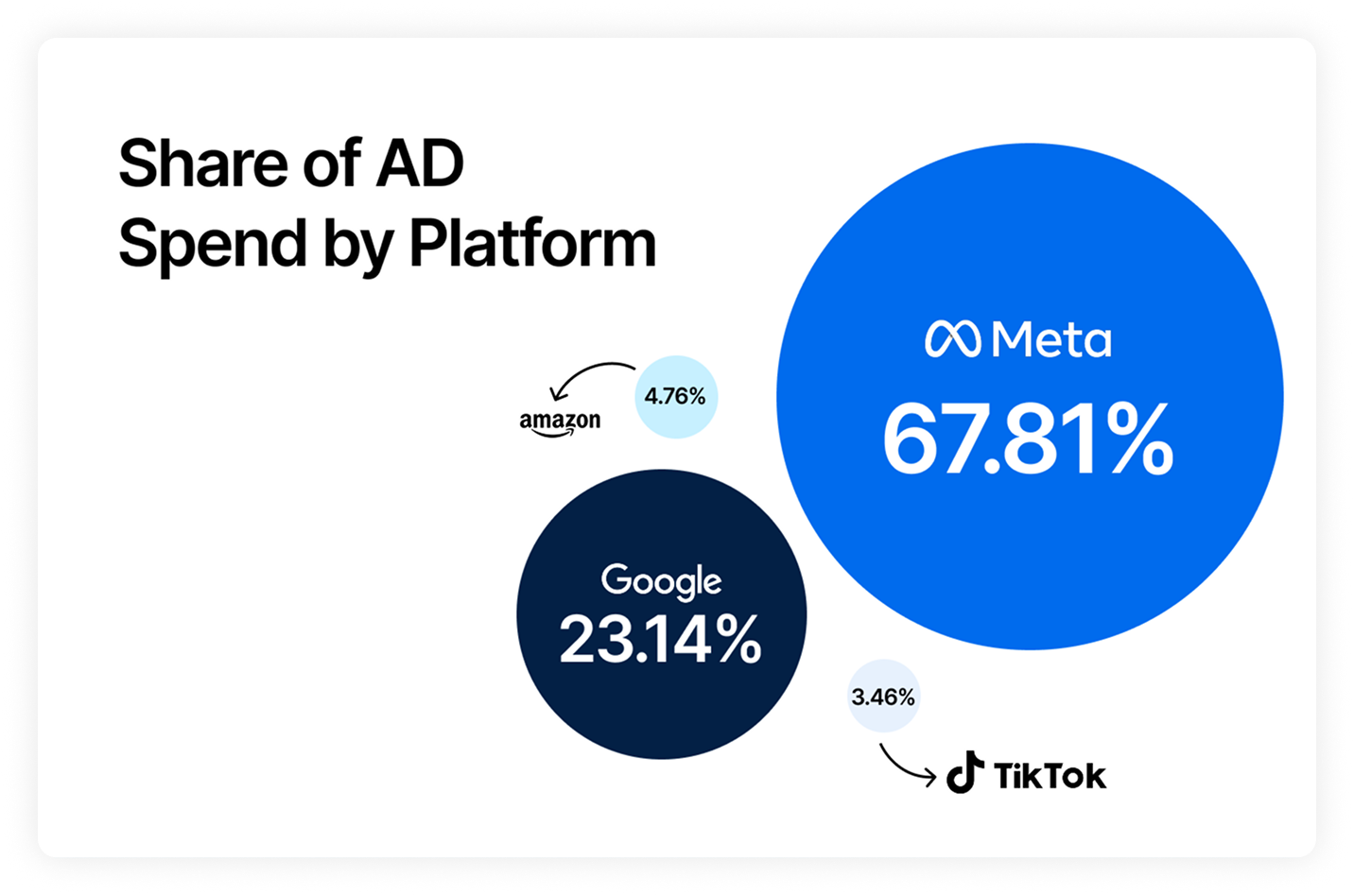
In 2025, Triple Whale brands invested $606.6M in ad spend across BFCM. Meta remained the dominant channel, accounting for 67.6% of spend, followed by Google at 22.65%. But smaller platforms gained share: TikTok reached 3.66% of spend, up 23.65% YoY, while AppLovin reached 2.03%, up 36.24% YoY.
The takeaway for 2026 is to know exactly where each channel fits.
Meta still offers scale
Google captures high-intent demand
Emerging channels like TikTok may offer more efficient reach for certain categories
The best way to monitor sales across multiple channels is with Triple Whale, and we’ve built boards specifically designed to master BFCM sales:
BFCM Mission Control Board
Hourly Performance Dashboard
BFCM Mission Control Board
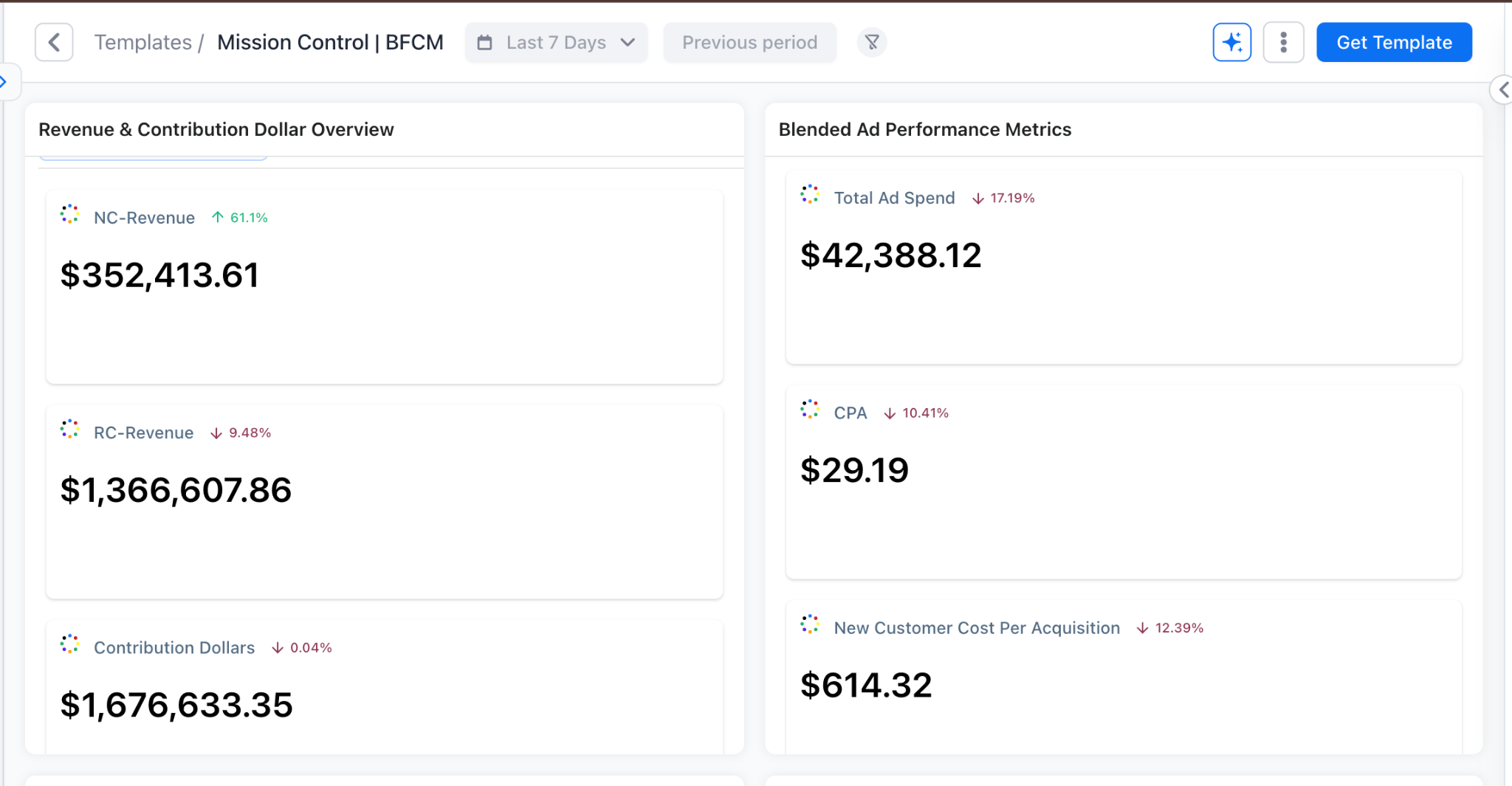
The BFCM Mission Control Board should act exactly as it sounds: your anchor in the craziness of BFCM. It’s full of useful widgets that cover everything you’ll need to keep track of during the event. It should be used to, first and foremost, take a look at your metrics from last year to set goals for how you expect to perform in 2026.
Hourly performance dashboard
What better way to analyze your performance to stay quick with your decision than with an hourly performance review? Here’s an easy way to see cumulative revenue, cumulative contribution dollars, and total revenue, hour by hour, throughout the day.
As you’re spending money, you’ll have a clear view of your top line metrics. As you are running ads, you can analyze performance and understand which of your ads are performing well to iterate and improve on them.
4. Launch campaign emails early
Owned channels remain one of the strongest ways to drive BFCM revenue without adding more paid media pressure. In 2025, Triple Whale brands ran 4.6M+ email flows, 5.5M+ email campaigns, 124K+ SMS flows, and 269K+ SMS campaigns, during BFCM.
The key is to plump up your list months before peak season. Try growing email and SMS audiences, segmenting customers by behavior, and testing offers before inboxes get crowded.
Planning and launching BFCM emails early is crucial to a successful season. To ensure you’re set up for success, try the following tips:
Capture emails easily
Make it easy and obvious for visitors to sign up for your email list, with email collection fields, sign-up pop-ups, and enticing copy that drives visitors to subscribe. Offering early access to sales is a great option, here!
Personalize the email campaigns
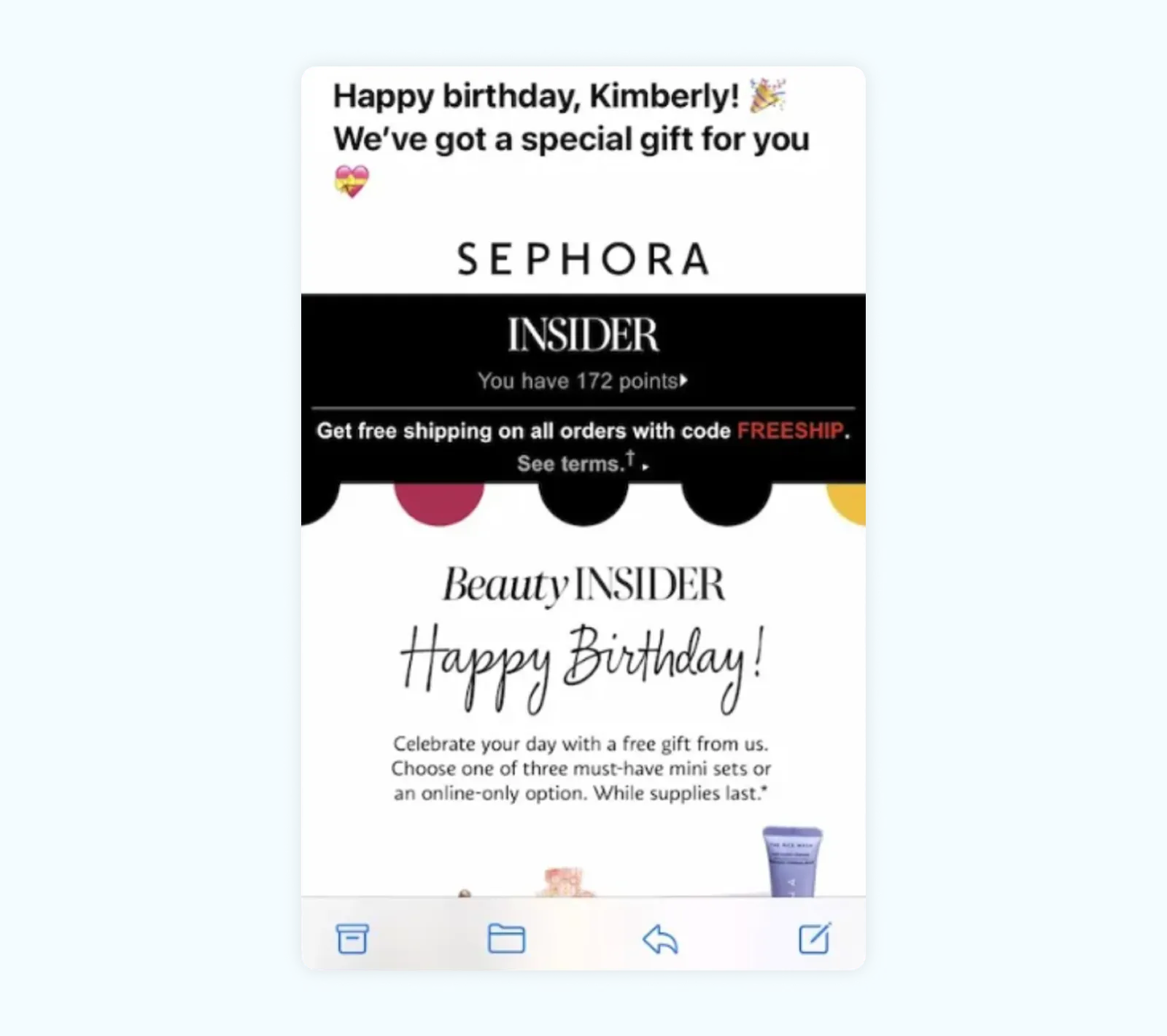
Personalization is more than putting their first name in the email subject line (although you should do that, too).
To get really personal, you should use the information collected about your customer through zero- and first-party data (using Triple Whale) to create segments that send relevant content specific to where each customer is on the purchase journey.
Set up abandoned cart emails
BFCM is a big "window" shopping moment, which means customers are likely to abandon their carts. In 2025, roughly 70% of shoppers abandoned their carts on average — and on mobile, that number climbs closer to 80%, according to Baymard Institute. When you set up automated cart abandonment emails, you can help capture some of those sales.
When customers are shopping for gifts, they need to know they can make a return without a hassle. According to the 2025 NRF and Happy Returns Retail Returns Landscape report, 82% of shoppers cite free returns as a major consideration when making a purchase — up from 76% the year before.
Your return policy should be well-communicated on your store’s website, and clearly showcased on the shipping, FAQ, and product pages. Simplify your returns by using an integration like ShipBob or ShipStation, with a bonus that all of your shipping and returns will be tracked within Triple Whale as well!
6. Provide personalized customer support
Customer support should be accessible, with self-service options available as well as direct phone or chat support (if you have the capacity!). Ensuring your potential or existing customers can ask questions about products and get answers immediately will improve your conversion rate!
BFCM can be a hectic time, and quick response times can put customers at ease. Utilize customer support platforms like Gorgias which use AI chatbots to give customers access to instant answers, which saves time for your front line agents while still making it possible to access a real agent if they need to.
In 2025, post-purchase survey responses showed that shoppers remembered discovering brands through Facebook 24.35% of the time, Instagram 22.7%, referred by a friend 17.26%, email 6.59%, Google 6.44%, and TikTok 6.11%.
That data can help you tailor support, follow-up messaging, and retention flows based on how customers actually entered your funnel.
7. Offer Buy Now, Pay Later options
In 2025, the economic pinch is felt worldwide, and many customers might need to make budgeted choices with their gifts for the holiday season. Offering a Buy Now, Pay Later (BNPL) option on your DTC site can benefit both customers and businesses for a few reasons:
Larger purchases: BNPL allows a customer to make a purchase for an item of higher value without the immediate financial burden, which can lead to higher average order value (AOV) for the business itself.
Impulse purchases: the flexibility of BNPL can encourage more impulse purchases, which are common during BFCM sales (especially if the offer/deal is compelling enough!).
Competitive advantage: Many customers will comparison shop during the BFCM period, and if the BNPL option on your site enables them to make a flexible purchase over a competitor that isn’t offering BNPL, you’ve won that customer.
To make sure your BNPL option is set up for BFCM success, ensure you partner with reputable BNPL providers like Klarna, Afterpay, or Affirm — this way, you’ll have a seamless integration and trusted experience for your customers.
8. Benchmark your performance to set goals
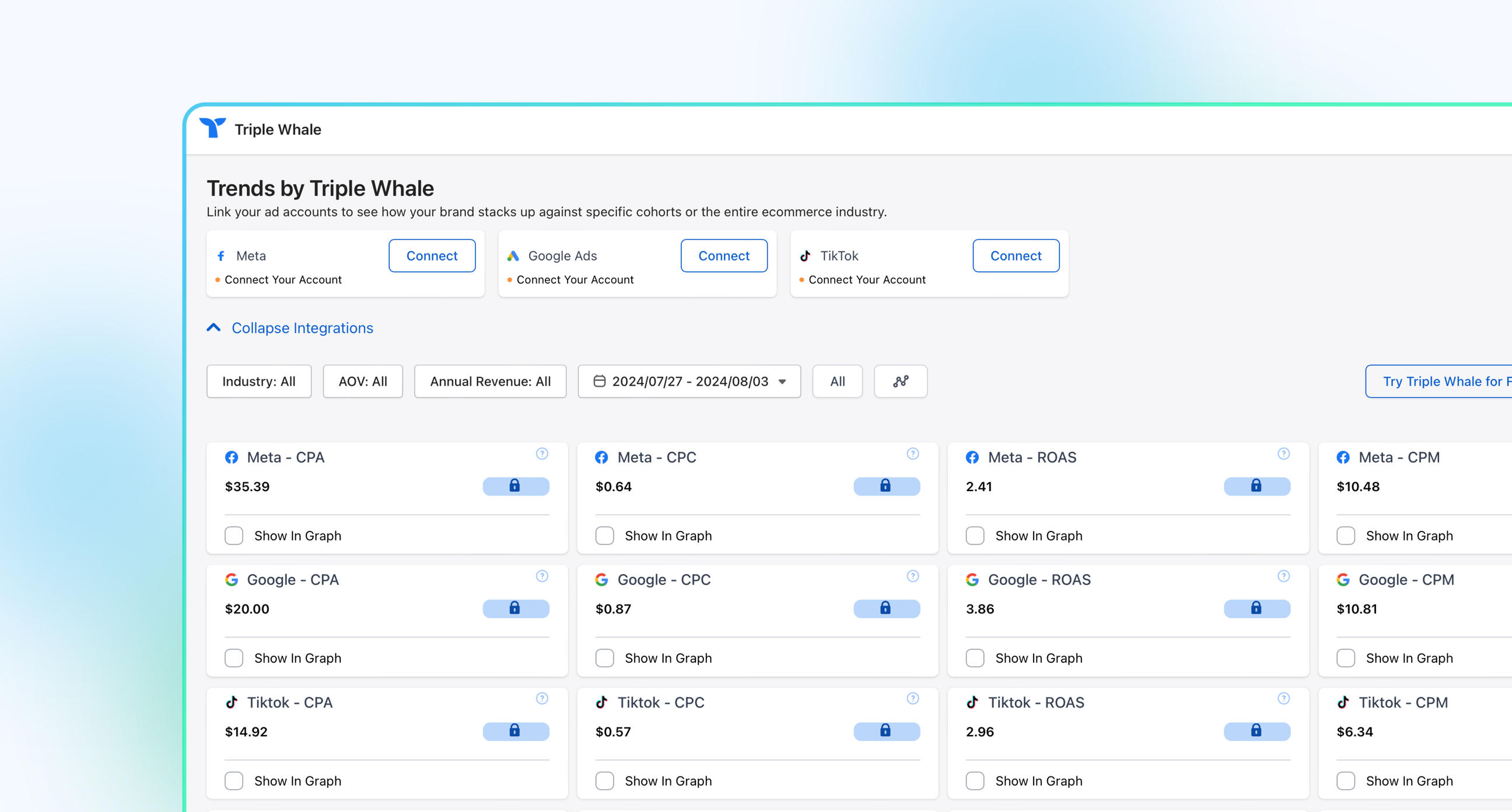
In an unpredictable period like BFCM, it’s great to see how peers in your industry are performing. Triple Whale’s Benchmark’s is built from real performance data across 60,000+ ecommerce brands in Triple Whale, helping you see exactly how you stack up in your industry.
You can also evaluate your performance over BFCM 2025 to use that as a standard/starting point for how you plan to market your products during the BFCM 2026 season.
One way to do this is using Moby: an AI-agent similar to ChatGPT that’s trained on your business. With the ability to analyze data within a few seconds, you can ask Moby questions to understand how your business performed during BFCM last year, to allow you to make better-informed decisions about this year’s BFCM.
Ask Moby: “What were my top selling products over BFCM 2024?” to get an idea of which products were flying off the shelves last year. Chances are, they will be just as popular this BFCM, so you can create a marketing plan that centers your top products for 2025.
9. Make sure your site is mobile optimized
Unsurprisingly, more and more customers are choosing to shop on mobile devices versus desktops. In 2025, a record 70% of ecommerce orders during Cyber Week originated from mobile phones.
If your site isn’t optimized for mobile browsing and purchasing, you’re simply leaving sales on the table. You should ensure your mobile experience is intuitive and that it’s easy to make purchases, in addition to being mobile responsive.
The next step would be to create a full mobile app for your shopping experiences, possible with a service like Tapcart. Since an app gives you the ability to send push notifications to engage customers directly, which will help you stay top of mind with customers this holiday season.
10. Implement retargeting strategies
With Triple Whale’s Pixel, you can track the behavior of visitors to your site, including content like pages viewed, purchases, add to cart, and the ad that directed the customer to the site in the first place. Not only does this allow for transparency and accuracy of your ad conversion data, you can use the events tracked to create robust retargeting efforts for the visitors that didn’t make a purchase.
Using Sonar, you can transfer data back to Meta using the Conversions API (CAPI), which includes conversions missed by the Meta web pixel, detailed customer information, and corrected conversion values to improve platform reporting and budget allocation.
You can then use the enhanced insights to create more tailored and targeted campaigns from the more complete record of events, leading to better retargeting campaigns on the platform side.
Conclusion
As Black Friday Cyber Monday 2026 approaches, it's crucial for DTC brands to be well-prepared to capitalize on the biggest sales opportunity of the year. By following the tips outlined in this checklist, you'll be equipped to extend sales periods, reward loyal customers, optimize your top sales channels, and much more.
Get there faster with Triple Whale, the AI operating that understands your brand. Triple Whale gives you real-time data analytics across every channel, benchmarks built on 60,000+ ecommerce brands, and the insights to know what's working before you scale spend. Book a demo today.
Component Sales
5.32K
Benchmark your ecommerce brand against industry leaders
It's BFCM season. The six-week gauntlet of calculating promos (do I protect margins or push for volume?), praying inventory holds through, and watching CPMs rise every time you refresh your dashboard.
In 2025, Triple Whale brands generated almost 3 billion in revenue, so we know a thing or two about helping ecommerce brands dominate the peak sales period of the year.
Here are our top 10 ecommerce tips to rule BFCM 2026 and beyond.
1. Extend the sales period beyond just BFCM weekend
Many brands have learned that extending the sale beyond just BFCM can bring great success. This can either mean starting a sale early or extending it beyond Cyber Monday. Whichever route you choose, you need to ensure you are advertising it accurately, clearly, and with enough time to generate the sales you’re hoping for.
In 2025, Triple Whale brands generated $1.77B in revenue and 16.6M orders during the pre-BFCM window. They also spent $396.6M on ads before the official weekend, equal to about 65% of actual BFCM weekend ad spend. Translation: shoppers are buying earlier, and brands can’t afford to wait until Black Friday morning to launch.
2. Reward your loyal customers
BFCM is a major acquisition moment, but the balance between new and returning customers changes as brands mature. In 2025, brands in the $0-1M GMV tier drove 66.05% of revenue from new customers, while $10M+ brands drove 54.69% of revenue from returning customers.
For larger brands, that means loyal audiences are a major BFCM advantage. Try tactics such as:
Early access
VIP offers
Loyalty points
Exclusive bundles
A loyalty program, set up with the help of platforms like Yotpo or Okendo, can help provide a vehicle for offering rewards points, perks for referrals, friends and family sales, and exclusive sales you can offer customers on your subscription list.
Additionally, creating an opportunity for loyal customers to use points to snag BFCM deals is a fantastic method for making them feel like they’re getting more bang for their buck.
3. Invest in your top sales channels
In 2025, Triple Whale brands invested $606.6M in ad spend across BFCM. Meta remained the dominant channel, accounting for 67.6% of spend, followed by Google at 22.65%. But smaller platforms gained share: TikTok reached 3.66% of spend, up 23.65% YoY, while AppLovin reached 2.03%, up 36.24% YoY.
The takeaway for 2026 is to know exactly where each channel fits.
Meta still offers scale
Google captures high-intent demand
Emerging channels like TikTok may offer more efficient reach for certain categories
The best way to monitor sales across multiple channels is with Triple Whale, and we’ve built boards specifically designed to master BFCM sales:
BFCM Mission Control Board
Hourly Performance Dashboard
BFCM Mission Control Board
The BFCM Mission Control Board should act exactly as it sounds: your anchor in the craziness of BFCM. It’s full of useful widgets that cover everything you’ll need to keep track of during the event. It should be used to, first and foremost, take a look at your metrics from last year to set goals for how you expect to perform in 2026.
Hourly performance dashboard
What better way to analyze your performance to stay quick with your decision than with an hourly performance review? Here’s an easy way to see cumulative revenue, cumulative contribution dollars, and total revenue, hour by hour, throughout the day.
As you’re spending money, you’ll have a clear view of your top line metrics. As you are running ads, you can analyze performance and understand which of your ads are performing well to iterate and improve on them.
4. Launch campaign emails early
Owned channels remain one of the strongest ways to drive BFCM revenue without adding more paid media pressure. In 2025, Triple Whale brands ran 4.6M+ email flows, 5.5M+ email campaigns, 124K+ SMS flows, and 269K+ SMS campaigns, during BFCM.
The key is to plump up your list months before peak season. Try growing email and SMS audiences, segmenting customers by behavior, and testing offers before inboxes get crowded.
Planning and launching BFCM emails early is crucial to a successful season. To ensure you’re set up for success, try the following tips:
Capture emails easily
Make it easy and obvious for visitors to sign up for your email list, with email collection fields, sign-up pop-ups, and enticing copy that drives visitors to subscribe. Offering early access to sales is a great option, here!
Personalize the email campaigns
Personalization is more than putting their first name in the email subject line (although you should do that, too).
To get really personal, you should use the information collected about your customer through zero- and first-party data (using Triple Whale) to create segments that send relevant content specific to where each customer is on the purchase journey.
Set up abandoned cart emails
BFCM is a big "window" shopping moment, which means customers are likely to abandon their carts. In 2025, roughly 70% of shoppers abandoned their carts on average — and on mobile, that number climbs closer to 80%, according to Baymard Institute. When you set up automated cart abandonment emails, you can help capture some of those sales.
When customers are shopping for gifts, they need to know they can make a return without a hassle. According to the 2025 NRF and Happy Returns Retail Returns Landscape report, 82% of shoppers cite free returns as a major consideration when making a purchase — up from 76% the year before.
Your return policy should be well-communicated on your store’s website, and clearly showcased on the shipping, FAQ, and product pages. Simplify your returns by using an integration like ShipBob or ShipStation, with a bonus that all of your shipping and returns will be tracked within Triple Whale as well!
6. Provide personalized customer support
Customer support should be accessible, with self-service options available as well as direct phone or chat support (if you have the capacity!). Ensuring your potential or existing customers can ask questions about products and get answers immediately will improve your conversion rate!
BFCM can be a hectic time, and quick response times can put customers at ease. Utilize customer support platforms like Gorgias which use AI chatbots to give customers access to instant answers, which saves time for your front line agents while still making it possible to access a real agent if they need to.
In 2025, post-purchase survey responses showed that shoppers remembered discovering brands through Facebook 24.35% of the time, Instagram 22.7%, referred by a friend 17.26%, email 6.59%, Google 6.44%, and TikTok 6.11%.
That data can help you tailor support, follow-up messaging, and retention flows based on how customers actually entered your funnel.
7. Offer Buy Now, Pay Later options
In 2025, the economic pinch is felt worldwide, and many customers might need to make budgeted choices with their gifts for the holiday season. Offering a Buy Now, Pay Later (BNPL) option on your DTC site can benefit both customers and businesses for a few reasons:
Larger purchases: BNPL allows a customer to make a purchase for an item of higher value without the immediate financial burden, which can lead to higher average order value (AOV) for the business itself.
Impulse purchases: the flexibility of BNPL can encourage more impulse purchases, which are common during BFCM sales (especially if the offer/deal is compelling enough!).
Competitive advantage: Many customers will comparison shop during the BFCM period, and if the BNPL option on your site enables them to make a flexible purchase over a competitor that isn’t offering BNPL, you’ve won that customer.
To make sure your BNPL option is set up for BFCM success, ensure you partner with reputable BNPL providers like Klarna, Afterpay, or Affirm — this way, you’ll have a seamless integration and trusted experience for your customers.
8. Benchmark your performance to set goals
In an unpredictable period like BFCM, it’s great to see how peers in your industry are performing. Triple Whale’s Benchmark’s is built from real performance data across 60,000+ ecommerce brands in Triple Whale, helping you see exactly how you stack up in your industry.
You can also evaluate your performance over BFCM 2025 to use that as a standard/starting point for how you plan to market your products during the BFCM 2026 season.
One way to do this is using Moby: an AI-agent similar to ChatGPT that’s trained on your business. With the ability to analyze data within a few seconds, you can ask Moby questions to understand how your business performed during BFCM last year, to allow you to make better-informed decisions about this year’s BFCM.
Ask Moby: “What were my top selling products over BFCM 2024?” to get an idea of which products were flying off the shelves last year. Chances are, they will be just as popular this BFCM, so you can create a marketing plan that centers your top products for 2025.
9. Make sure your site is mobile optimized
Unsurprisingly, more and more customers are choosing to shop on mobile devices versus desktops. In 2025, a record 70% of ecommerce orders during Cyber Week originated from mobile phones.
If your site isn’t optimized for mobile browsing and purchasing, you’re simply leaving sales on the table. You should ensure your mobile experience is intuitive and that it’s easy to make purchases, in addition to being mobile responsive.
The next step would be to create a full mobile app for your shopping experiences, possible with a service like Tapcart. Since an app gives you the ability to send push notifications to engage customers directly, which will help you stay top of mind with customers this holiday season.
10. Implement retargeting strategies
With Triple Whale’s Pixel, you can track the behavior of visitors to your site, including content like pages viewed, purchases, add to cart, and the ad that directed the customer to the site in the first place. Not only does this allow for transparency and accuracy of your ad conversion data, you can use the events tracked to create robust retargeting efforts for the visitors that didn’t make a purchase.
Using Sonar, you can transfer data back to Meta using the Conversions API (CAPI), which includes conversions missed by the Meta web pixel, detailed customer information, and corrected conversion values to improve platform reporting and budget allocation.
You can then use the enhanced insights to create more tailored and targeted campaigns from the more complete record of events, leading to better retargeting campaigns on the platform side.
Conclusion
As Black Friday Cyber Monday 2026 approaches, it's crucial for DTC brands to be well-prepared to capitalize on the biggest sales opportunity of the year. By following the tips outlined in this checklist, you'll be equipped to extend sales periods, reward loyal customers, optimize your top sales channels, and much more.
Get there faster with Triple Whale, the AI operating that understands your brand. Triple Whale gives you real-time data analytics across every channel, benchmarks built on 60,000+ ecommerce brands, and the insights to know what's working before you scale spend. Book a demo today.
Share
Allie Mistakidis
Allie Mistakidis
Allie Mistakidis is a Content Writer at Triple Whale, silversmith at Aloraflora Jewelry, and retail store co-owner at Whiskeyjack Boutique in Windsor, ON, Canada. She has a Masters degree in plumage evolution in birds, and spent several years doing technical support, including at Shopify. You can connect with her on LinkedIn.
Body Copy: The following benchmarks compare advertising metrics from April 1-17 to the previous period. Considering President Trump first unveiled his tariffs on April 2, the timing corresponds with potential changes in advertising behavior among ecommerce brands (though it isn’t necessarily correlated).


 Moby AIAsk questions, analyze performance, and work with your business context.
 ActionsTake governed action across the tools that run your business.
 AutomationsSchedule recurring analysis and work that runs on your terms.
 Landing PagesCreative conversion-focused ecommerce pages with Moby.
 Creative StudioGenerate and refine creative grounded in your brand.






.jpg)




.webp)

.webp)
