Blog
How AI Discovery Works in Ecommerce (and What Drives Visibility)

How AI Discovery Works in Ecommerce (and What Drives Visibility)

Shoppers are turning to AI-powered chatbots and assistants to research products, compare options, and make final purchase decisions. Instead of scanning ten blue hyperlinks, they're receiving curated answers generated by AI.

McKinsey found that 44% of users who have tried AI-powered search now say it's their primary way to get information. 

It’s clear shoppers are on board with using AI in ecommerce. The problem for the brands, however, is they have no (or, very little) insights into how it all works.

This article explains everything under the hood of ecommerce AI discovery — from retrieval to the signals and platform-specific factors you need to know to get seen.

Key takeaways:

  • AI discovery is the process by which AI systems identify, evaluate, and surface products in response to user queries.
  • AI systems retrieve information from product feeds, website content, reviews, and third-party sources before generating recommendations.
  • Visibility also depends on signals like structured data, feed quality, content clarity, reviews, and brand consistency.
  • Triple Whale’s AI Visibility tool is purpose-built for ecommerce brands to better understand where they show up in AI-powered search — and how to influence their visibility. 

What is AI discovery in ecommerce?

AI discovery in ecommerce is the use of artificial intelligence to help shoppers find products. 

Through machine learning, AI systems select and recommend products based on relevance, context, and supporting signals.

Historically, a brand’s visibility depended largely on where a page ranked for a keyword. In the era of AI discovery, visibility depends on whether an AI system decides your product helps answer a user's question.

Melissa Dusendang, Head of Ecommerce & Operations at SHEFit, tells us that discovery has become more conversational. “There was a time when people were trained to enter specific keywords to get answers,” she says. “Now they simply type an entire sentence into the [LLM] search bar."

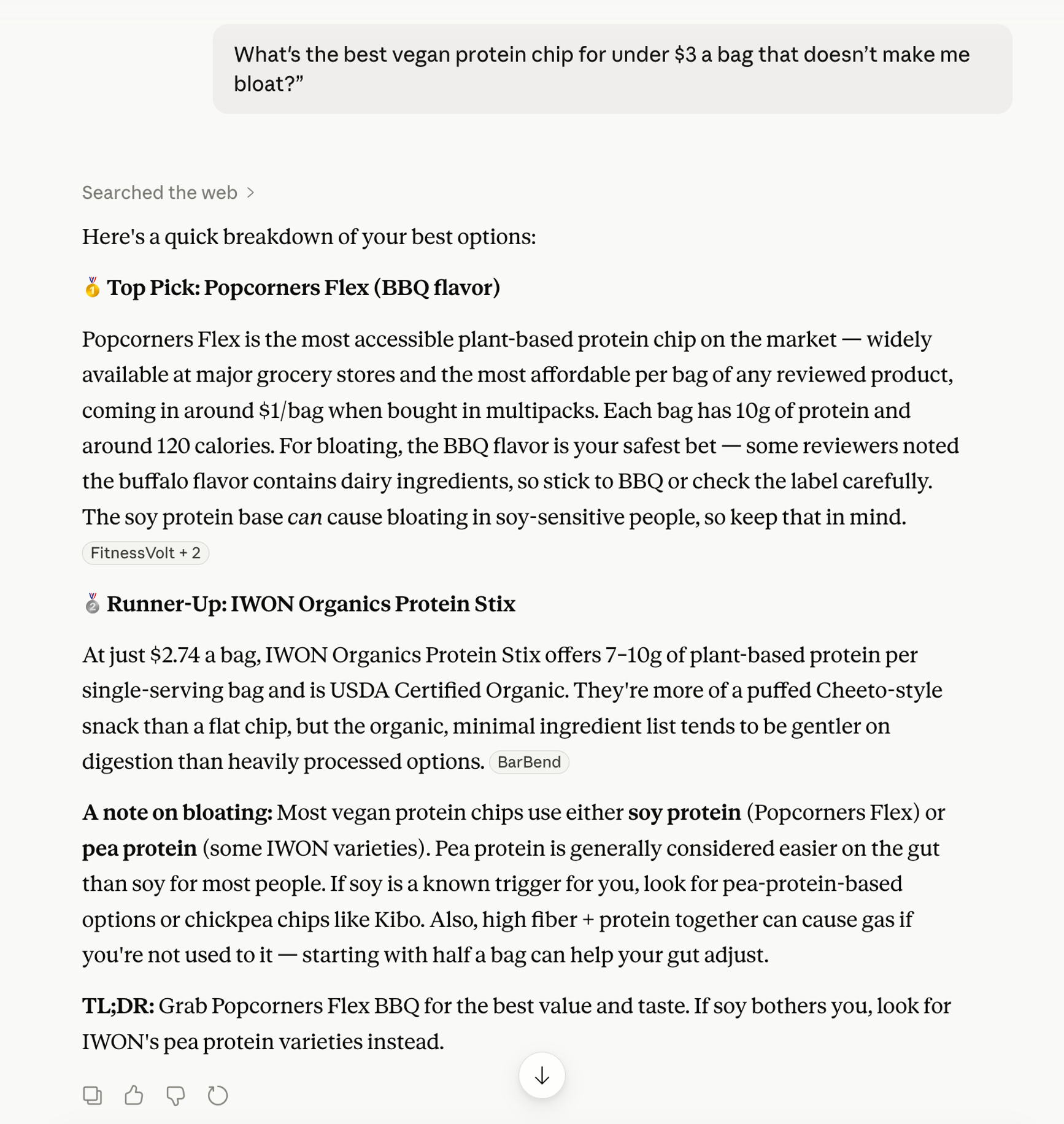
For example, a shopper may no longer search for "best vegan protein chips.” Instead, they might ask: "What's the best vegan protein chip for under $3 a bag that doesn’t make me bloat?”
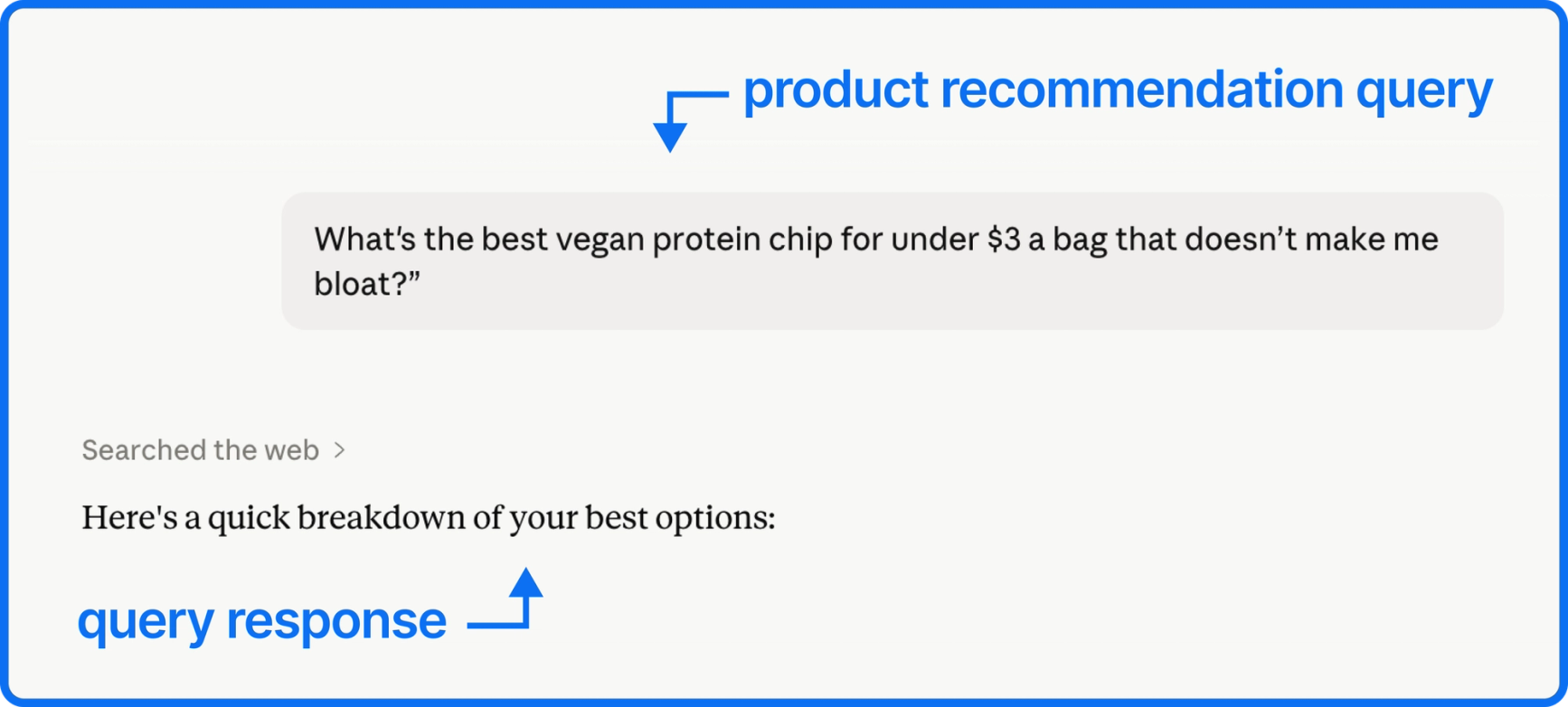
screenshot of a query inside an AI chatbot, example

These types of questions are commonly called a product recommendation query or informational query. They have a practical, task-oriented goal.

The constraint ("doesn't make me bloat") also makes it a faceted query, meaning it has multiple filtering criteria (vegan + under $3 + low-bloat).

How AI discovery works

AI discovery builds on the evolution of search itself. Search engines moved from keyword matching to understanding intent, and now many platforms are generating answers using retrieved information and large language models (LLMs). 

Let’s look at the steps involved. 

Retrieval: What data gets pulled

AI systems have been trained on a massive corpus of text, such as licensed data, human-created text, and publicly available content. When a user sends a query, the system retrieves from this trained “memory” to answer the question.

However, modern systems don't rely solely on training data to form an answer. That’s because that type of memory has a knowledge cutoff and can hallucinate (OpenAI defines this as “when AI generates a confident response that is factually incorrect”).

Instead, they retrieve relevant information in real time when responding to a query. AI learns patterns across millions of sources, then uses that to generate new text. This is called Retrieval-Augmented Generation (RAG). 

Depending on the platform, that information may come from several sources:

  • Product feeds
  • Website content
  • Reviews and user-generated content
  • Third-party sources

One particularly important trend is the growing influence of third-party content.

Triple Whale's analysis of more than 600,000 AI citations found that Reddit alone accounted for nearly 29% of all cited sources, making it the most referenced third-party platform across ecommerce-related AI queries.

Interpretation: How AI understands products

Once information is retrieved, AI systems attempt to understand what the user is actually asking.

Rather than matching exact keywords, modern AI systems rely on semantic understanding. Technologies like embeddings and vector search help models capture meaning. 

Similar concepts cluster near each other in this vector space. So searching for "bloating from chips" can surface documents about "digestive sensitivity to legumes" even without exact word overlap. 

The product selected isn't necessarily the one with the highest ranking. It's the one that best matches the user's situation.

This means AI can connect products to:

  • Specific use cases
  • Customer problems
  • Desired outcomes
  • Product attributes
  • Lifestyle contexts

Generation: How answers and recommendations are formed

After retrieving and interpreting information, AI systems generate an answer. Importantly, these recommendations are a probabilistic system. Meaning, when you're asking a question, you're not going to get the same answer back every time. Every answer is essentially a dice roll.

That's one reason visibility is increasingly measured through share of voice and citation frequency rather than simple rankings (more on this below). 
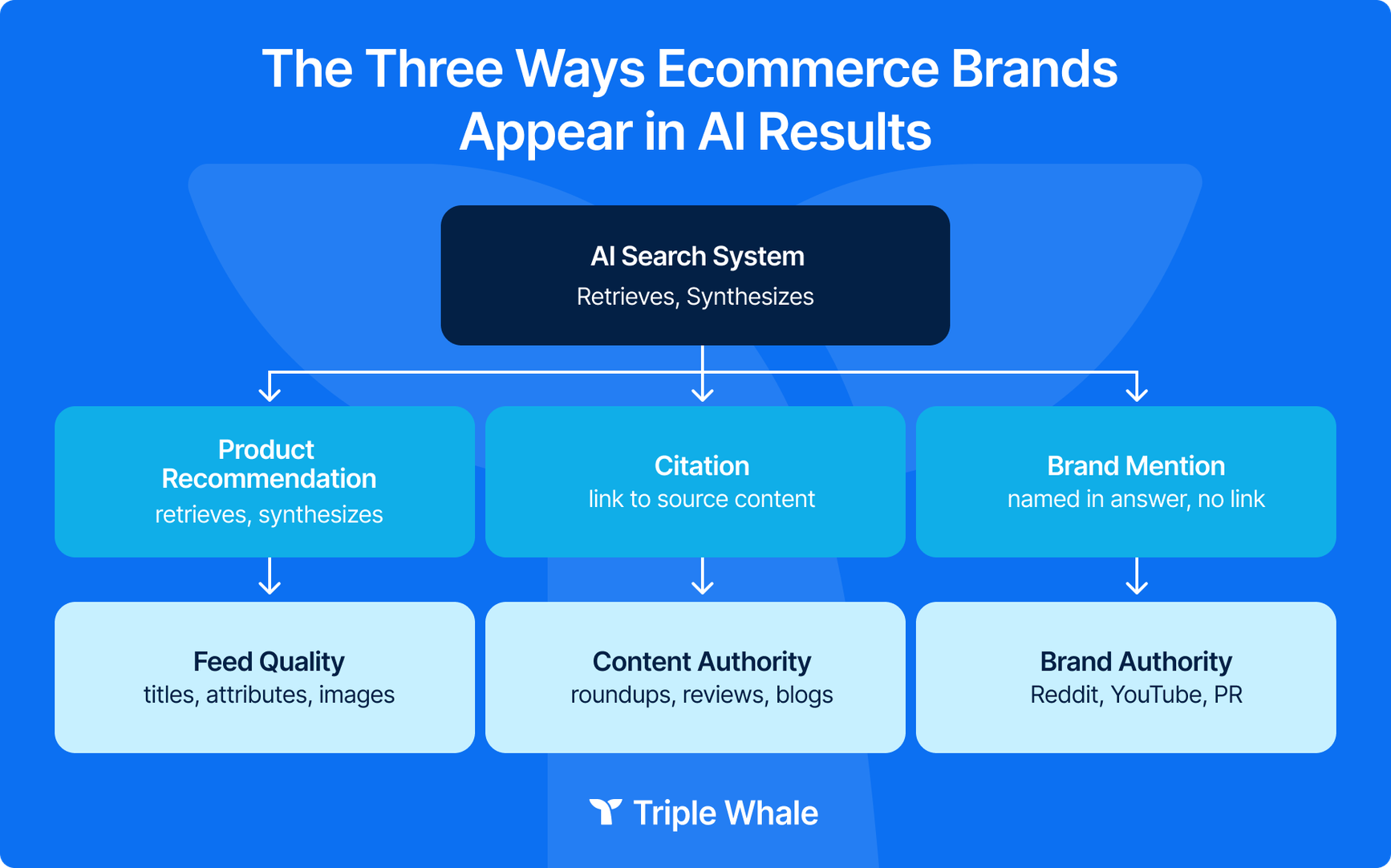
Three ways ecommerce brands appear in results diagram

These answers often appear as:

  • Summarized recommendations
  • Product comparisons
  • Curated buying advice
  • Citation-based answers
  • Source links for verification
example of a response from an AI chatbot

What signals influence whether your product gets surfaced

AI systems evaluate multiple signals when deciding which brands and products to include in generated answers. While no platform fully discloses its selection criteria, several patterns consistently emerge across AI search environments.

  • Structured data (schema markup): Structured product information helps AI systems understand pricing, availability, reviews, specifications, and brand relationships in a machine-readable format.
  • Product feed quality: Accurate product titles, attributes, descriptions, categories, and inventory data improve how products are represented and retrieved.
  • Content clarity and use-case alignment: Content that clearly explains who a product is for, what problem it solves, and how it's used tends to align better with intent-based queries.
  • Reviews and third-party validation: AI systems increasingly rely on customer reviews and external validation signals to assess credibility, quality, and sentiment.
  • Conversational query alignment: Content that mirrors natural customer questions (e.g., “best for,” “how to,” “what is”) often performs better than content optimized only around keywords.
  • Brand/entity consistency: Consistent information across websites, marketplaces, social platforms, review sites, and publisher content helps AI systems recognize your brand as a trustworthy entity.

That last point is key. As Alejandra Tenorio, VP of Digital & Ecommerce at RMS Beauty, notes, it’s good to frame it as "Are you showing up in the spaces you think you own? And if you are showing up, are you showing up correctly?” It's easy to assume you are,” she adds, “but the reality is you may not be — or the information may not be consistent."

Don’t know where to start? Check out our AI brand visibility audit guide.

Try the free ecommerce Ai visibility tool
Book a Demo

How AI discovery differs across platforms

While the fundamentals of AI discovery are similar across platforms, each system retrieves information, evaluates sources, and surfaces products differently. Most platforms do not directly disclose the complete set of retrieval and ranking inputs, however.

The biggest difference between platforms is that Google and Gemini lean heavily on Google's Shopping Graph, while ChatGPT, Perplexity, Claude, and Copilot rely more on a combination of web retrieval, product data providers, reviews, and authoritative content sources.

Platform Data Retrieval Method Citation Style ecommerce Strengths Optimization Focus
ChatGPT Product feeds, web retrieval, and third-party commerce data sources Product cards & citations Conversational discovery & recommendations Product feeds, reviews, brand authority
Google AI / Gemini Google Search index, Shopping Graph, and Merchant Center data Inline links Shopping visibility & purchase intent Merchant Center, structured data, SEO
Perplexity Real-time web retrieval with source citation Heavy citations Product research & evaluation Publisher mentions, reviews, Reddit
Microsoft Copilot Bing Search-grounded retrieval Inline citations Search-integrated shopping SEO, Bing indexing, retailer presence
Claude Web search and retrieved source documents Source links Deep research & comparison Authoritative content, brand-owned resources

Google AI Overviews

As of May 2026, AI Mode and AI Overviews are powered by Gemini 3.5 to better answer searchers’ long-tail questions.

Google's ecosystem is heavily influenced by its Shopping Graph, Merchant Center data, and traditional search index. Google says the Shopping Graph “is a dynamic repository of product info that provides an up-to-date view of the products available.”

ChatGPT (and Similar Assistants)

According to OpenAI, the models that power ChatGPT, “are developed using three primary sources of information: (1) information that is publicly available on the internet, (2) information that we partner with third parties to access, and (3) information that our users, human trainers, and researchers provide or generate.”

When it comes to shopping in ChatGPT, it may show a list of merchant offerings. “This list is generated by ChatGPT based on merchant and product metadata from third-party providers or directly from the merchants themselves. Merchants are ranked based on factors like availability, price, quality, and whether they are the maker or primary seller of that item,” says OpenAI.

Perplexity

Perplexity's approach is highly citation-driven. The platform retrieves information in real time and prominently displays sources used to generate answers. Because citations are visible, Perplexity offers one of the clearest windows into how AI discovery works.

Bing Copilot

Bing Copilot combines Bing's search index with shopping data and retrieval systems. Copilot offers will “summarize and return relevant results from across the web and from advertisers.” For ecommerce brands already investing in Microsoft Shopping and Bing Merchant Center, many foundational optimization practices carry over naturally.

Why traditional SEO doesn’t fully capture AI discovery

Many people, when starting their AEO journey, wonder: Isn’t this just AI SEO for ecommerce brands?

Traditional SEO metrics were built around rankings, clicks, and traffic. AI discovery introduces an entirely different visibility layer.

Traditional Search (SEO) AI Engine Optimization (AEO) What it Means
Rankings Citations AI systems don't rely exclusively on top-ranking pages. Brands can be cited and recommended even if they aren't ranked first for a query.
Top 10 Zero-click AI systems often retrieve information from sources beyond traditional top search results. Relevance and retrievability can matter more than position.
Traffic Influence AI-generated answers can satisfy research needs without generating a click, meaning brand discovery can occur without a recorded website visit.
Crawl Selection Being indexed is necessary but doesn't guarantee visibility. AI systems selectively surface information they determine best answers the user's question.

The attribution gap: When discovery happens before the click

One of the biggest challenges for ecommerce brands interested in AI discovery is measurement. Many discovery moments now happen before any measurable interaction occurs.

A customer may discover your brand through an AI-generated recommendation, but that interaction often goes unrecorded in traditional analytics platforms.

This shift requires marketers to think beyond rankings and start evaluating whether their brand is actually participating in AI-generated conversations.

Zero-Click Discovery and the "Dark Funnel"

AI search is accelerating the trend toward zero-click discovery. The discovery event happened inside AI. The conversion happened somewhere else. 

A shopper might:

  1. Ask ChatGPT for recommendations.
  2. Learn about your brand.
  3. Visit your site directly later.
  4. Search your brand name.
  5. Purchase.

Most attribution models focus on the final interaction before conversion. Last-click attribution, for example, would give the credit to the branded search. Meanwhile, the AI recommendation that introduced the customer to your brand receives no credit at all.

Melissa Dusendang provides some insights into the attribution gap, saying that "Last click is where it ended. That's important. But top of funnel is where it starts.” 

She goes on to say that AI visibility and social monitoring are helping us understand where conversations begin. “It's not about replacing last-click attribution. It's about understanding what created the opportunity in the first place,” she adds.

How to improve your visibility in AI discovery

Improving visibility in AI discovery means aligning your content, data, and brand signals with how AI systems retrieve and evaluate products.

Start with the fundamentals:

  • Implement structured data: Ensure product schema is accurate and complete so AI systems can understand product attributes.
  • Maintain high-quality product feeds: Keep titles, descriptions, categories, attributes, pricing, and availability updated across all feeds.
  • Create content around customer use cases: Answer real customer questions instead of focusing exclusively on keywords.
  • Strengthen reviews and validation signals: Encourage authentic reviews and cultivate credible third-party mentions.
  • Build consistent entity signals: Ensure your brand information is consistent across your website, marketplaces, social channels, and review platforms.
  • Monitor AI visibility: Begin tracking citations, mentions, and share of voice across AI platforms.

Chris Stout, Sr. Director of Digital Marketing at Elk, advises focusing on foundational data quality before chasing advanced tactics. "Make sure your brand entity story is clear across the web and that you have all the attributes in your product feed,” he says. “These things are almost box-checking in their simplicity, but they're missed surprisingly often."

Melissa Dusendag recommends starting with customer conversations. "Go to your CX team and ask what customers are asking every day. What problems are they solving?” she says. “They'll tell you exactly what content you should be creating and what topics matter most."

How to start measuring AI-driven visibility

While measurement remains imperfect, you can begin building visibility benchmarks through AI search analytics tools

Alejandra Tenorio says “it's important to partner with vendors that are having these conversations and operating at the forefront of the industry because the landscape is changing so quickly."

Triple Whale is the go-to for ecommerce brands that want to monitor their AI visibility and social sentiment. Use it to gather insights like:

  • Citation tracking: Monitor how often your products and brand appear in AI-generated responses.
  • Share of voice: Compare visibility against competitors across major AI platforms.
  • Brand mention monitoring: Track how your brand is discussed across sources frequently cited by AI systems.
  • Customer feedback signals: Use post-purchase surveys to ask customers how they discovered your brand and look for AI-assisted journeys.

Triple Whale's AEO tracking is built into the same platform where you measure the rest of your business performance, so you can connect AI visibility to real revenue. Get started for free here.

FAQs

What is ecommerce AI discovery?

Ecommerce AI discovery is the process by which AI systems retrieve, evaluate, and recommend products based on user intent, context, and supporting information rather than traditional rankings alone.

How do I know if my brand is being cited by AI search tools?

You can track prompts and monitor AI citations and share of voice across platforms. Tools like Triple Whale’s free AI Visibility tool are designed specifically for AI search measurement.

What signals matter most for AI visibility?

The most important signals include structured data, product feed quality, content clarity, reviews, and third-party credibility. Brand consistency — that is, telling a similar messaging story across all signals — is also an important signal. 

How do AI systems like ChatGPT and Google AI Overviews find products?

AI systems find products by combining information from search indexes, structured product databases, merchant feeds, reviews, and community discussions to identify relevant items. 
Component Sales
5.32K
Artificial Intelligence
Ecommerce Metrics

How AI Discovery Works in Ecommerce (and What Drives Visibility)

Last Updated: 
June 9, 2026

Shoppers are turning to AI-powered chatbots and assistants to research products, compare options, and make final purchase decisions. Instead of scanning ten blue hyperlinks, they're receiving curated answers generated by AI.

McKinsey found that 44% of users who have tried AI-powered search now say it's their primary way to get information. 

It’s clear shoppers are on board with using AI in ecommerce. The problem for the brands, however, is they have no (or, very little) insights into how it all works.

This article explains everything under the hood of ecommerce AI discovery — from retrieval to the signals and platform-specific factors you need to know to get seen.

Key takeaways:

  • AI discovery is the process by which AI systems identify, evaluate, and surface products in response to user queries.
  • AI systems retrieve information from product feeds, website content, reviews, and third-party sources before generating recommendations.
  • Visibility also depends on signals like structured data, feed quality, content clarity, reviews, and brand consistency.
  • Triple Whale’s AI Visibility tool is purpose-built for ecommerce brands to better understand where they show up in AI-powered search — and how to influence their visibility. 

What is AI discovery in ecommerce?

AI discovery in ecommerce is the use of artificial intelligence to help shoppers find products. 

Through machine learning, AI systems select and recommend products based on relevance, context, and supporting signals.

Historically, a brand’s visibility depended largely on where a page ranked for a keyword. In the era of AI discovery, visibility depends on whether an AI system decides your product helps answer a user's question.

Melissa Dusendang, Head of Ecommerce & Operations at SHEFit, tells us that discovery has become more conversational. “There was a time when people were trained to enter specific keywords to get answers,” she says. “Now they simply type an entire sentence into the [LLM] search bar."

For example, a shopper may no longer search for "best vegan protein chips.” Instead, they might ask: "What's the best vegan protein chip for under $3 a bag that doesn’t make me bloat?”

screenshot of a query inside an AI chatbot, example

These types of questions are commonly called a product recommendation query or informational query. They have a practical, task-oriented goal.

The constraint ("doesn't make me bloat") also makes it a faceted query, meaning it has multiple filtering criteria (vegan + under $3 + low-bloat).

How AI discovery works

AI discovery builds on the evolution of search itself. Search engines moved from keyword matching to understanding intent, and now many platforms are generating answers using retrieved information and large language models (LLMs). 

Let’s look at the steps involved. 

Retrieval: What data gets pulled

AI systems have been trained on a massive corpus of text, such as licensed data, human-created text, and publicly available content. When a user sends a query, the system retrieves from this trained “memory” to answer the question.

However, modern systems don't rely solely on training data to form an answer. That’s because that type of memory has a knowledge cutoff and can hallucinate (OpenAI defines this as “when AI generates a confident response that is factually incorrect”).

Instead, they retrieve relevant information in real time when responding to a query. AI learns patterns across millions of sources, then uses that to generate new text. This is called Retrieval-Augmented Generation (RAG). 

Depending on the platform, that information may come from several sources:

  • Product feeds
  • Website content
  • Reviews and user-generated content
  • Third-party sources

One particularly important trend is the growing influence of third-party content.

Triple Whale's analysis of more than 600,000 AI citations found that Reddit alone accounted for nearly 29% of all cited sources, making it the most referenced third-party platform across ecommerce-related AI queries.

Interpretation: How AI understands products

Once information is retrieved, AI systems attempt to understand what the user is actually asking.

Rather than matching exact keywords, modern AI systems rely on semantic understanding. Technologies like embeddings and vector search help models capture meaning. 

Similar concepts cluster near each other in this vector space. So searching for "bloating from chips" can surface documents about "digestive sensitivity to legumes" even without exact word overlap. 

The product selected isn't necessarily the one with the highest ranking. It's the one that best matches the user's situation.

This means AI can connect products to:

  • Specific use cases
  • Customer problems
  • Desired outcomes
  • Product attributes
  • Lifestyle contexts

Generation: How answers and recommendations are formed

After retrieving and interpreting information, AI systems generate an answer. Importantly, these recommendations are a probabilistic system. Meaning, when you're asking a question, you're not going to get the same answer back every time. Every answer is essentially a dice roll.

That's one reason visibility is increasingly measured through share of voice and citation frequency rather than simple rankings (more on this below). 

Three ways ecommerce brands appear in results diagram

These answers often appear as:

  • Summarized recommendations
  • Product comparisons
  • Curated buying advice
  • Citation-based answers
  • Source links for verification
example of a response from an AI chatbot

What signals influence whether your product gets surfaced

AI systems evaluate multiple signals when deciding which brands and products to include in generated answers. While no platform fully discloses its selection criteria, several patterns consistently emerge across AI search environments.

  • Structured data (schema markup): Structured product information helps AI systems understand pricing, availability, reviews, specifications, and brand relationships in a machine-readable format.
  • Product feed quality: Accurate product titles, attributes, descriptions, categories, and inventory data improve how products are represented and retrieved.
  • Content clarity and use-case alignment: Content that clearly explains who a product is for, what problem it solves, and how it's used tends to align better with intent-based queries.
  • Reviews and third-party validation: AI systems increasingly rely on customer reviews and external validation signals to assess credibility, quality, and sentiment.
  • Conversational query alignment: Content that mirrors natural customer questions (e.g., “best for,” “how to,” “what is”) often performs better than content optimized only around keywords.
  • Brand/entity consistency: Consistent information across websites, marketplaces, social platforms, review sites, and publisher content helps AI systems recognize your brand as a trustworthy entity.

That last point is key. As Alejandra Tenorio, VP of Digital & Ecommerce at RMS Beauty, notes, it’s good to frame it as "Are you showing up in the spaces you think you own? And if you are showing up, are you showing up correctly?” It's easy to assume you are,” she adds, “but the reality is you may not be — or the information may not be consistent."

Don’t know where to start? Check out our AI brand visibility audit guide.

Try the free ecommerce Ai visibility tool
Book a Demo

How AI discovery differs across platforms

While the fundamentals of AI discovery are similar across platforms, each system retrieves information, evaluates sources, and surfaces products differently. Most platforms do not directly disclose the complete set of retrieval and ranking inputs, however.

The biggest difference between platforms is that Google and Gemini lean heavily on Google's Shopping Graph, while ChatGPT, Perplexity, Claude, and Copilot rely more on a combination of web retrieval, product data providers, reviews, and authoritative content sources.

Platform Data Retrieval Method Citation Style ecommerce Strengths Optimization Focus
ChatGPT Product feeds, web retrieval, and third-party commerce data sources Product cards & citations Conversational discovery & recommendations Product feeds, reviews, brand authority
Google AI / Gemini Google Search index, Shopping Graph, and Merchant Center data Inline links Shopping visibility & purchase intent Merchant Center, structured data, SEO
Perplexity Real-time web retrieval with source citation Heavy citations Product research & evaluation Publisher mentions, reviews, Reddit
Microsoft Copilot Bing Search-grounded retrieval Inline citations Search-integrated shopping SEO, Bing indexing, retailer presence
Claude Web search and retrieved source documents Source links Deep research & comparison Authoritative content, brand-owned resources

Google AI Overviews

As of May 2026, AI Mode and AI Overviews are powered by Gemini 3.5 to better answer searchers’ long-tail questions.

Google's ecosystem is heavily influenced by its Shopping Graph, Merchant Center data, and traditional search index. Google says the Shopping Graph “is a dynamic repository of product info that provides an up-to-date view of the products available.”

ChatGPT (and Similar Assistants)

According to OpenAI, the models that power ChatGPT, “are developed using three primary sources of information: (1) information that is publicly available on the internet, (2) information that we partner with third parties to access, and (3) information that our users, human trainers, and researchers provide or generate.”

When it comes to shopping in ChatGPT, it may show a list of merchant offerings. “This list is generated by ChatGPT based on merchant and product metadata from third-party providers or directly from the merchants themselves. Merchants are ranked based on factors like availability, price, quality, and whether they are the maker or primary seller of that item,” says OpenAI.

Perplexity

Perplexity's approach is highly citation-driven. The platform retrieves information in real time and prominently displays sources used to generate answers. Because citations are visible, Perplexity offers one of the clearest windows into how AI discovery works.

Bing Copilot

Bing Copilot combines Bing's search index with shopping data and retrieval systems. Copilot offers will “summarize and return relevant results from across the web and from advertisers.” For ecommerce brands already investing in Microsoft Shopping and Bing Merchant Center, many foundational optimization practices carry over naturally.

Why traditional SEO doesn’t fully capture AI discovery

Many people, when starting their AEO journey, wonder: Isn’t this just AI SEO for ecommerce brands?

Traditional SEO metrics were built around rankings, clicks, and traffic. AI discovery introduces an entirely different visibility layer.

Traditional Search (SEO) AI Engine Optimization (AEO) What it Means
Rankings Citations AI systems don't rely exclusively on top-ranking pages. Brands can be cited and recommended even if they aren't ranked first for a query.
Top 10 Zero-click AI systems often retrieve information from sources beyond traditional top search results. Relevance and retrievability can matter more than position.
Traffic Influence AI-generated answers can satisfy research needs without generating a click, meaning brand discovery can occur without a recorded website visit.
Crawl Selection Being indexed is necessary but doesn't guarantee visibility. AI systems selectively surface information they determine best answers the user's question.

The attribution gap: When discovery happens before the click

One of the biggest challenges for ecommerce brands interested in AI discovery is measurement. Many discovery moments now happen before any measurable interaction occurs.

A customer may discover your brand through an AI-generated recommendation, but that interaction often goes unrecorded in traditional analytics platforms.

This shift requires marketers to think beyond rankings and start evaluating whether their brand is actually participating in AI-generated conversations.

Zero-Click Discovery and the "Dark Funnel"

AI search is accelerating the trend toward zero-click discovery. The discovery event happened inside AI. The conversion happened somewhere else. 

A shopper might:

  1. Ask ChatGPT for recommendations.
  2. Learn about your brand.
  3. Visit your site directly later.
  4. Search your brand name.
  5. Purchase.

Most attribution models focus on the final interaction before conversion. Last-click attribution, for example, would give the credit to the branded search. Meanwhile, the AI recommendation that introduced the customer to your brand receives no credit at all.

Melissa Dusendang provides some insights into the attribution gap, saying that "Last click is where it ended. That's important. But top of funnel is where it starts.” 

She goes on to say that AI visibility and social monitoring are helping us understand where conversations begin. “It's not about replacing last-click attribution. It's about understanding what created the opportunity in the first place,” she adds.

How to improve your visibility in AI discovery

Improving visibility in AI discovery means aligning your content, data, and brand signals with how AI systems retrieve and evaluate products.

Start with the fundamentals:

  • Implement structured data: Ensure product schema is accurate and complete so AI systems can understand product attributes.
  • Maintain high-quality product feeds: Keep titles, descriptions, categories, attributes, pricing, and availability updated across all feeds.
  • Create content around customer use cases: Answer real customer questions instead of focusing exclusively on keywords.
  • Strengthen reviews and validation signals: Encourage authentic reviews and cultivate credible third-party mentions.
  • Build consistent entity signals: Ensure your brand information is consistent across your website, marketplaces, social channels, and review platforms.
  • Monitor AI visibility: Begin tracking citations, mentions, and share of voice across AI platforms.

Chris Stout, Sr. Director of Digital Marketing at Elk, advises focusing on foundational data quality before chasing advanced tactics. "Make sure your brand entity story is clear across the web and that you have all the attributes in your product feed,” he says. “These things are almost box-checking in their simplicity, but they're missed surprisingly often."

Melissa Dusendag recommends starting with customer conversations. "Go to your CX team and ask what customers are asking every day. What problems are they solving?” she says. “They'll tell you exactly what content you should be creating and what topics matter most."

How to start measuring AI-driven visibility

While measurement remains imperfect, you can begin building visibility benchmarks through AI search analytics tools

Alejandra Tenorio says “it's important to partner with vendors that are having these conversations and operating at the forefront of the industry because the landscape is changing so quickly."

Triple Whale is the go-to for ecommerce brands that want to monitor their AI visibility and social sentiment. Use it to gather insights like:

  • Citation tracking: Monitor how often your products and brand appear in AI-generated responses.
  • Share of voice: Compare visibility against competitors across major AI platforms.
  • Brand mention monitoring: Track how your brand is discussed across sources frequently cited by AI systems.
  • Customer feedback signals: Use post-purchase surveys to ask customers how they discovered your brand and look for AI-assisted journeys.

Triple Whale's AEO tracking is built into the same platform where you measure the rest of your business performance, so you can connect AI visibility to real revenue. Get started for free here.

FAQs

What is ecommerce AI discovery?

Ecommerce AI discovery is the process by which AI systems retrieve, evaluate, and recommend products based on user intent, context, and supporting information rather than traditional rankings alone.

How do I know if my brand is being cited by AI search tools?

You can track prompts and monitor AI citations and share of voice across platforms. Tools like Triple Whale’s free AI Visibility tool are designed specifically for AI search measurement.

What signals matter most for AI visibility?

The most important signals include structured data, product feed quality, content clarity, reviews, and third-party credibility. Brand consistency — that is, telling a similar messaging story across all signals — is also an important signal. 

How do AI systems like ChatGPT and Google AI Overviews find products?

AI systems find products by combining information from search indexes, structured product databases, merchant feeds, reviews, and community discussions to identify relevant items. 

Kaleena Stroud

Kaleena Stroud is a copywriter for SaaS and DTC businesses.

Kaleena Stroud

Kaleena Stroud is a content writer at Triple Whale, bringing data stories to life. She spent many years running an online copywriting business, where she helped brands launch and revamp their Shopify stores. Her work has been featured in Practical Ecommerce, Convert, and Create & Cultivate.

Body Copy: The following benchmarks compare advertising metrics from April 1-17 to the previous period. Considering President Trump first unveiled 
his tariffs on April 2, the timing corresponds with potential changes in advertising behavior among ecommerce brands (though it isn’t necessarily correlated).

Ready to make confident, data-driven decisions faster than ever?

Thank you! Your submission has been received!
Oops! Something went wrong while submitting the form.