You open your attribution dashboard and see a 3.2x ROAS. Strong — but is it actually good for a brand like yours? A 3x ROAS can be top-tier in one category and below average in another.
Without context, performance data is hard to act on. Ads Benchmarks gives you that context — right inside Triple Whale Attribution.
What is Ads Benchmarks?
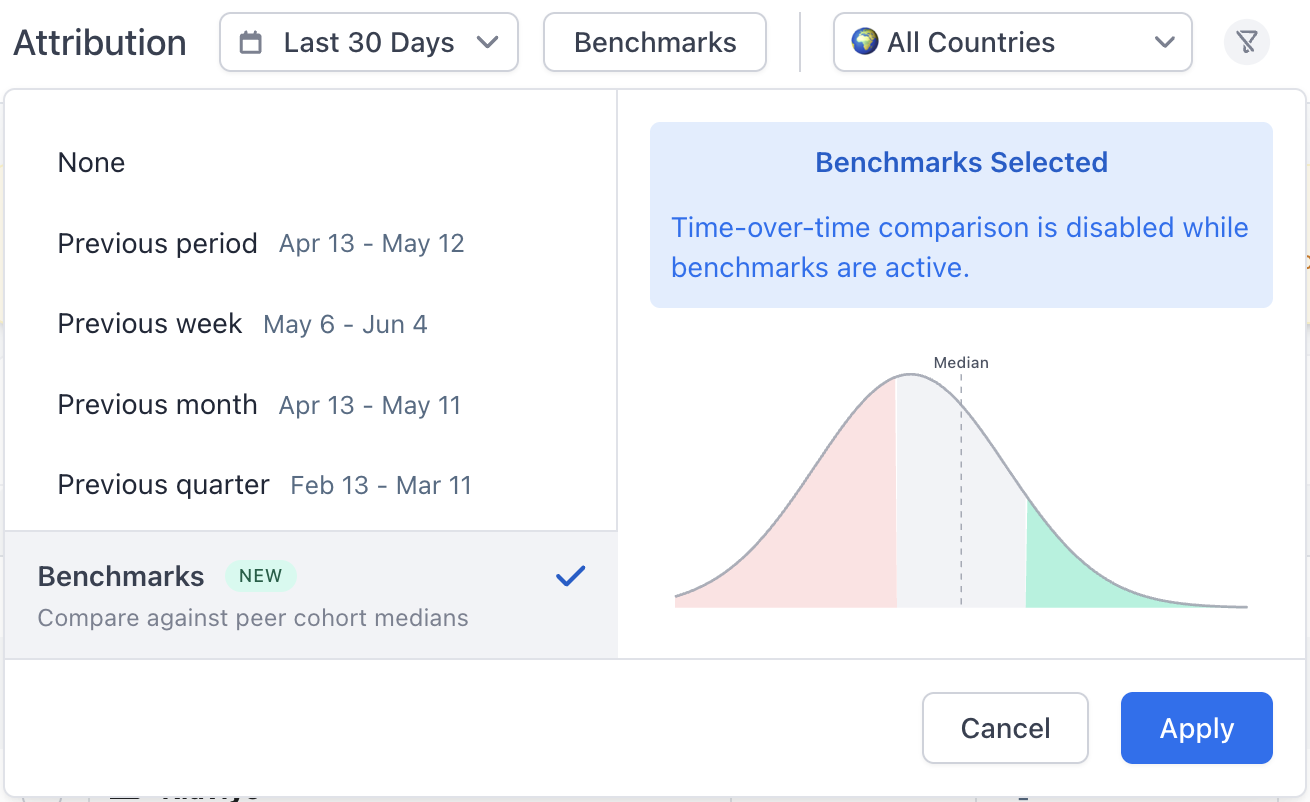
Ads Benchmarks is a new feature inside Triple Whale Attribution that compares your channel performance against a dynamic peer group of ecommerce brands that operate like yours — not generic industry averages.
It surfaces real-time benchmarks directly in your Attribution page across the metrics that shape spend decisions, such as:
Blended ROAS
Blended CPA
CPM
Average CTR
New Customer %
AOV
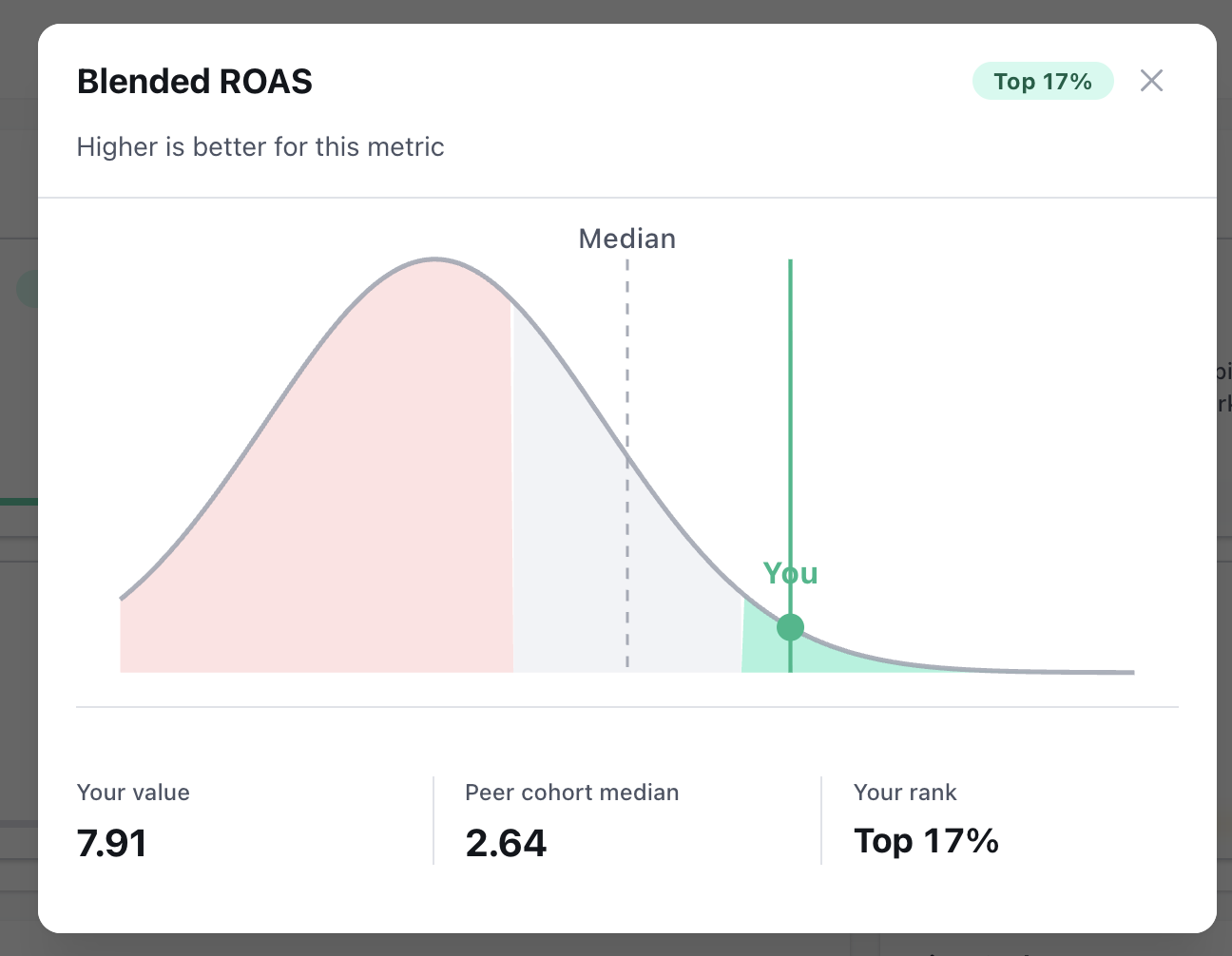
For each metric, you can see whether you're in the top 25%, at median, or in the bottom 25% for your peer group — across Meta, Google, TikTok, and more.
This only works because of the scale and structure behind Triple Whale’s data.
60,000 brands worth of data
Every benchmark is an anonymized, cross-brand median computed from a dataset of 60,000+ ecommerce brands connected to Triple Whale.
The raw data is structured at a granular level — one row per shop, per day, per channel — which allows us to normalize performance across channels and time, then group brands into cohorts.
Brands are matched using signals like industry, revenue band, AOV, and ad channel mix. All monetary values are normalized to USD before aggregation so comparisons hold across markets.
Medians, not averages
Ecommerce performance is highly skewed. A small number of extreme performers can distort averages and create misleading "typical" benchmarks.
The median reflects the actual middle of the market — half of similar brands perform above it, half below. Percentile bands let you see the full distribution, not just a single point of comparison.
Privacy at every layer
No individual store or brand is ever exposed. Only aggregated, cohort-level statistics are surfaced. A strict minimum cohort size is applied before any benchmark appears. If a cohort is too small, it rolls up to a broader group rather than risk surfacing identifiable data.
What can I see with Ad Benchmarks?
Attribution tells you what happened. Benchmarks tell you how it compares. Here's what that looks like in practice:
See where you rank
For every key metric — Blended ROAS, CPA, CPM, CTR, New Customer %, and AOV — you'll see a direct % number that showcases where you stack up within your peer group. Not a vague "industry average."
Compare across channels
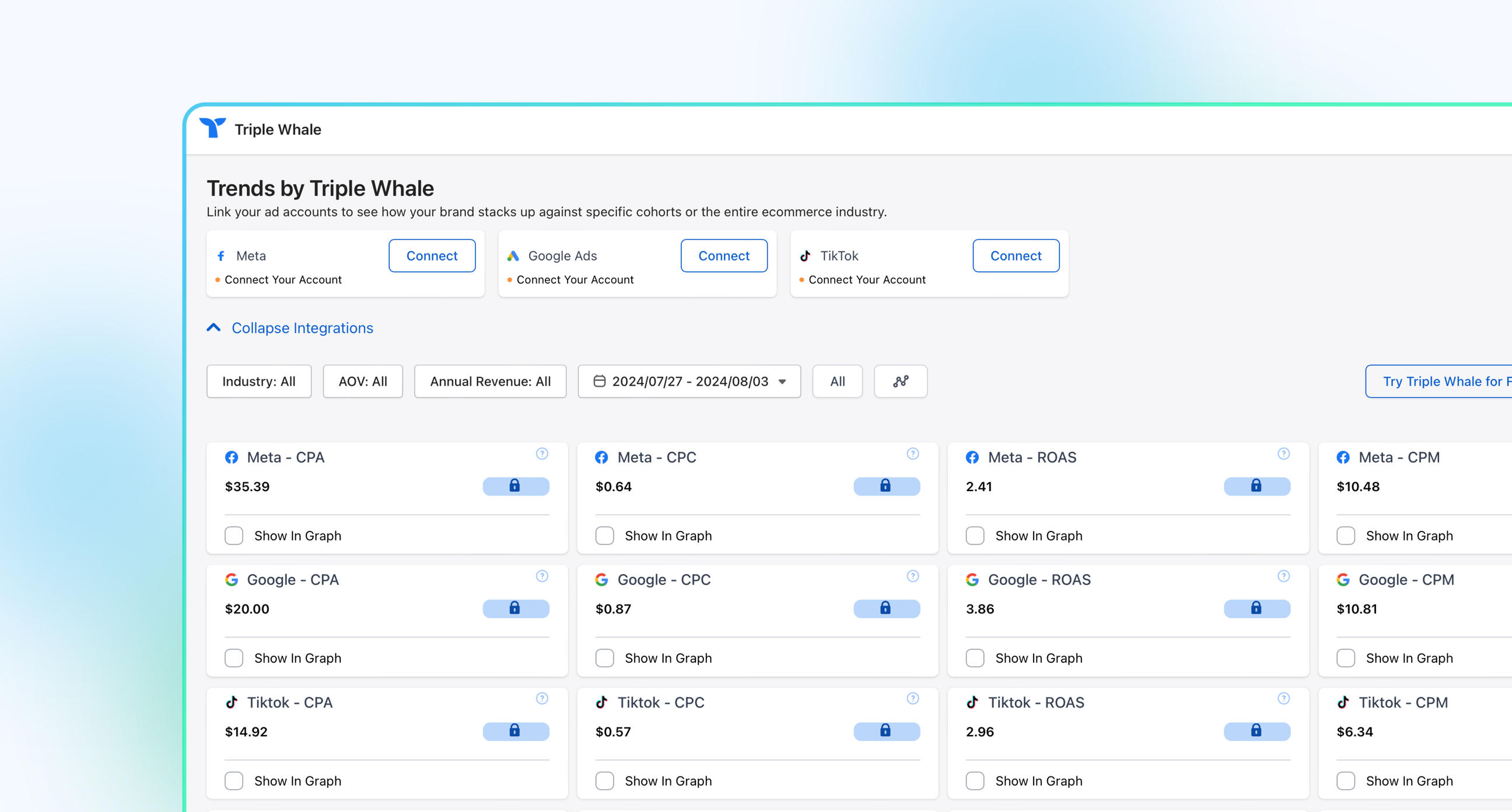
Benchmarks surface across Meta, Google, TikTok, and more — so you can spot where you're outperforming on one channel and underperforming on another, and prioritize accordingly.
Know what deserves attention
When a metric dips, it's not always a problem. Benchmarks give you the context to tell the difference between a real gap and normal variance for brands like yours.
Stop second-guessing
Ads Benchmarks helps answer the questions that shape spend decisions, like:
Is our ROAS actually strong for a brand like ours?
Are our CPMs or CTRs competitive by channel?
Are we outperforming brands with similar products, scale, and channel mix?
Where are we leading, and where are we falling behind?
Which metrics deserve a closer look before we scale, hold, or optimize?
How to Get Started
Already a Triple Whale customer on the Automate plan?
Ads Benchmarks is available now, directly inside your Attribution page. Head to your attribution dashboard to explore your benchmarks.
On a Foundation or legacy plan?
Ads Benchmarks is available on the Automate plan. Talk to your CSM to learn how to unlock it.
Not a Triple Whale customer yet?
Start with the free tool. Enter your industry, revenue range, and AOV to get an instant performance baseline against your industry peers — no account required.
You open your attribution dashboard and see a 3.2x ROAS. Strong — but is it actually good for a brand like yours? A 3x ROAS can be top-tier in one category and below average in another.
Without context, performance data is hard to act on. Ads Benchmarks gives you that context — right inside Triple Whale Attribution.
What is Ads Benchmarks?
Ads Benchmarks is a new feature inside Triple Whale Attribution that compares your channel performance against a dynamic peer group of ecommerce brands that operate like yours — not generic industry averages.
It surfaces real-time benchmarks directly in your Attribution page across the metrics that shape spend decisions, such as:
Blended ROAS
Blended CPA
CPM
Average CTR
New Customer %
AOV
For each metric, you can see whether you're in the top 25%, at median, or in the bottom 25% for your peer group — across Meta, Google, TikTok, and more.
This only works because of the scale and structure behind Triple Whale’s data.
60,000 brands worth of data
Every benchmark is an anonymized, cross-brand median computed from a dataset of 60,000+ ecommerce brands connected to Triple Whale.
The raw data is structured at a granular level — one row per shop, per day, per channel — which allows us to normalize performance across channels and time, then group brands into cohorts.
Brands are matched using signals like industry, revenue band, AOV, and ad channel mix. All monetary values are normalized to USD before aggregation so comparisons hold across markets.
Medians, not averages
Ecommerce performance is highly skewed. A small number of extreme performers can distort averages and create misleading "typical" benchmarks.
The median reflects the actual middle of the market — half of similar brands perform above it, half below. Percentile bands let you see the full distribution, not just a single point of comparison.
Privacy at every layer
No individual store or brand is ever exposed. Only aggregated, cohort-level statistics are surfaced. A strict minimum cohort size is applied before any benchmark appears. If a cohort is too small, it rolls up to a broader group rather than risk surfacing identifiable data.
What can I see with Ad Benchmarks?
Attribution tells you what happened. Benchmarks tell you how it compares. Here's what that looks like in practice:
See where you rank
For every key metric — Blended ROAS, CPA, CPM, CTR, New Customer %, and AOV — you'll see a direct % number that showcases where you stack up within your peer group. Not a vague "industry average."
Compare across channels
Benchmarks surface across Meta, Google, TikTok, and more — so you can spot where you're outperforming on one channel and underperforming on another, and prioritize accordingly.
Know what deserves attention
When a metric dips, it's not always a problem. Benchmarks give you the context to tell the difference between a real gap and normal variance for brands like yours.
Stop second-guessing
Ads Benchmarks helps answer the questions that shape spend decisions, like:
Is our ROAS actually strong for a brand like ours?
Are our CPMs or CTRs competitive by channel?
Are we outperforming brands with similar products, scale, and channel mix?
Where are we leading, and where are we falling behind?
Which metrics deserve a closer look before we scale, hold, or optimize?
How to Get Started
Already a Triple Whale customer on the Automate plan?
Ads Benchmarks is available now, directly inside your Attribution page. Head to your attribution dashboard to explore your benchmarks.
On a Foundation or legacy plan?
Ads Benchmarks is available on the Automate plan. Talk to your CSM to learn how to unlock it.
Not a Triple Whale customer yet?
Start with the free tool. Enter your industry, revenue range, and AOV to get an instant performance baseline against your industry peers — no account required.
Indera Sahadeo is a product marketing manager at Triple Whale, where she helps ecommerce brands turn performance data into smarter growth decisions. She’s passionate about connecting product innovation to the real-world challenges marketers face running DTC brands. Indera specializes in translating complex insights into clear, practical applications teams can confidently act on. She closely studies how the ecommerce landscape is evolving, and what smarter measurement means for brands building lasting competitive advantage.
Body Copy: The following benchmarks compare advertising metrics from April 1-17 to the previous period. Considering President Trump first unveiled his tariffs on April 2, the timing corresponds with potential changes in advertising behavior among ecommerce brands (though it isn’t necessarily correlated).


 Moby AIAsk questions, analyze performance, and work with your business context.
 ActionsTake governed action across the tools that run your business.
 AutomationsSchedule recurring analysis and work that runs on your terms.
 Landing PagesCreative conversion-focused ecommerce pages with Moby.
 Creative StudioGenerate and refine creative grounded in your brand.


.png)










.webp)

.webp)
