Brand visibility in AI-generated answers is the new SEO battleground. As search shifts from blue links to chatbots, knowing how to show up has never been more critical.
In this guide, we break down everything you need to know about AI SEO for ecommerce — from terminology to query tracking and more — so you can future-proof your storefront in the AI-driven search era.
Key takeaways
- The terminology is still unsettled; you'll see it called AEO, GEO, LLMO, and more. At Triple Whale, we use AEO (AI Engine Optimization) as our umbrella term.
- AI SEO is three layers working together: 1) technical infrastructure that lets AI systems read your site, 2) content that's worth citing, and 3) off-site authority that helps AI see you as trustworthy.
- Standard analytic tools to track AI SEO are limited. Triple Whale's AI Visibility tool is the only AI visibility solution built specifically for ecommerce — and it’s free to get started.
Ecommerce AI SEO: What it Looks Like in 2026
ChatGPT launched in late 2022, which means shopping using generative AI is still in its infancy — and so is the practice of optimizing for it, among other large language models (LLMs).
Before diving in, it's worth drawing a clear line between the action and the methodology of ecommerce AI.
AI search is what your customers are doing. It refers to search-powered LLMs and machine learning. This technology interprets shopping queries and returns direct, synthesized answers rather than a list of links.
Ecommerce AI SEO is how you respond to that shift as a brand. It's the methodology of optimizing your visibility inside those AI-generated responses, recommendations, and shopping results.
What’s the Correct Word for Ecommerce AI SEO Optimization?
There's no settled playbook yet, and that's reflected in the terminology itself. You'll see it called AEO (Answer Engine Optimization), GEO (Generative Engine Optimization), or simply AI SEO depending on who you ask.
While they may be interchangeable, the subtle differences are important. A brand optimizing for Google AI Overviews is doing something meaningfully different than a brand optimizing for ChatGPT product recommendations, for example.
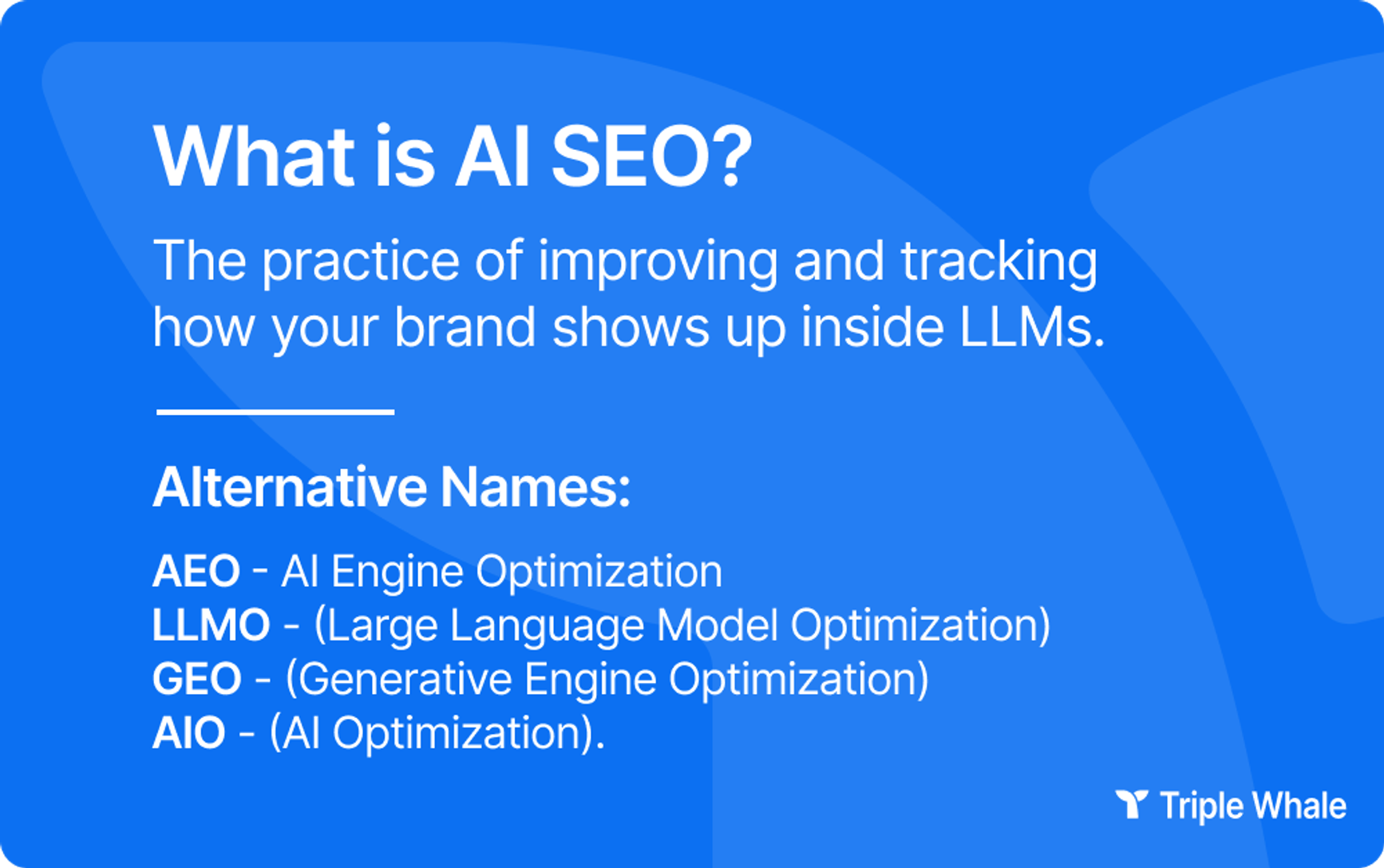
AI SEO Terminology
AEO (AI Engine Optimization)
This is the practice of improving and tracking how your brand appears in LLMs. You'll also see it used as Answer Engine Optimization — the practice of optimizing content for featured snippets and AI-generated answers.
GEO (Generative Engine Optimization)
This largely overlaps with AEO. It’s the practice of tailoring digital content to be understood, cited, and used by AI-powered search engines.
LLMO (Large Language Model Optimization)
This is the most technically precise term, yet the least used. It’s largely the same as GEO and AEO.
AIO (AI Overviews)
This is slightly different. AI Overviews are the AI-generated summaries Google displays at the top of search results. Optimizing for AIO is one specific application within the broader AEO/GEO/LLMO umbrella.
For some, AIO can also stand for AI Optimization, or AI SEO. This would have a similar if not identical definition to Generative Engine Optimization and AI Engine Optimization.
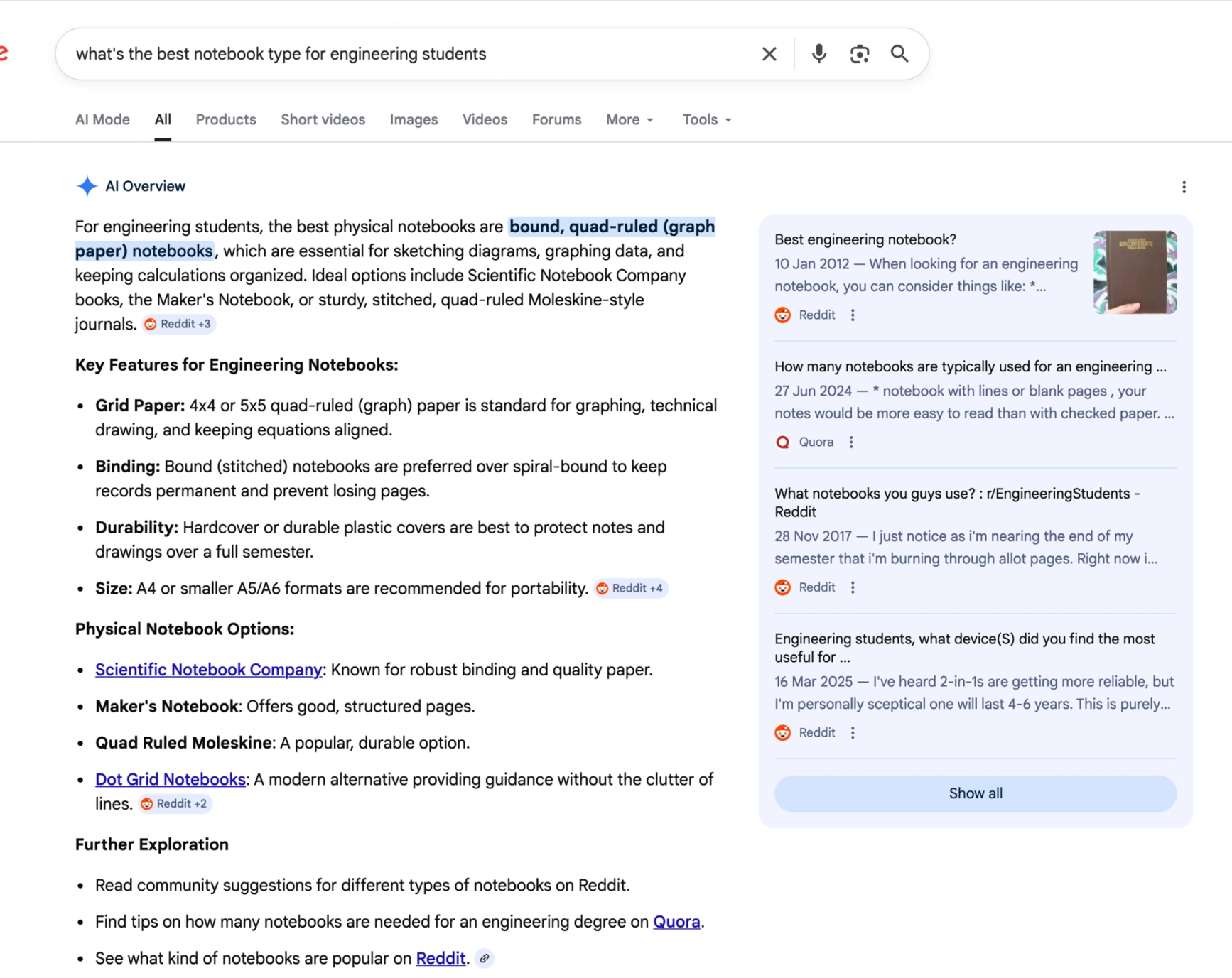
At Triple Whale, we lead with AEO — AI Engine Optimization — as our umbrella term. This all lives under a single north star: AI Visibility. AI Visibility has two dimensions:
- Tracking: It means observing and monitoring how AI systems talk about your brand today — what they say, where they surface you, and how accurately they represent you.
- Influencing: This is the action of AEO/GEO. It's the active practice of shaping how your brand is described, recommended, and cited tomorrow.
How Does AI Search Differ from Traditional Keyword-based SEO?
For almost two decades, the digital path to purchase has been quite structured: You type what you’re looking for into a search bar and you browse the websites until you discover the product you want.
AI in ecommerce has made it so shoppers can skip the link-hopping and go straight into seeing top product picks.
For shoppers, this feels like a convenience upgrade. For brands and retailers, it's a shift in how your products get discovered through keywords.
When search engines rewarded brevity, shoppers learned to type in fragments — "best blender," "cheap running shoes," "waterproof jacket women."
AI now intermediates the buying journey. These systems can understand context and generate a direct answer. This is known as “semantic search.”
Semantic search understands the meaning behind a query, not just the keywords. For example, "shoes for a beach wedding" returns sandals and strappy heels. This is the foundation most modern search runs on, including Google for years now.
Shoppers are now taking this further by ditching the keywords and writing the queries the way they actually think. This is called “conversational search.”
Conversational search is multi-turn, dialogue-based querying. The shopper refines their decision-making through follow-ups. For example, they may follow the query above with "show me something similar but cheaper" or "does it come in green?" Learn more about how ecommerce visibility works in AI platforms.
| Traditional Search (SEO) | AI Search (AEO) | |
|---|---|---|
| Query | Keyword — "noise cancelling headphones" | Conversational — "what are the best noise cancelling headphones for work?" |
| What | Ranked list of links | Synthesized answer |
| How | Shopper selects and visits pages | Shopper receives recommendations and follow-up queries |
| Relevance | Determined by SEO signals | Determined by intent and context |
With SEO, you could boost an article’s ranking through user-focused content, optimizing keywords, and updated information on your blog.
Unlike Google's algorithm, AI models don't rank pages. They synthesize information from training data and live retrieval, then generate answers.
Keywords still matter, and classic SEO practices are far from dead. But AI-powered shopping surfaces are becoming their own strategic priority.
How Do AI Search Systems Discover and Surface Ecommerce Products?
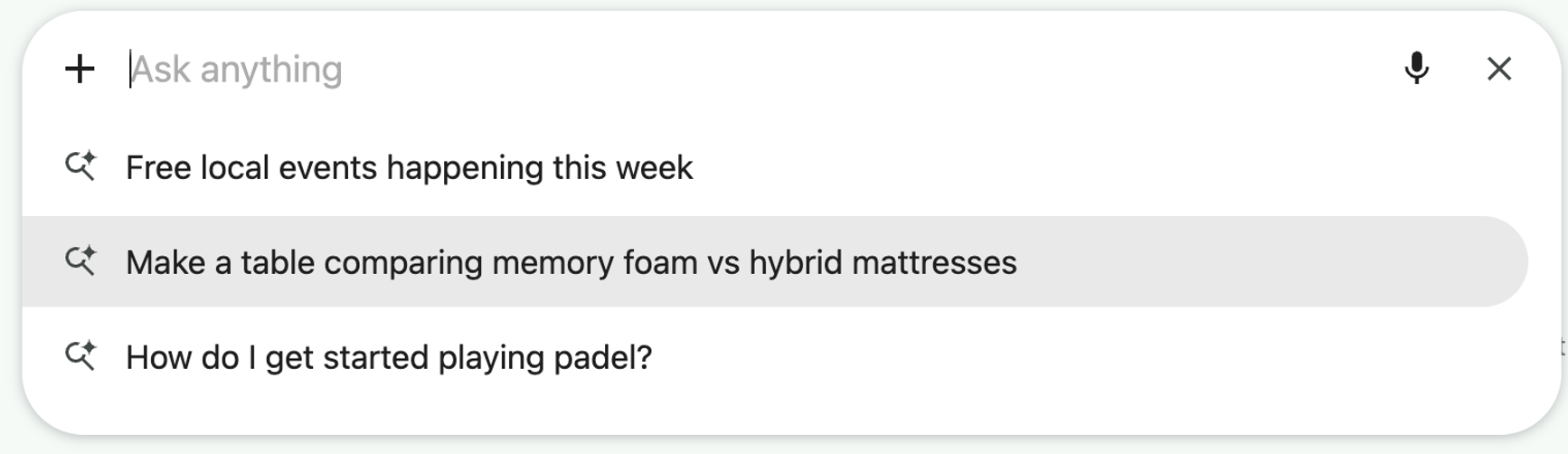
AI search systems read a question, draw on information from across the web, and produce a response: a product recommendation, a feature comparison, a summary of reviews, and more.
The Three Ways Ecommerce Brands Appear in AI Results
Type "waterproof hiking boots under $150" into a conventional search engine and you get a page of results that you then navigate yourself.
Ask the same question to an AI search tool and you're likely to receive a short list of specific boots, with reasons, sourced from product pages, editorial roundups, and customer reviews.
The three boots it may recommend likely come from three different source types simultaneously — one from a Merchant Center feed, one cited from a Wirecutter roundup, one surfaced because the brand has strong branded search volume and Reddit presence.
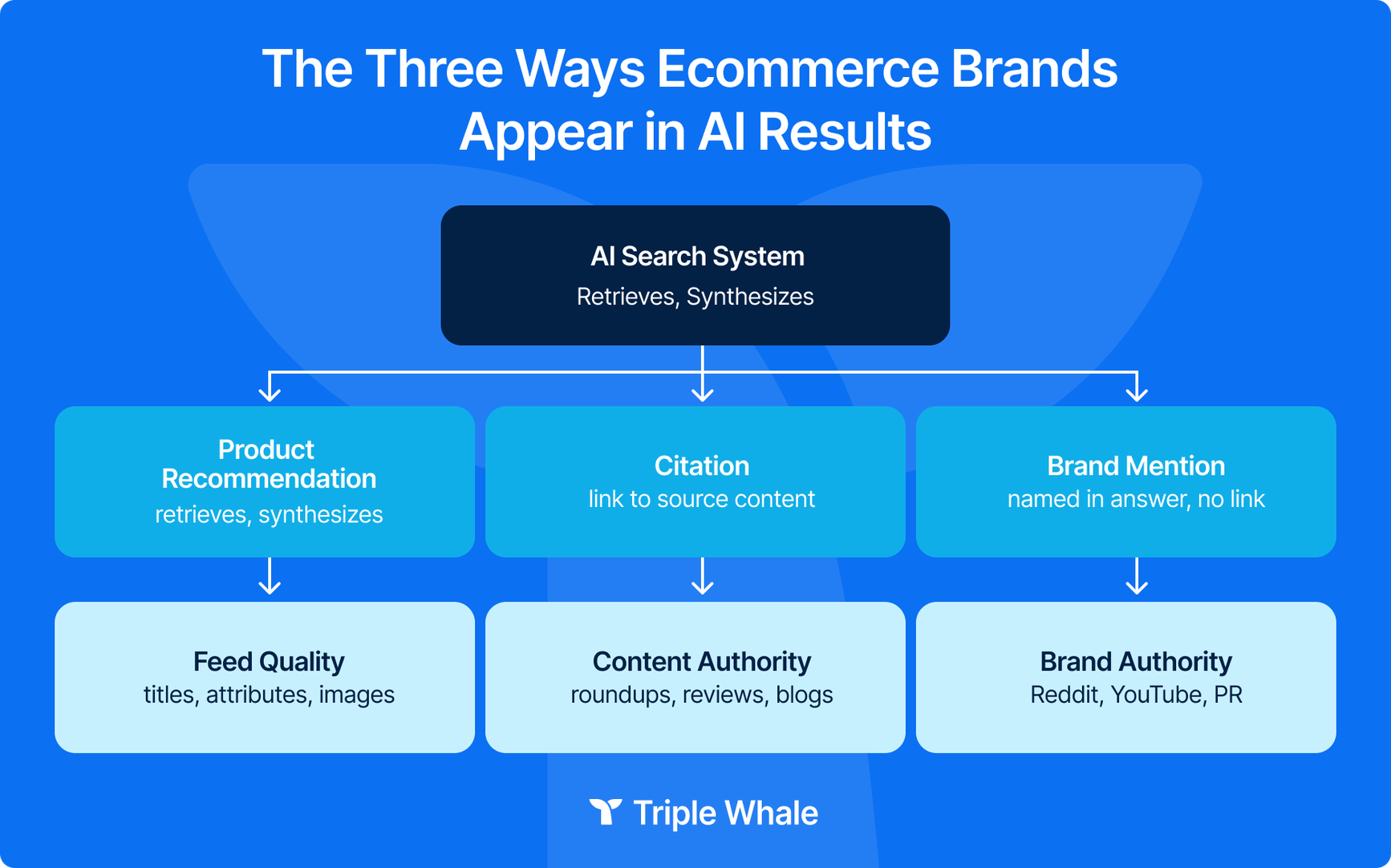
Let’s take a closer look at what this looks like for your ecommerce brand.
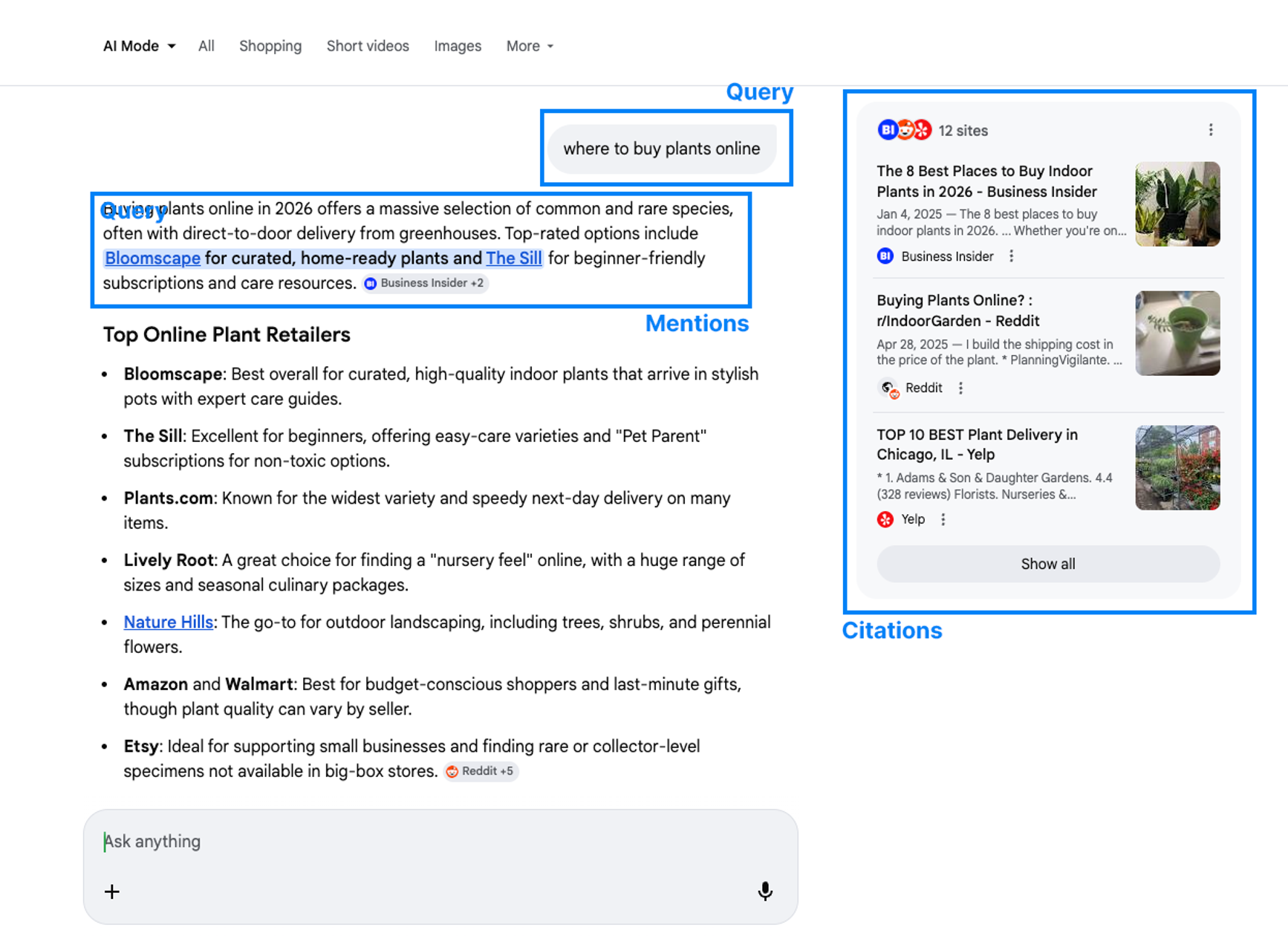
Mentions
These are the most direct forms of AI visibility. The AI names your brand in its response. If someone asks "what's the best email marketing tool for Shopify stores" and the AI responds with a list that includes your brand by name — that's a mention.
Citations
These are a step removed but equally powerful. This is when the AI doesn't just name your brand, but it links to or references a piece of content. These could be a blog post, a review on a third-party site, or a comparison article that features your product.
Product recommendations / Product mentions
The AI explicitly recommends a specific product to a user, often with a link to purchase.
| Traditional Search (SEO) | AI Search (AEO) | |
|---|---|---|
| Query | Keyword — "noise cancelling headphones" | Conversational — "what are the best noise cancelling headphones for work?" |
| What | Ranked list of links | Synthesized answer |
| How | Shopper selects and visits pages | Shopper receives recommendations and follow-up queries |
| Relevance | Determined by SEO signals | Determined by intent and context |
Which AI Platforms Matter Most for Ecommerce Brands?
For ecommerce brands, the ones that matter most are the ones your customers are already using to discover, research, and buy. Below we break down the key players by search capability, shopping intent, and where to focus your efforts first.
Search AI
Google Shopping and Amazon should be the foundation for almost every ecommerce brand. Google has reigned supreme over top-of-funnel shopping intent, while Amazon has reigned at the bottom-of-funnel. When it comes to ecommerce AI SEO, it’s easiest to start here.
| Reach | 8.5B searches/day |
| Product Feed Integration | Yes, Merchant Center |
| Ad Formats | PMax, PLAs |
Google AI Overviews now appear on a large share of commercial queries and frequently include shoppable product carousels sourced from Google Merchant Center.
| Amazon | |
|---|---|
| Reach | 2.7B monthly visits |
| Product Feed Integration | Native (Amazon catalog) |
| Ad Formats | Sponsored |
Rufus is Amazon's built-in AI shopping assistant, now rolling out broadly. It synthesizes product titles, bullet points, descriptions, A+ content, and customer reviews to answer shopper questions conversationally.
| Microsoft Copilot | |
|---|---|
| Reach | ~900M searches/day |
| Product Feed Integration | Yes, Merchant Center |
| Ad Formats | Smart Shopping, PLAs |
Copilot sits in a strong middle position — powered by the same LLM infrastructure as ChatGPT, but embedded directly into Bing's search engine and integrated with Microsoft's shopping tab.
LLMs and Conversational Assistants
Conversational assistants are quickly becoming the most prominent frontier of AI SEO — and the numbers are starting to reflect it.
According to Triple Whale data, AI-attributed orders still represent a small share of total attribution, but that share is moving fast: We've seen 59x growth in AI-attributed orders in 2025 versus 2024.
| Open AI ChatGPT | |
|---|---|
| Reach | 100M+ daily users |
| Product Feed Integration | No native feed |
| Ad Formats | No paid formats (yet) |
ChatGPT is the largest conversational AI surface by a wide margin. Brands can't buy their way in here; visibility comes from following AI SEO strategy for ecommerce brands.
| Perplexity | |
|---|---|
| Reach | 15M daily users |
| Product Feed Integration | Limited (beta) |
| Ad Formats | Sponsored answers |
Its user base is smaller, but skews heavily toward research-driven, high-intent shoppers. Its shopping cards surface products directly in answers, and its sponsored answers format offers one of the few direct paid visibility options in the conversational AI space.
Social Media
Meta, TikTok, and their peers are embedding AI deeper into search, recommendations, and product feeds, meaning the line between social browsing and intent-driven shopping is blurring fast.
| Meta AI | |
|---|---|
| Reach | 3.2B platform MAUs |
| Product Feed Integration | Yes, Meta Catalog |
| Ad Formats | Advantage+, Dynamic Ads |
With Facebook, Instagram, and WhatsApp, Meta AI is now embedded across all three, powering search, product discovery, and shopping recommendations. For ecommerce brands, the Meta Catalog remains the core feed input, and Advantage+ and Dynamic Ads are the most mature AI-driven ad formats in the social space.
| TikTok | |
|---|---|
| Reach | 1.6B platform MAUs |
| Product Feed Integration | Yes, TikTok Catalog |
| Ad Formats | Smart+, GMV Max, TopView |
According to TikTok, one out of four of its users search for something within the first 30 seconds of opening the app. The platform recently launched an AI-powered Search Center within TikTok Ads Manager Marketing Dive to make buying search ads easier.
How the Buyer Journey Changes in AI search
AI search changes the customer journey because it compresses the traditional multi-touchpoint funnel.
A shopper who previously visited a brand's blog, a review site, and a product page before buying may now receive a single AI-generated recommendation that collapses all three into one response.
For marketers, this is known as “zero-click” search. Many shoppers are getting the information they need without ever clicking onto your site. Or, they may be shortening their journey and making a decision quicker.
This compression means brands have fewer opportunities to influence a purchase decision, which raises the stakes for appearing in that single AI response rather than somewhere in a longer organic journey.
The Three Pillars of Ecommerce AI SEO
Optimizing for AI-driven search comes down to three things: Making sure AI systems can read your site (infrastructure), giving them something worth citing (content), and building the off-site signals that make your brand a trusted source (off-site content).
Pillar 1: Infrastructure (So LLMs Can Read Your Website)
Your website infrastructure needs to be structured, machine-readable, and API-ready. Yet, JavaScript-heavy pages may be silently blocking the bots that index and surface your content.
Agentic Readiness
There are three common sources to check:
- Your robots.txt file: Directives in this file instruct crawlers which pages or directories they are permitted to access.
- Content Delivery Network (CDN): Many CDN providers include bot-blocking or traffic-filtering rules by default.
- Your web application firewall (WAF): WAF rules that block suspicious or automated user agents may also block the search and AI bots you actually want on your site.
Technical Foundation
Your site's technical health is the bedrock of whether search and AI bots can discover, understand, and cite your content.
The four core areas to address are:
- Internal errors: Broken links, redirect chains, and server errors create dead ends for crawlers.
- Duplication errors: When the same content exists at multiple URLs, bots struggle to determine which version to index.
- Missing metadata: Page titles and meta descriptions should be unique, descriptive, and present on every indexable page.
- Page speed and Core Web Vitals: Google's Core Web Vitals — Largest Contentful Paint, Cumulative Layout Shift, and Interaction to Next Paint — are established ranking signals.
Data Integrity
Schema markup is the language LLMs and search bots read. Deploying it consistently across all page types reduces your reliance on crawlable URLs and gives bots a direct, structured feed of your content.
Focus on these schema types for ecommerce GEO visibility:
- All page types: Category pages, editorial content, FAQs, and homepages all benefit from relevant schema types.
- Product feeds: A complete product feed is a more reliable signal than a partial one. Every unfilled attribute — size, material, availability, pricing — is a gap to be filled.
- PDP footprint: A single canonical PDP with schema markup can surface variant options — colours, sizes, configurations — directly to bots without requiring additional pages.
Pillar 2: On-Site Optimization
LLMs reward current, authoritative, and well-structured content. Much like with SEO, you need to optimize on-site content in a specific way.
Optimize for Conversational Search
As mentioned earlier, “conversational search” is the longer-tail keyword, multi-turn querying.
For example, instead of typing “noise cancelling headphones,” a shopper would query “what are the best noise cancelling headphones I can use at work?”
They may also follow the query above with "show me something similar but cheaper" or "does it come in white?"
To bolster the multi-turn queries, you can also optimize your product descriptions to address these questions. Think of bottom-funnel questions here, such as "Is this pan oven-safe?" or "What size should I order?" rather than as keyword-stuffed marketing copy.
Write for Chunk Retrieval
Every discrete section of your page should be able to exist independently, make complete sense out of context, and directly answer a specific question.
- Clear, descriptive headers: A section heading that tells bots and users exactly what the section answers is far more likely to be matched, extracted, and surfaced in an AI response.
- A key takeaway at the top: Leading with the answer, then supporting it, makes the most important information immediately retrievable without parsing the full section.
- Questions as subheads: Framing subheadings as the actual questions your audience asks directly mirrors how prompts are written.
- Bullets, tables, and repeatable formatting: Structured formatting creates predictable, parseable content. Dense prose is harder to chunk cleanly.
Pillar 3: Off-site Authority and Citation Signals
AI aggregates signals from everywhere: your site, ads, Amazon listings, reviews, social posts, press mentions. It’s earned across your entire digital footprint.
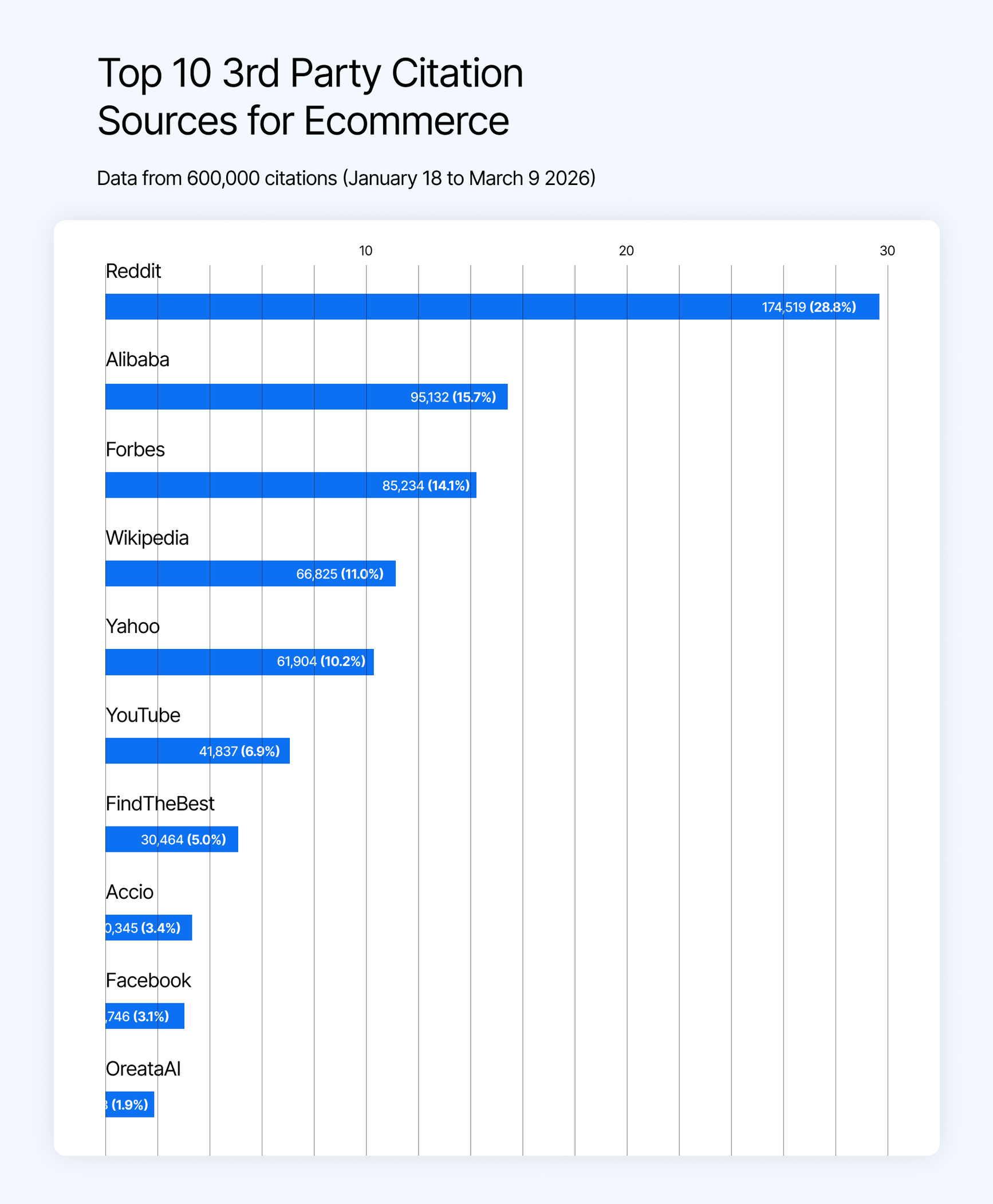
Start Social Monitoring (to Get Mentioned in Online Platforms)
Social listening is how you monitor, understand, and influence that signal before it hardens. YouTube, Reddit, and Wikipedia often carry the most influence, but you can also refer to our proprietary data in the image above.
- Join communities: Wherever you’ve found your category is actively discussed.
- Monitor conversations: Identify and follow key threads or keywords so you can track discussions and common questions.
- Participate authentically: Answer questions and share helpful insights without promoting your brand directly.
Earn Publisher and Affiliate Features
Getting featured in publisher listicles and affiliate comparison posts is one of the highest-leverage AI SEO tactics for ecommerce brands. Build your PR, content placement, and social platform wish list around them. Then, create an outreach plan.
Types of placements:
- Earned media and PR: Pitched stories, data, and expert commentary to the publications your AI visibility audit identified.
- Thought leadership: Long-form articles and interviews positioning a founder or your brand's subject matter experts.
- Expert attribution: No matter where you’re published, bylined pieces and attributed quotes create named, structured associations between your expertise and your brand.
How to Measure AI Visibility
Using a spreadsheet or document of your choice, you can manually prompt ChatGPT, Perplexity, and Google with purchase-intent queries in your category.
- Build a Prompt Library
Start by collecting the exact queries your customers are typing into AI platforms — product questions, category searches, comparison prompts. This becomes the foundation for everything that follows.
- Start Manual Tracking
Run your prompt library through the AI platforms that matter most to your brand and record what comes back. Note when your brand appears, how it's described, and when competitors show up instead.
- Calculate Your Score
Turn your tracking into a single benchmark — a snapshot of where your AI visibility stands today. This is your baseline, the number you'll work to move as your AEO strategy matures.
Challenges with Manually Tracking AI Visibility
With zero-click search, no click means no session, no pixel, no conversion event. The value of that exposure is real but largely invisible to standard measurement tools.
These blind spots compound once you realize this also means:
- Can't connect visibility to revenue: Existing AEO tools track mentions but can't tie improvements to actual sales.
- No visibility into competitors: Brands don't know which competitors are getting cited in AI responses or why.
- No way to track progress: Without daily tracking, there's no way to know if your content efforts are moving the needle.
Better Ways to Track Your AI Visibility
The tool landscape is sparse, but growing fast. Here are some ways to keep track of your keywords for AI mentions in ecommerce SEO.
Triple Whale
Triple Whale is the go-to for ecommerce brands that want to connect AI visibility to actual revenue. Its AI Attribution tracks when platforms like ChatGPT drive traffic and orders to your store — so you're not just monitoring mentions, you're measuring impact.
It also resolves all current AI SEO challenges by:
- Trusted Attribution: Triple Whale shows you which sales are attributed to AI suggestions.
- Competitor tracking: Triple Whale shows you exactly who's winning and the sources AI is pulling from.
- Progress tracking: Triple Whale tracks mentions, citations, and sentiment over time so you can measure improvement.
Triple Whale's AEO tracking is built into the same platform where you measure the rest of your business performance, so you can connect AI visibility to real revenue. Get started for free here.
Semrush and Ahrefs
The stars of traditional SEO are both adding AI visibility features, making them a natural starting point for brands already using them for keyword and backlink tracking.
Ready to Be Successful in AI SEO for Ecommerce?
AI SEO for ecommerce is still early, but it’s moving fast. While the playbook is still being written, we’re already seeing forward-thinking brands break through and grow their visibility in AI-driven search experiences.
“LLMs are fundamentally changing commerce, ushering in a new era of agentic shopping and discovery where intent, context, and relevance matter more than ever. Triple Whale has been a trusted partner as we’ve navigated many chapters of our DTC growth, and this is a natural next step in what we can build together as we lean into their AEO solutions and define what the next generation of discovery looks like for RMS Beauty." — Alejandra Tenorio, Vice President, Digital Marketing and eCommerce
If you want to understand how your products show up in AI search — and tie that visibility directly to revenue — you need the right infrastructure in place.
Triple Whale brings AEO tracking into the same platform you already use to measure performance, so you can see what’s working, double down faster, and stay ahead as this channel evolves. Get started for free.
FAQs
What is ecommerce AI SEO and how is it different from traditional SEO?
Traditional SEO is about ranking at the top of Google’s search page. Ecommerce AI SEO is about being referenced — where AI models recommend, cite, or surface your brand when generating an answer.
Which AI platforms should ecommerce brands prioritize for visibility?
Consider starting with Google and Amazon’s newer AI features. Most brands with strong content should invest in ChatGPT and consider one other LLM in the future for visibility tracking purposes. For social-first brands, Meta AI and TikTok's AI-powered shopping features would make a great priority.
What tools are available to track AI visibility for ecommerce brands?
Triple Whale’s AI Visibility is the only free AI visibility tool built for ecommerce. It gives you clarity on how your brand appears in AI-generated answers across all major LLMs and search engines.