Blog
How to Use the CPA Formula to Measure and Improve Campaign Efficiency

How to Use the CPA Formula to Measure and Improve Campaign Efficiency

By 

Every marketer and business owner eventually lands on the same question: how much does it actually cost to acquire one customer?

That’s what cost per acquisition (CPA) measures. It’s one of the most direct indicators of marketing efficiency, and getting the calculation right is the first step toward understanding whether your campaigns are pulling their weight.

This article walks through the CPA formula step by step. You’ll learn how to calculate CPA, how to interpret the result, and how CPA fits alongside related metrics like CLV, customer acquisition cost (CAC), and return on ad spend (ROAS)

What is cost per acquisition (CPA)?

Cost per acquisition is the amount of money you spend to acquire a single new customer or lead through a specific campaign or channel. It’s a campaign-level or channel-level metric, and it’s one of the most commonly tracked key performance indicators (KPIs) in digital marketing performance reporting. 

CPA is sometimes confused with CAC, but they’re not the same thing. CPA typically measures the cost of a specific conversion event within a single campaign or acquisition channel. CAC is broader: it accounts for all marketing and sales costs across the entire business over a given period. For a deeper breakdown of how these two metrics differ, check out our guide on the difference between CPA and CAC. 

What is the CPA formula?

Well, there are two CPA formula variants, and each one has a specific use case. Let’s break them both down.

Standard CPA formula
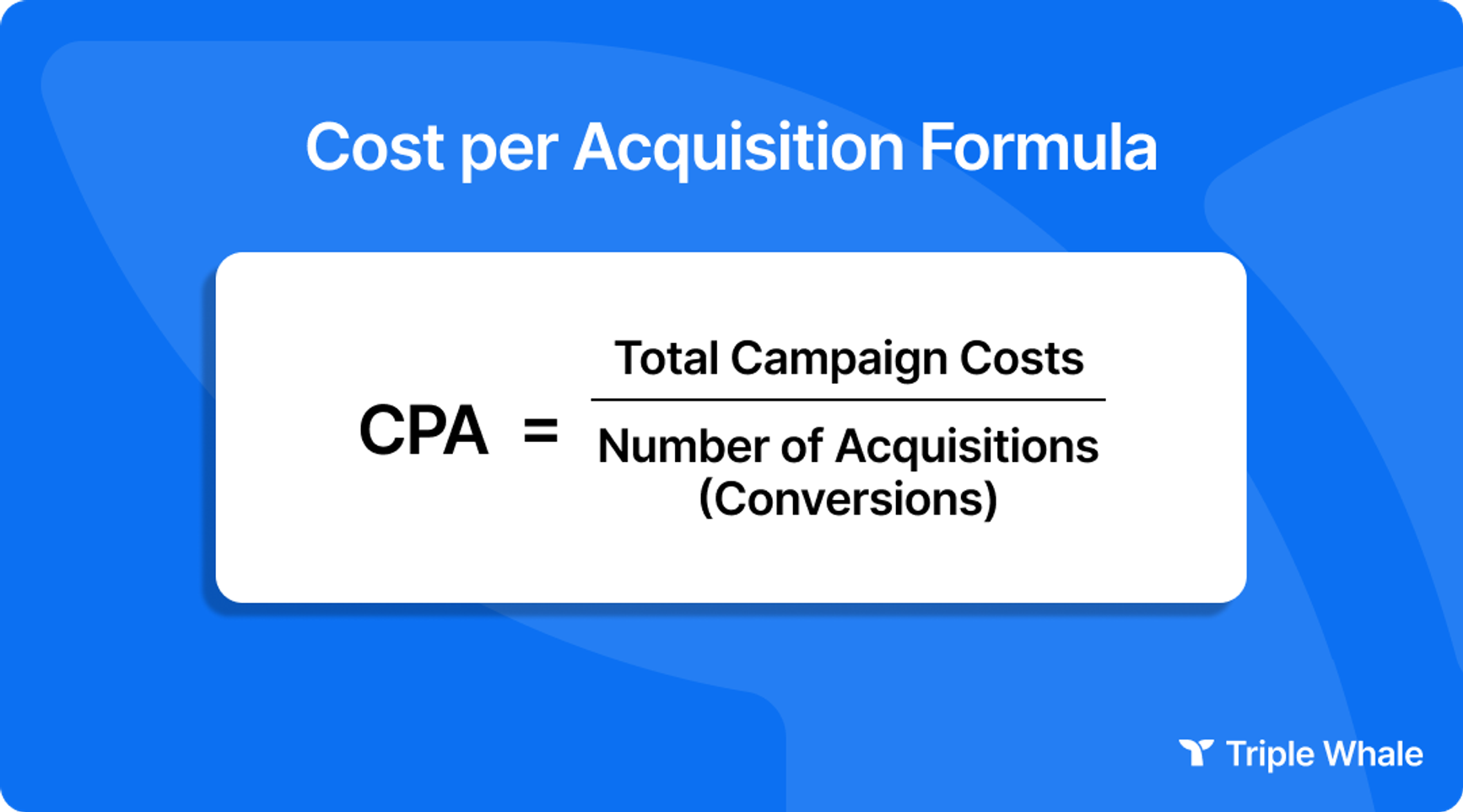
This is the cost per acquisition formula most marketers default to because it gives you a direct, real-world measure of what you paid for each new customer.

What to include in “total campaign cost”:

  • Media spend. The dollars you put into the ad platform (Google Ads, Meta, TikTok, etc.).
  • Agency fees. If you’re working with an agency to monitor the campaign.
  • Creative production costs. Design, video, and copywriting for the campaign’s ad assets.
  • Allocated marketing salaries. The portion of your team’s time dedicated to the campaign.
  • Sales commissions. If your acquisition effort includes a sales component. 

What to exclude:

  • Costs associated with serving existing customers
  • Customer service expenses
  • General overhead not directly tied to the customer acquisition campaign

Including those inflates your CPA and makes it an unreliable measure of acquisition efficiency.

One more thing: “new customers acquired” should reflect only net-new customers or leads generated during the measurement period. Repeat purchasers or existing contacts re-engaged through the campaign don’t count here. 

Alternate CPA formula

CPA = Cost Per Click (CPC) ÷ Conversion Rate

This CPA equation is useful when you already have CPC and conversion rate data available from a platform like Google Ads or Meta Ads Manager and want to estimate or project CPA without aggregating total campaign costs from scratch. 

Example: If your CPC is $2.50 and your landing page conversion rate is 5%, your CPA = $2.50 ÷ 0.05 = $50. 

This formula also makes it easy to model how changes to CPC or conversion rate will affect CPA. If you can improve your conversion rate from 5% to 6% while keeping CPC flat, your CPA drops from $50 to about $41.67. That kind of forecasting is valuable for optimization planning and budget conversations. 

How to calculate CPA step by step

The CPA calculation formula is straightforward, but getting an accurate result depends on being rigorous about your inputs. Here’s the process:

Step 1: Define the campaign and time period

Pick the specific campaign (or channel) and the date range you want to evaluate. Whether it’s a 30-day paid social campaign, a quarterly Google Ads push, or a product launch, define the boundaries clearly before you start pulling numbers.

Step 2: Identify and sum all relevant campaign costs

List every cost directly attributable to the campaign. This includes media spend, creative production, agency fees, and any allocated salaries or commissions. Add them up to get your total campaign cost. 

Step 3: Count new customers or leads acquired

Pull the number of net-new customers or qualified leads generated by the campaign during the defined period. Make sure you’re not double-counting existing customers who came back through the campaign.

Step 4: Apply the formula

Divide total campaign cost by new customers acquired. That’s your CPA!

Step 5: Sanity-check the result

Does the number make sense? Compare it to your previous campaigns, your CLV, and your margin. If the CPA seems unusually high or low, go back and check your cost inputs and conversion count. A mistake in either one throws the whole calculation off. 

A worked example: Calculating CPA with real numbers 

Let’s walk through a realistic scenario. Say you run a DTC skincare brand and you just wrapped a 30-day paid social campaign on Meta. 

Item Amount
Meta ad spend $8,000
Creative production (video + static) $1,500
Agency management fee $1,200
Allocated marketing team salary $800
Total campaign cost $11,500

During that 30-day window, the campaign generated 230 new customers. 

CPA = $11,500 ÷ 230 = $50.00

Now, is a $50 CPA good? It depends on context. 

If your average CLV is $180, a $50 CPA means you’re spending about 28% of lifetime value on acquisition (which is within healthy territory). If CLV is only $70, a $50 CPA is eating up more than 70% of customer value, and there’s almost no margin left after fulfillment and product costs. You’d need to either bring CPA down or improve retention to raise CLV. 

What your CPA actually tells you

Knowing how to calculate CPA is only half the job. The other half is knowing what to do with the number once you have it. 

What a rising CPA signals

A rising CPA means you’re spending more to acquire each customer. The two most common causes:

  1. Cost increased while conversions held flat. This often happens when CPCs rise due to increased auction competition — more advertisers bidding on the same audiences or keywords.
  2. Conversions declined while spend held flat. This usually points to creative fatigue, audience saturation, or a landing page issue that’s dragging down conversion rate. 

Diagnosing which cause is driving the increase determines the correct response. A cost problem calls for bid strategy or channel adjustments. A conversion problem calls for creative optimization, audience targeting refinement, or landing page testing. 

What a falling CPA signals

A falling CPA generally indicates improving efficiency. You’re getting more conversions per dollar spent. This is the expected outcome of optimization efforts like retargeting, creative testing, and audience refinement. 

On the other hand, a CPA that falls too low may signal that you’re under-investing in acquisition. You might be reaching only the easiest-to-convert audiences and leaving growth on the table. Efficiency and scale are often in tension. 

Why a very low CPA isn’t always a good sign

If CPA is extremely low, it may mean the campaign is only reaching high-intent, bottom-of-funnel audiences who would have converted anyway, not that the marketing is working efficiently at scale. 

Sustainable customer acquisition requires investing in audiences beyond the lowest-hanging fruit. That will naturally raise CPA somewhat, but it expands the customer base and supports long-term growth. Think of it as a tradeoff: a slightly higher CPA can be the price of scaling. 

CPA and customer lifetime value (LTV): The ratio that matters 

CPA in isolation doesn’t tell you whether your acquisition is sustainable. For that, you need to compare it to customer lifetime value. 

The rule of thumb: CPA should not exceed one-third of CLV.

If your CLV is $300, a CPA above $100 puts the unit economics of acquisition under pressure. The remaining two-thirds of CLV needs to cover cost of goods, fulfillment, customer service, and still contribute to profit margin. A CPA that eats more than one-third of CLV compresses margins to the point where growth becomes unprofitable. 

Worked example: If your brand’s average CLV is $450, the target CPA ceiling is $150. If your current CPA is $180, you’re either over-spending on acquisition or need to improve CLV through retention strategies. 

IF you’re not sure how to figure out your customer lifetime value, check out our guide on how to calculate CLV.

CPA industry benchmarks: How does your number compare?

Benchmarks vary significantly by industry, channel, and business model. The table below uses Triple Whale’s own aggregated data across thousands of ecommerce brands over the last 365 days, showing median CPA by industry vertical:

Industry Median CPA
Baby $26.96
Books & Music $26.46
Lifestyle & Boutique $27.75
Food & Beverage $29.33
Toys, Art, & Collectibles $29.94
Apparel & Accessories $31.17
Pets & Animals $31.21
Beauty $31.44
Media & Publishing $32.91
Automotive $33.85
Business Supplies & Equipment $34.46
Sports & Outdoors $35.75
Health & Wellness $36.36
Travel Accessories & Luggage $40.51
Home & Garden $41.04
Electronics $43.45
Medical Devices & Equipment $50.42

Keep in mind that the industry trends are directional reference points rather than targets. The most meaningful benchmark is your company’s own historical CPA trend. If your CPA is dramatically higher than industry norms, that may signal a problem, but optimization decisions should still be based on profitability metrics like LTV and margin, not benchmarks alone. 

CPA and ROAS: Two metrics that work together 

Return on ad spend (ROAS) measures how much revenue you generate for every dollar of ad spend. While CPA tells you what it cost to acquire a customer, ROAS tells you how much revenue that ad spend returned. 

The practical takeaway: use CPA to evaluate acquisition efficiency and ROAS to evaluate revenue return. Tracking both together gives a more complete picture of campaign performance than either metric alone. 

Limitations of CPA as a standalone metric

CPA is useful, but it’s incomplete. Here’s where the formula can mislead without additional context:

  • Customer quality differences. Two campaigns can have identical CPAs but produce customers with very different lifetime values, repeat purchase rates, or return behavior. A $40 CPA that brings in one-time buyers isn’t the same as a $40 CPA that brings in loyal repeat customers. 
  • CPA reflects past performance. It’s a lagging indicator — it shows what acquisition cost was during a specific campaign or time period, but it doesn’t predict future performance. 
  • Attribution limitations. CPA is usually calculated at the campaign or channel level. When customers interact with multiple touchpoints before converting, attribution models (such as last-click attribution) may assign all credit to the final channel, which can distort the true cost of acquisition. 

CPA is most useful when tracked as a part of a broader marketing dashboard that includes CLV, ROAS, customer acquisition cost (CAC), and marketing ROI — not as a standalone decision-making metric.

How to reduce CPA without sacrificing growth

Here are a handful of actionable strategies to bring CPA down while keeping your acquisition engine healthy:

  • Audience targeting refinement. Narrowing to high-intent segments or lookalike audiences based on existing customer data reduces wasted spend and improves conversion rates. 
  • Creative optimization. Testing ad creative (copy, imagery, offer framing) directly affects click-through and conversion rates, both of which drive CPA down via the CPC ÷ conversion rate formula.
  • Landing page optimization. Improving landing page relevance, load speed, and conversion rate lowers CPA without changing media spend.
  • Retargeting. Re-engaging users who’ve already shown intent (site visitors, cart abandoners) typically produces lower CPAs than cold prospecting campaigns.
  • Bid strategy and channel mix. Adjusting bidding strategies (like target CPA bidding in Google Ads) and reallocating budget toward lower-CPA channels improves blended acquisition efficiency. 

Final thoughts

The CPA formula is simple. The challenge is the inputs, the interpretation, and the context. Calculating CPA correctly means being precise about which costs to include, counting only net-new customers, and then using the result as one signal, alongside CLV, ROAS, and CAC, rather than the only signal. 

If you’re running paid acquisition at scale, having all of these metrics in a single dashboard with real-time data across every channel is what makes it easier to make decisions quickly and confidently. That’s what Triple Whale is built for.

FAQs

What is the CPA formula?

The standard CPA formula is Total Campaign Cost ÷ Number of New Customers Acquired. There’s also an alternative formula: CPC ÷ Conversion Rate, which is useful when you have platform-level data available. 

What is the difference between CPA and CAC?

CPA measures the cost to acquire a customer through a specific campaign or channel. CAC is a broader metric that accounts for all marketing and sales costs across the entire business. CPA is a campaign-level view; CAC is a company-level view.

What does it mean if my CPA is going up?

A rising CPA usually means either your costs increased (CPCs went up, competition increased) or your conversions declined (creative fatigue, audience saturation, landing page issues). Check both sides of the equation to diagnose the cause.

Can a CPA be too low?

Yes, a very low CPA can indicate that you’re only reaching bottom-of-funnel, high-intent audiences, which are people who would’ve converted regardless. That limits your growth. Sustainable acquisition often means accepting a slightly higher CPA to reach new audiences. 

How is CPA different from ROAS?

CPA measures the cost to acquire a customer. ROAS measures the revenue returned per dollar of ad spend. They answer different questions and are most useful when tracked together for a complete view of campaign efficiency and revenue performance. 
Component Sales
5.32K
Ecommerce Metrics
Ecommerce Strategies

How to Use the CPA Formula to Measure and Improve Campaign Efficiency

Last Updated: 
April 10, 2026

Every marketer and business owner eventually lands on the same question: how much does it actually cost to acquire one customer?

That’s what cost per acquisition (CPA) measures. It’s one of the most direct indicators of marketing efficiency, and getting the calculation right is the first step toward understanding whether your campaigns are pulling their weight.

This article walks through the CPA formula step by step. You’ll learn how to calculate CPA, how to interpret the result, and how CPA fits alongside related metrics like CLV, customer acquisition cost (CAC), and return on ad spend (ROAS)

What is cost per acquisition (CPA)?

Cost per acquisition is the amount of money you spend to acquire a single new customer or lead through a specific campaign or channel. It’s a campaign-level or channel-level metric, and it’s one of the most commonly tracked key performance indicators (KPIs) in digital marketing performance reporting. 

CPA is sometimes confused with CAC, but they’re not the same thing. CPA typically measures the cost of a specific conversion event within a single campaign or acquisition channel. CAC is broader: it accounts for all marketing and sales costs across the entire business over a given period. For a deeper breakdown of how these two metrics differ, check out our guide on the difference between CPA and CAC. 

What is the CPA formula?

Well, there are two CPA formula variants, and each one has a specific use case. Let’s break them both down.

Standard CPA formula

This is the cost per acquisition formula most marketers default to because it gives you a direct, real-world measure of what you paid for each new customer.

What to include in “total campaign cost”:

  • Media spend. The dollars you put into the ad platform (Google Ads, Meta, TikTok, etc.).
  • Agency fees. If you’re working with an agency to monitor the campaign.
  • Creative production costs. Design, video, and copywriting for the campaign’s ad assets.
  • Allocated marketing salaries. The portion of your team’s time dedicated to the campaign.
  • Sales commissions. If your acquisition effort includes a sales component. 

What to exclude:

  • Costs associated with serving existing customers
  • Customer service expenses
  • General overhead not directly tied to the customer acquisition campaign

Including those inflates your CPA and makes it an unreliable measure of acquisition efficiency.

One more thing: “new customers acquired” should reflect only net-new customers or leads generated during the measurement period. Repeat purchasers or existing contacts re-engaged through the campaign don’t count here. 

Alternate CPA formula

CPA = Cost Per Click (CPC) ÷ Conversion Rate

This CPA equation is useful when you already have CPC and conversion rate data available from a platform like Google Ads or Meta Ads Manager and want to estimate or project CPA without aggregating total campaign costs from scratch. 

Example: If your CPC is $2.50 and your landing page conversion rate is 5%, your CPA = $2.50 ÷ 0.05 = $50. 

This formula also makes it easy to model how changes to CPC or conversion rate will affect CPA. If you can improve your conversion rate from 5% to 6% while keeping CPC flat, your CPA drops from $50 to about $41.67. That kind of forecasting is valuable for optimization planning and budget conversations. 

How to calculate CPA step by step

The CPA calculation formula is straightforward, but getting an accurate result depends on being rigorous about your inputs. Here’s the process:

Step 1: Define the campaign and time period

Pick the specific campaign (or channel) and the date range you want to evaluate. Whether it’s a 30-day paid social campaign, a quarterly Google Ads push, or a product launch, define the boundaries clearly before you start pulling numbers.

Step 2: Identify and sum all relevant campaign costs

List every cost directly attributable to the campaign. This includes media spend, creative production, agency fees, and any allocated salaries or commissions. Add them up to get your total campaign cost. 

Step 3: Count new customers or leads acquired

Pull the number of net-new customers or qualified leads generated by the campaign during the defined period. Make sure you’re not double-counting existing customers who came back through the campaign.

Step 4: Apply the formula

Divide total campaign cost by new customers acquired. That’s your CPA!

Step 5: Sanity-check the result

Does the number make sense? Compare it to your previous campaigns, your CLV, and your margin. If the CPA seems unusually high or low, go back and check your cost inputs and conversion count. A mistake in either one throws the whole calculation off. 

A worked example: Calculating CPA with real numbers 

Let’s walk through a realistic scenario. Say you run a DTC skincare brand and you just wrapped a 30-day paid social campaign on Meta. 

Item Amount
Meta ad spend $8,000
Creative production (video + static) $1,500
Agency management fee $1,200
Allocated marketing team salary $800
Total campaign cost $11,500

During that 30-day window, the campaign generated 230 new customers. 

CPA = $11,500 ÷ 230 = $50.00

Now, is a $50 CPA good? It depends on context. 

If your average CLV is $180, a $50 CPA means you’re spending about 28% of lifetime value on acquisition (which is within healthy territory). If CLV is only $70, a $50 CPA is eating up more than 70% of customer value, and there’s almost no margin left after fulfillment and product costs. You’d need to either bring CPA down or improve retention to raise CLV. 

What your CPA actually tells you

Knowing how to calculate CPA is only half the job. The other half is knowing what to do with the number once you have it. 

What a rising CPA signals

A rising CPA means you’re spending more to acquire each customer. The two most common causes:

  1. Cost increased while conversions held flat. This often happens when CPCs rise due to increased auction competition — more advertisers bidding on the same audiences or keywords.
  2. Conversions declined while spend held flat. This usually points to creative fatigue, audience saturation, or a landing page issue that’s dragging down conversion rate. 

Diagnosing which cause is driving the increase determines the correct response. A cost problem calls for bid strategy or channel adjustments. A conversion problem calls for creative optimization, audience targeting refinement, or landing page testing. 

What a falling CPA signals

A falling CPA generally indicates improving efficiency. You’re getting more conversions per dollar spent. This is the expected outcome of optimization efforts like retargeting, creative testing, and audience refinement. 

On the other hand, a CPA that falls too low may signal that you’re under-investing in acquisition. You might be reaching only the easiest-to-convert audiences and leaving growth on the table. Efficiency and scale are often in tension. 

Why a very low CPA isn’t always a good sign

If CPA is extremely low, it may mean the campaign is only reaching high-intent, bottom-of-funnel audiences who would have converted anyway, not that the marketing is working efficiently at scale. 

Sustainable customer acquisition requires investing in audiences beyond the lowest-hanging fruit. That will naturally raise CPA somewhat, but it expands the customer base and supports long-term growth. Think of it as a tradeoff: a slightly higher CPA can be the price of scaling. 

CPA and customer lifetime value (LTV): The ratio that matters 

CPA in isolation doesn’t tell you whether your acquisition is sustainable. For that, you need to compare it to customer lifetime value. 

The rule of thumb: CPA should not exceed one-third of CLV.

If your CLV is $300, a CPA above $100 puts the unit economics of acquisition under pressure. The remaining two-thirds of CLV needs to cover cost of goods, fulfillment, customer service, and still contribute to profit margin. A CPA that eats more than one-third of CLV compresses margins to the point where growth becomes unprofitable. 

Worked example: If your brand’s average CLV is $450, the target CPA ceiling is $150. If your current CPA is $180, you’re either over-spending on acquisition or need to improve CLV through retention strategies. 

IF you’re not sure how to figure out your customer lifetime value, check out our guide on how to calculate CLV.

CPA industry benchmarks: How does your number compare?

Benchmarks vary significantly by industry, channel, and business model. The table below uses Triple Whale’s own aggregated data across thousands of ecommerce brands over the last 365 days, showing median CPA by industry vertical:

Industry Median CPA
Baby $26.96
Books & Music $26.46
Lifestyle & Boutique $27.75
Food & Beverage $29.33
Toys, Art, & Collectibles $29.94
Apparel & Accessories $31.17
Pets & Animals $31.21
Beauty $31.44
Media & Publishing $32.91
Automotive $33.85
Business Supplies & Equipment $34.46
Sports & Outdoors $35.75
Health & Wellness $36.36
Travel Accessories & Luggage $40.51
Home & Garden $41.04
Electronics $43.45
Medical Devices & Equipment $50.42

Keep in mind that the industry trends are directional reference points rather than targets. The most meaningful benchmark is your company’s own historical CPA trend. If your CPA is dramatically higher than industry norms, that may signal a problem, but optimization decisions should still be based on profitability metrics like LTV and margin, not benchmarks alone. 

CPA and ROAS: Two metrics that work together 

Return on ad spend (ROAS) measures how much revenue you generate for every dollar of ad spend. While CPA tells you what it cost to acquire a customer, ROAS tells you how much revenue that ad spend returned. 

The practical takeaway: use CPA to evaluate acquisition efficiency and ROAS to evaluate revenue return. Tracking both together gives a more complete picture of campaign performance than either metric alone. 

Limitations of CPA as a standalone metric

CPA is useful, but it’s incomplete. Here’s where the formula can mislead without additional context:

  • Customer quality differences. Two campaigns can have identical CPAs but produce customers with very different lifetime values, repeat purchase rates, or return behavior. A $40 CPA that brings in one-time buyers isn’t the same as a $40 CPA that brings in loyal repeat customers. 
  • CPA reflects past performance. It’s a lagging indicator — it shows what acquisition cost was during a specific campaign or time period, but it doesn’t predict future performance. 
  • Attribution limitations. CPA is usually calculated at the campaign or channel level. When customers interact with multiple touchpoints before converting, attribution models (such as last-click attribution) may assign all credit to the final channel, which can distort the true cost of acquisition. 

CPA is most useful when tracked as a part of a broader marketing dashboard that includes CLV, ROAS, customer acquisition cost (CAC), and marketing ROI — not as a standalone decision-making metric.

How to reduce CPA without sacrificing growth

Here are a handful of actionable strategies to bring CPA down while keeping your acquisition engine healthy:

  • Audience targeting refinement. Narrowing to high-intent segments or lookalike audiences based on existing customer data reduces wasted spend and improves conversion rates. 
  • Creative optimization. Testing ad creative (copy, imagery, offer framing) directly affects click-through and conversion rates, both of which drive CPA down via the CPC ÷ conversion rate formula.
  • Landing page optimization. Improving landing page relevance, load speed, and conversion rate lowers CPA without changing media spend.
  • Retargeting. Re-engaging users who’ve already shown intent (site visitors, cart abandoners) typically produces lower CPAs than cold prospecting campaigns.
  • Bid strategy and channel mix. Adjusting bidding strategies (like target CPA bidding in Google Ads) and reallocating budget toward lower-CPA channels improves blended acquisition efficiency. 

Final thoughts

The CPA formula is simple. The challenge is the inputs, the interpretation, and the context. Calculating CPA correctly means being precise about which costs to include, counting only net-new customers, and then using the result as one signal, alongside CLV, ROAS, and CAC, rather than the only signal. 

If you’re running paid acquisition at scale, having all of these metrics in a single dashboard with real-time data across every channel is what makes it easier to make decisions quickly and confidently. That’s what Triple Whale is built for.

FAQs

What is the CPA formula?

The standard CPA formula is Total Campaign Cost ÷ Number of New Customers Acquired. There’s also an alternative formula: CPC ÷ Conversion Rate, which is useful when you have platform-level data available. 

What is the difference between CPA and CAC?

CPA measures the cost to acquire a customer through a specific campaign or channel. CAC is a broader metric that accounts for all marketing and sales costs across the entire business. CPA is a campaign-level view; CAC is a company-level view.

What does it mean if my CPA is going up?

A rising CPA usually means either your costs increased (CPCs went up, competition increased) or your conversions declined (creative fatigue, audience saturation, landing page issues). Check both sides of the equation to diagnose the cause.

Can a CPA be too low?

Yes, a very low CPA can indicate that you’re only reaching bottom-of-funnel, high-intent audiences, which are people who would’ve converted regardless. That limits your growth. Sustainable acquisition often means accepting a slightly higher CPA to reach new audiences. 

How is CPA different from ROAS?

CPA measures the cost to acquire a customer. ROAS measures the revenue returned per dollar of ad spend. They answer different questions and are most useful when tracked together for a complete view of campaign efficiency and revenue performance. 
Allie Mistakidis

Allie Mistakidis is a Content Writer at Triple Whale, silversmith at Aloraflora Jewelry, and retail store co-owner at Whiskeyjack Boutique in Windsor, ON, Canada. She has a Masters degree in plumage evolution in birds, and spent several years doing technical support, including at Shopify. You can connect with her on LinkedIn.

Calculate cost per acquisition the right way with both CPA formula variants, step-by-step calculation examples, and guidance for interpreting your results.

Body Copy: The following benchmarks compare advertising metrics from April 1-17 to the previous period. Considering President Trump first unveiled 
his tariffs on April 2, the timing corresponds with potential changes in advertising behavior among ecommerce brands (though it isn’t necessarily correlated).

Ready to make confident, data-driven decisions faster than ever?

Thank you! Your submission has been received!
Oops! Something went wrong while submitting the form.