Triple Whale and Northbeam are both attribution, analytics, and measurement platforms for ecommerce. Both offer multi-touch attribution, marketing mix modeling, and incrementality testing.
But the two are fundamentally different in practice. Triple Whale is a complete platform — attribution, AI, BI, and more — built for profitable growth at every stage of scale. Northbeam suits teams with dedicated analytics resources and a singular focus on measurement.
Here's a clear-eyed breakdown of how they compare in 2026.
Key Summary
According to G2, reviewers found Triple Whale easier to use and set up. They found Northbeam is easier to administer. Triple Whale and Northbeam are closely matched on ease of doing business — with Triple Whale scoring 9.1 and Northbeam 9.2, a difference of just 0.1. But when it comes to what matters most to buyers, the picture is clear:
Reviewers felt that Triple Whale meets the needs of their business better than Northbeam.
When comparing quality of ongoing product support, reviewers felt that Triple Whale is the preferred option.
For feature updates and roadmaps, reviewers preferred the direction of Triple Whale over Northbeam.
MTA, MMM, and Incrementality in One Unified System (Compass)
MMM+, Incrementality
AI Capabilities
Moby AI
None
Real-Time Data Refresh
Included in All Plans
Upgrade Required
First-Party Pixel
Triple Pixel (proprietary)
Whitelabeled Snowplow (more ad-blocker prone)
Creative Analytics
AI-powered Moby Studio
Static / manual
Official Shopify Partner
Yes
No
Overview
Triple Whale
Triple Whale is the complete intelligence platform for ecommerce, trusted by more than 60,000 brands — from $1M startups to enterprises doing $250M+ in annual revenue. Notable customers include Marine Layer, True Classic, Peloton, Pressed Juicery, and OUAI.
Triple Whale pulls all your data into one place, gives you the measurement tools to trust it, and uses the smartest AI in the industry to translate that data into clear recommendations.
Marketing measurement is one part of it — but Triple Whale also consolidates attribution, creative analytics, product analytics, web analytics, profit tracking, email enrichment, and AI agents into a single platform. One login. One contract.
Triple Whale is #1 in mid-market adoption at 33%, according to Ramp — more than double Northbeam's 16%
Northbeam
Northbeam describes itself as "the marketing intelligence platform for profitable growth." It's a sophisticated measurement tool that has MTA, MMM, and incrementality, but is limited to that lane.
Founded in 2019, the platform serves under 1,000 clients, primarily brands spending $250K+/mo on paid media with sophisticated in-house data teams. Known customers include Ridge, HexClad, Jones Road Beauty, and PetMeds.
Attribution & Measurement
Triple Whale and Northbeam both offer multiple options but optimize for different user profiles.
Feature
Triple Whale
Northbeam
Simple Attribution Models
First Click, Last Click
First Touch, Last Touch, Last Non-Direct Touch
Multi-Touch Attribution Models
Linear (All & Paid), Triple Attribution, Total Impact, Clicks & Deterministic Views
MTA, MMM, and Incrementality in One Unified System (Compass)
MMM+, Incrementality
Triple Whale offers seven attribution models including Total Impact and Clicks & Deterministic Views. For measurement, Triple Whale has its own unified measurement platform, Compass, which layers MTA, MMM, and incrementality into a single continuously calibrating system. Compass is backed by Marketing Data Scientists and Moby AI, so you get tailored recommendations rather than raw model outputs.
“Triple Whale has really helped us bring all of those data points into a singular platform and align on how we are going to measure MTA across channels. It’s a full suite for a marketing professional that's going to exponentially multiply the value of their work.” – Austin Urlocker, Dixxon Flannel
Northbeam applies a more research-heavy methodology, using holdout testing and fractional weighting suited to intricate media mixes. It also introduced Clicks + Deterministic Views in October 2025, extending verified impression tracking across Meta, TikTok, Snapchat, Pinterest, and others.
On raw measurement depth, Northbeam is a respectable competitor. However, MMM setup on Triple Whale takes days. On Northbeam, it routinely takes weeks to months. And even with a full measurement suite, you're still running a separate BI tool, a separate tracking layer, and more.
Data Sources and Tracking Approaches
Triple Whale relies on first-party data captured directly from merchants’ sites through the Triple Pixel — a proprietary, first-party tracking infrastructure designed specifically for ecommerce.
Example of the modern day customer journey tracking
Northbeam's pixel is a whitelabeled version of Snowplow Analytics, an open-source third-party product that is more susceptible to ad blocker interference. Northbeam has no identity resolution layer, meaning cross-device journeys are harder to stitch together accurately.
Real-time Accuracy and Reporting
Triple Whale delivers real-time dashboards with sub-3-second report load times, letting media buyers track spend, profit, and ROI as campaigns run. Data is live at every pricing tier.
Northbeam refreshes every four hours on Starter; more frequent updates require an upgrade. During high-stakes periods like BFCM, where decisions are made minute by minute, this gap has real cost implications.
“Historically, we were running into fairly big issues during our big seasonal moments like Black Friday, Cyber Monday, or our Summer Sale. Triple Whale — because it has the Shopify integration and those add platform integrations — we're actually able to get real-time, up to basically the minute, reporting of what's happening in our ad accounts and our business at large. That was a massive unlock.” – Matt Casciani, Marketing Director at Rhoback
AI & Automation
This is the sharpest dividing line between the two platforms. Triple Whale's Moby AI includes Moby Chat (a conversational AI for plain-language data queries against your live store data), Moby Media Buyer (automated recommendations that tell you what to scale, cut, and why), and Moby Studio (AI-powered creative analytics without a single spreadsheet).
Screenshot of Triple Whale’s Moby AI Capabilities
"[With Moby], you have a system that looks at all the data and gives you clear suggestions. I feel more secure trusting the AI because people are biased. It's not just the working hours saved — it's the availability of reliable data and suggestions 24/7." – Felix Leshno, Co-Founder & CXO, Underoutfit
On the other hand, Northbeam has no AI capabilities. Creative analysis in Northbeam is static and manual.
Feature
Triple Whale
Northbeam
Automated Attribution
Yes
No
Measurement Analysis
Yes
No
Measurement Recommendations
Yes
No
Setup and Integration Experience
Triple Whale's integration is plug-and-play — typically live in under a day. Connect your store, install Triple Pixel, and start tracking immediately. For enterprise customers on Headless or Custom store setups, Triple Whale now offers automated Triple Pixel installation, eliminating the manual work that used to slow down onboarding.
Triple Whale has a dedicated CSM team, where access starts from $1K MRR. And Moby acts as an always-on team member from day one, available 24/7 for data questions, analysis, and recommendations.
Northbeam’s setup generally spans several days to weeks. Northbeam has a steep learning curve – many brands end up hiring someone specifically to manage it. Northbeam offers up to 18 annual media strategy sessions at Enterprise tier.
"I love how intuitive Triple Whale's UI is. I was with Northbeam before, but I switched to Triple Whale because your UI is just so much better.” – Jacqueline Wicks, Head of Growth, DTC, Power Plate
Pricing
Triple Whale
Triple Whale offers a free plan to get started, with paid tiers that scale based on your store's needs. Sonar Send, Triple Whale's retention and email enrichment tool, is now included free for all paying customers.
Paid plans unlock advanced attribution, Compass (MMM, MTA, and incrementality), AI capabilities through Moby, and dedicated customer success starting at $1,000 MRR.
When accounting for the tools Northbeam requires you to buy separately, you’d have to add to your tech stack:
Server-Side Tracking
Website Analytics
Custom Business Intelligence
Product Analytics
Email / SMS Flow / Ad Enrichment
Data Storage
Reverse ETL
AI Agent
Whereas Triple Whale's total cost of ownership is substantially lower for most brands, even at higher tiers.
Enterprise Scale and Deployment
For brands operating at enterprise scale, the platform you choose needs to support the organizational infrastructure around it, not just the measurement layer.
Unified Data Architecture at No Added Cost
Triple Whale: Stores all business data — attribution, product analytics, cohort data, creative performance, subscription data, inventory, and profitability — in one platform at no added cost. Data refreshes every 15 minutes or less across all plans. No separate data warehouse, no reverse ETL, no added contracts.
Northbeam: Focused on measurement data only. Brands running Northbeam still need separate tools for data storage (e.g. Snowflake), reverse ETL (e.g. Daasity), and business intelligence. Data refresh on the Starter plan is limited to 4x per day; faster cadences require an upgrade.
Flexible BI and Analytics for Cross-Functional Teams
Triple Whale: Delivers a no-code dashboard builder, segmentation builder, and full SQL editor — giving analysts the depth they need while giving non-technical stakeholders clean, self-serve views. Supports multi-store reporting natively. Moby AI acts as an always-on marketing data science team, surfacing anomalies, flagging opportunities, and generating recommendations without requiring a dedicated analytics hire.
Northbeam: Offers a Metrics Explorer for correlation analysis and basic Product Analytics dashboards, but no custom BI layer, no SQL editor, and no multi-store reporting. Teams needing custom views or cross-functional dashboards require a separate BI tool such as Looker.
Capability
Triple Whale
Northbeam
Setup
MMM live in days; backed by Marketing Data Scientists
MMM setup typically weeks to months
Security & Compliance
Built into the platform
Not publicly detailed
AI & Automation
Moby AI, the intelligent core of Triple Whale
No AI capabilities
Dedicated CSM
Yes, from $1K MRR
Only on custom plans
Integrations & APIs
60+ integrations and open APIs
~32 integrations
Mobile App
Yes
Yes, iOS (limited functionality)
Headless / Custom Store Deployment
Automated Triple Pixel installation
Manual setup required
Who Each Tool Is Best For?
Choose Triple Whale if:
You want a single platform for attribution, analytics, AI, and marketing automation
You need real-time data without paying a premium for it
You want AI-powered creative analysis and agentic campaign support
You're consolidating your tech stack to reduce cost and complexity
You're ready to scale to enterprise or need enterprise-grade automation — Triple Whale serves brands from $1M startups to $500M+ operations, with the data infrastructure, AI, and deployment support to match.
Advanced MTA and MMM are your primary focus and you have the resources to manage a longer implementation
You're comfortable building and maintaining a broader stack of complementary tools around your measurement layer
You don't need AI capabilities or real-time data at the moment
Common Limitations
Both platforms' attribution accuracy depends on reliable conversion data — a challenge amplified post-iOS 14.5 and in stricter privacy environments.
Triple Whale
Triple Whale may see pixel-based over-attribution in very complex, multi-step journeys, though this is largely mitigated by Compass's unified MTA/MMM/incrementality layer. Its deep Shopify focus is a strength for most e-commerce brands, but less relevant for brands on other platforms.
Northbeam
Northbeam requires more technical resources to configure and maintain, has a steeper learning curve — many brands end up hiring someone specifically to manage it — and its slower reporting cadence limits its usefulness for teams that need live feedback. Even at full Enterprise, there is no AI, no BI, and no retention tooling.
No attribution method perfectly recovers all blocked conversions. The goal is selecting the platform that best fits your team's size, data quality, and operating cadence.
Final Verdict
For the majority of commerce brands in 2026 Triple Whale is the more practical, more capable, and more cost-effective choice. It covers attribution and analytics while replacing a significant portion of the broader tool stack, and its Moby AI suite offers capabilities Northbeam simply doesn't have a roadmap to match.
Northbeam remains a legitimate option for brands with sophisticated analytics requirements and the internal resources to support a measurement-focused point solution. Its MTA and MMM models are well-regarded.
But for brands that want one platform, one contract, and AI-powered decision-making built in, Triple Whale has the clearer advantage.
Nope, Triple Whale started with SMB roots as a Shopify-native attribution tool, but has grown well beyond that. Thanks to Moby's agentic AI suite and enterprise-grade data infrastructure, Triple Whale now serves brands from high-growth startups to enterprises doing $50M–$500M+ in revenue.
Does Triple Whale have MMM and incrementality like Northbeam?
Yes, Triple Whale's unified measurement platform, Compass, includes Marketing Mix Modeling, Multi-Touch Attribution, and incrementality testing. It calibrates weekly and optimizes continuously, supported by Marketing Data Scientists and Moby AI.
Which tool is easiest to set up, Triple Whale or Northbeam?
Triple Whale is significantly easier to set up. Integration is plug-and-play. Most brands are live in under a day with no engineering help required.
Is Triple Whale better than Northbeam for attribution?
Yes, Triple Whale offers multiple attribution solutions, including MTA, Total Impact, and Clicks & Deterministic Views — plus its unified measurement platform, Compass.
Northbeam offers six attribution models and solid marketing measurement, with a focus on fractional weighting suited to large media teams.
Where Triple Whale really pulls ahead: The proprietary Triple Pixel captures first-party data with identity resolution that Northbeam's whitelabeled Snowplow pixel can't match.
Then, Moby AI turns attribution data into clear recommendations automatically; and the platform is built for the whole team — not just dedicated analysts.
Component Sales
5.32K
Benchmark your ecommerce brand against industry leaders
Triple Whale and Northbeam are both attribution, analytics, and measurement platforms for ecommerce. Both offer multi-touch attribution, marketing mix modeling, and incrementality testing.
But the two are fundamentally different in practice. Triple Whale is a complete platform — attribution, AI, BI, and more — built for profitable growth at every stage of scale. Northbeam suits teams with dedicated analytics resources and a singular focus on measurement.
Here's a clear-eyed breakdown of how they compare in 2026.
Key Summary
According to G2, reviewers found Triple Whale easier to use and set up. They found Northbeam is easier to administer. Triple Whale and Northbeam are closely matched on ease of doing business — with Triple Whale scoring 9.1 and Northbeam 9.2, a difference of just 0.1. But when it comes to what matters most to buyers, the picture is clear:
Reviewers felt that Triple Whale meets the needs of their business better than Northbeam.
When comparing quality of ongoing product support, reviewers felt that Triple Whale is the preferred option.
For feature updates and roadmaps, reviewers preferred the direction of Triple Whale over Northbeam.
MTA, MMM, and Incrementality in One Unified System (Compass)
MMM+, Incrementality
AI Capabilities
Moby AI
None
Real-Time Data Refresh
Included in All Plans
Upgrade Required
First-Party Pixel
Triple Pixel (proprietary)
Whitelabeled Snowplow (more ad-blocker prone)
Creative Analytics
AI-powered Moby Studio
Static / manual
Official Shopify Partner
Yes
No
Overview
Triple Whale
Triple Whale is the complete intelligence platform for ecommerce, trusted by more than 60,000 brands — from $1M startups to enterprises doing $250M+ in annual revenue. Notable customers include Marine Layer, True Classic, Peloton, Pressed Juicery, and OUAI.
Triple Whale pulls all your data into one place, gives you the measurement tools to trust it, and uses the smartest AI in the industry to translate that data into clear recommendations.
Marketing measurement is one part of it — but Triple Whale also consolidates attribution, creative analytics, product analytics, web analytics, profit tracking, email enrichment, and AI agents into a single platform. One login. One contract.
Triple Whale is #1 in mid-market adoption at 33%, according to Ramp — more than double Northbeam's 16%
Northbeam
Northbeam describes itself as "the marketing intelligence platform for profitable growth." It's a sophisticated measurement tool that has MTA, MMM, and incrementality, but is limited to that lane.
Founded in 2019, the platform serves under 1,000 clients, primarily brands spending $250K+/mo on paid media with sophisticated in-house data teams. Known customers include Ridge, HexClad, Jones Road Beauty, and PetMeds.
Attribution & Measurement
Triple Whale and Northbeam both offer multiple options but optimize for different user profiles.
Feature
Triple Whale
Northbeam
Simple Attribution Models
First Click, Last Click
First Touch, Last Touch, Last Non-Direct Touch
Multi-Touch Attribution Models
Linear (All & Paid), Triple Attribution, Total Impact, Clicks & Deterministic Views
MTA, MMM, and Incrementality in One Unified System (Compass)
MMM+, Incrementality
Triple Whale offers seven attribution models including Total Impact and Clicks & Deterministic Views. For measurement, Triple Whale has its own unified measurement platform, Compass, which layers MTA, MMM, and incrementality into a single continuously calibrating system. Compass is backed by Marketing Data Scientists and Moby AI, so you get tailored recommendations rather than raw model outputs.
“Triple Whale has really helped us bring all of those data points into a singular platform and align on how we are going to measure MTA across channels. It’s a full suite for a marketing professional that's going to exponentially multiply the value of their work.” – Austin Urlocker, Dixxon Flannel
Northbeam applies a more research-heavy methodology, using holdout testing and fractional weighting suited to intricate media mixes. It also introduced Clicks + Deterministic Views in October 2025, extending verified impression tracking across Meta, TikTok, Snapchat, Pinterest, and others.
On raw measurement depth, Northbeam is a respectable competitor. However, MMM setup on Triple Whale takes days. On Northbeam, it routinely takes weeks to months. And even with a full measurement suite, you're still running a separate BI tool, a separate tracking layer, and more.
Data Sources and Tracking Approaches
Triple Whale relies on first-party data captured directly from merchants’ sites through the Triple Pixel — a proprietary, first-party tracking infrastructure designed specifically for ecommerce.
Example of the modern day customer journey tracking
Northbeam's pixel is a whitelabeled version of Snowplow Analytics, an open-source third-party product that is more susceptible to ad blocker interference. Northbeam has no identity resolution layer, meaning cross-device journeys are harder to stitch together accurately.
Real-time Accuracy and Reporting
Triple Whale delivers real-time dashboards with sub-3-second report load times, letting media buyers track spend, profit, and ROI as campaigns run. Data is live at every pricing tier.
Northbeam refreshes every four hours on Starter; more frequent updates require an upgrade. During high-stakes periods like BFCM, where decisions are made minute by minute, this gap has real cost implications.
“Historically, we were running into fairly big issues during our big seasonal moments like Black Friday, Cyber Monday, or our Summer Sale. Triple Whale — because it has the Shopify integration and those add platform integrations — we're actually able to get real-time, up to basically the minute, reporting of what's happening in our ad accounts and our business at large. That was a massive unlock.” – Matt Casciani, Marketing Director at Rhoback
AI & Automation
This is the sharpest dividing line between the two platforms. Triple Whale's Moby AI includes Moby Chat (a conversational AI for plain-language data queries against your live store data), Moby Media Buyer (automated recommendations that tell you what to scale, cut, and why), and Moby Studio (AI-powered creative analytics without a single spreadsheet).
Screenshot of Triple Whale’s Moby AI Capabilities
"[With Moby], you have a system that looks at all the data and gives you clear suggestions. I feel more secure trusting the AI because people are biased. It's not just the working hours saved — it's the availability of reliable data and suggestions 24/7." – Felix Leshno, Co-Founder & CXO, Underoutfit
On the other hand, Northbeam has no AI capabilities. Creative analysis in Northbeam is static and manual.
Feature
Triple Whale
Northbeam
Automated Attribution
Yes
No
Measurement Analysis
Yes
No
Measurement Recommendations
Yes
No
Setup and Integration Experience
Triple Whale's integration is plug-and-play — typically live in under a day. Connect your store, install Triple Pixel, and start tracking immediately. For enterprise customers on Headless or Custom store setups, Triple Whale now offers automated Triple Pixel installation, eliminating the manual work that used to slow down onboarding.
Triple Whale has a dedicated CSM team, where access starts from $1K MRR. And Moby acts as an always-on team member from day one, available 24/7 for data questions, analysis, and recommendations.
Northbeam’s setup generally spans several days to weeks. Northbeam has a steep learning curve – many brands end up hiring someone specifically to manage it. Northbeam offers up to 18 annual media strategy sessions at Enterprise tier.
"I love how intuitive Triple Whale's UI is. I was with Northbeam before, but I switched to Triple Whale because your UI is just so much better.” – Jacqueline Wicks, Head of Growth, DTC, Power Plate
Pricing
Triple Whale
Triple Whale offers a free plan to get started, with paid tiers that scale based on your store's needs. Sonar Send, Triple Whale's retention and email enrichment tool, is now included free for all paying customers.
Paid plans unlock advanced attribution, Compass (MMM, MTA, and incrementality), AI capabilities through Moby, and dedicated customer success starting at $1,000 MRR.
When accounting for the tools Northbeam requires you to buy separately, you’d have to add to your tech stack:
Server-Side Tracking
Website Analytics
Custom Business Intelligence
Product Analytics
Email / SMS Flow / Ad Enrichment
Data Storage
Reverse ETL
AI Agent
Whereas Triple Whale's total cost of ownership is substantially lower for most brands, even at higher tiers.
Enterprise Scale and Deployment
For brands operating at enterprise scale, the platform you choose needs to support the organizational infrastructure around it, not just the measurement layer.
Unified Data Architecture at No Added Cost
Triple Whale: Stores all business data — attribution, product analytics, cohort data, creative performance, subscription data, inventory, and profitability — in one platform at no added cost. Data refreshes every 15 minutes or less across all plans. No separate data warehouse, no reverse ETL, no added contracts.
Northbeam: Focused on measurement data only. Brands running Northbeam still need separate tools for data storage (e.g. Snowflake), reverse ETL (e.g. Daasity), and business intelligence. Data refresh on the Starter plan is limited to 4x per day; faster cadences require an upgrade.
Flexible BI and Analytics for Cross-Functional Teams
Triple Whale: Delivers a no-code dashboard builder, segmentation builder, and full SQL editor — giving analysts the depth they need while giving non-technical stakeholders clean, self-serve views. Supports multi-store reporting natively. Moby AI acts as an always-on marketing data science team, surfacing anomalies, flagging opportunities, and generating recommendations without requiring a dedicated analytics hire.
Northbeam: Offers a Metrics Explorer for correlation analysis and basic Product Analytics dashboards, but no custom BI layer, no SQL editor, and no multi-store reporting. Teams needing custom views or cross-functional dashboards require a separate BI tool such as Looker.
Capability
Triple Whale
Northbeam
Setup
MMM live in days; backed by Marketing Data Scientists
MMM setup typically weeks to months
Security & Compliance
Built into the platform
Not publicly detailed
AI & Automation
Moby AI, the intelligent core of Triple Whale
No AI capabilities
Dedicated CSM
Yes, from $1K MRR
Only on custom plans
Integrations & APIs
60+ integrations and open APIs
~32 integrations
Mobile App
Yes
Yes, iOS (limited functionality)
Headless / Custom Store Deployment
Automated Triple Pixel installation
Manual setup required
Who Each Tool Is Best For?
Choose Triple Whale if:
You want a single platform for attribution, analytics, AI, and marketing automation
You need real-time data without paying a premium for it
You want AI-powered creative analysis and agentic campaign support
You're consolidating your tech stack to reduce cost and complexity
You're ready to scale to enterprise or need enterprise-grade automation — Triple Whale serves brands from $1M startups to $500M+ operations, with the data infrastructure, AI, and deployment support to match.
Advanced MTA and MMM are your primary focus and you have the resources to manage a longer implementation
You're comfortable building and maintaining a broader stack of complementary tools around your measurement layer
You don't need AI capabilities or real-time data at the moment
Common Limitations
Both platforms' attribution accuracy depends on reliable conversion data — a challenge amplified post-iOS 14.5 and in stricter privacy environments.
Triple Whale
Triple Whale may see pixel-based over-attribution in very complex, multi-step journeys, though this is largely mitigated by Compass's unified MTA/MMM/incrementality layer. Its deep Shopify focus is a strength for most e-commerce brands, but less relevant for brands on other platforms.
Northbeam
Northbeam requires more technical resources to configure and maintain, has a steeper learning curve — many brands end up hiring someone specifically to manage it — and its slower reporting cadence limits its usefulness for teams that need live feedback. Even at full Enterprise, there is no AI, no BI, and no retention tooling.
No attribution method perfectly recovers all blocked conversions. The goal is selecting the platform that best fits your team's size, data quality, and operating cadence.
Final Verdict
For the majority of commerce brands in 2026 Triple Whale is the more practical, more capable, and more cost-effective choice. It covers attribution and analytics while replacing a significant portion of the broader tool stack, and its Moby AI suite offers capabilities Northbeam simply doesn't have a roadmap to match.
Northbeam remains a legitimate option for brands with sophisticated analytics requirements and the internal resources to support a measurement-focused point solution. Its MTA and MMM models are well-regarded.
But for brands that want one platform, one contract, and AI-powered decision-making built in, Triple Whale has the clearer advantage.
Nope, Triple Whale started with SMB roots as a Shopify-native attribution tool, but has grown well beyond that. Thanks to Moby's agentic AI suite and enterprise-grade data infrastructure, Triple Whale now serves brands from high-growth startups to enterprises doing $50M–$500M+ in revenue.
Does Triple Whale have MMM and incrementality like Northbeam?
Yes, Triple Whale's unified measurement platform, Compass, includes Marketing Mix Modeling, Multi-Touch Attribution, and incrementality testing. It calibrates weekly and optimizes continuously, supported by Marketing Data Scientists and Moby AI.
Which tool is easiest to set up, Triple Whale or Northbeam?
Triple Whale is significantly easier to set up. Integration is plug-and-play. Most brands are live in under a day with no engineering help required.
Is Triple Whale better than Northbeam for attribution?
Yes, Triple Whale offers multiple attribution solutions, including MTA, Total Impact, and Clicks & Deterministic Views — plus its unified measurement platform, Compass.
Northbeam offers six attribution models and solid marketing measurement, with a focus on fractional weighting suited to large media teams.
Where Triple Whale really pulls ahead: The proprietary Triple Pixel captures first-party data with identity resolution that Northbeam's whitelabeled Snowplow pixel can't match.
Then, Moby AI turns attribution data into clear recommendations automatically; and the platform is built for the whole team — not just dedicated analysts.
Share
Kaleena Stroud
Kaleena Stroud is a copywriter for SaaS and DTC businesses.
Kaleena Stroud
Kaleena Stroud is a content writer at Triple Whale, bringing data stories to life. She spent many years running an online copywriting business, where she helped brands launch and revamp their Shopify stores. Her work has been featured in Practical Ecommerce, Convert, and Create & Cultivate.
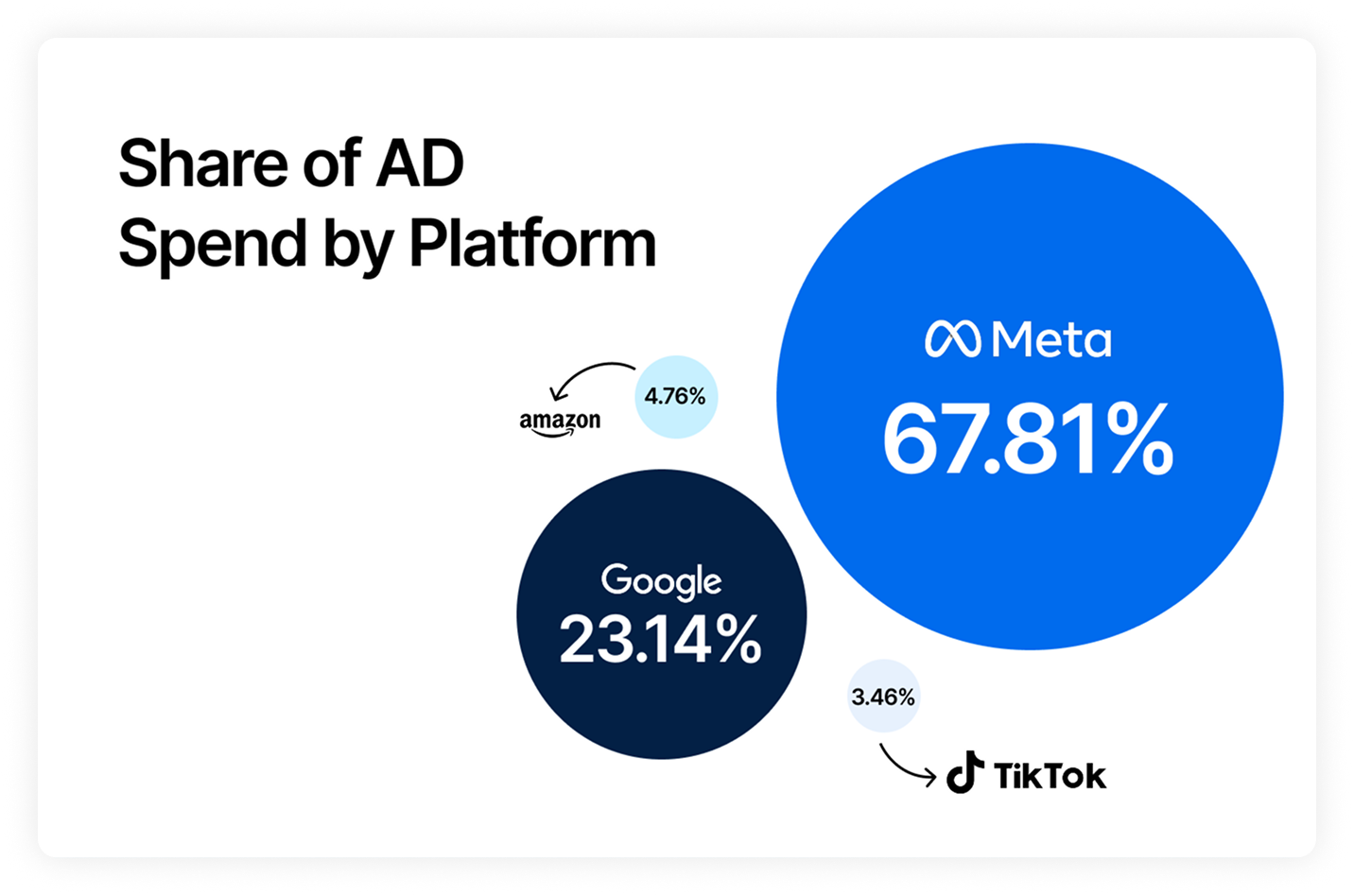
Body Copy: The following benchmarks compare advertising metrics from April 1-17 to the previous period. Considering President Trump first unveiled his tariffs on April 2, the timing corresponds with potential changes in advertising behavior among ecommerce brands (though it isn’t necessarily correlated).


 Moby AIAsk questions, analyze performance, and work with your business context.
 ActionsTake governed action across the tools that run your business.
 AutomationsSchedule recurring analysis and work that runs on your terms.
 Landing PagesCreative conversion-focused ecommerce pages with Moby.
 Creative StudioGenerate and refine creative grounded in your brand.









.webp)

.webp)
