AI assistants now equal 56% of global search volume, according to recent stats by Search Engine Land.
It’s okay to still be worrying about keywords, but the AI search is growing at an incredible rate. That means that those optimizing for AI search (in addition to keywords) are going to be dominating this space in the years to come.
If you haven’t started yet, it’s still a great time to jump into the world of AI visibility (the measurement of how often and how accurately your brand appears in responses generated by AI search engines and chatbots).
An AI visibility audit is the perfect place to start. This guide gives you a complete, repeatable audit process that you can complete in under 60 minutes.
Key takeaways
- AI visibility is a growing strategic priority, measuring how often and accurately a brand appears in AI-generated answers, as AI search is growing rapidly.
- The audit measures five key areas: mentions, citations, sentiment, share of voice, and technical accessibility to AI crawlers.
- Triple Whale provides an AI Visibility tool that automatically tracks brand mentions, citations, and sentiment across multiple AI platforms, supporting its core goal to be the AI operating system for ecommerce.
What is an AI Visibility Audit?
An AI visibility audit is a step-by-step process for measuring how (or if) your brand appears inside AI-generated answers across platforms like ChatGPT, Google AI Overviews, Perplexity, and Gemini.
Unlike a traditional SEO audit, which focuses on keywords, rankings, and backlinks to help you rank on Google, an AI visibility audit measures the things that determine whether your brand is inclined to be included in AI search results.
| SEO Audit | AI Visibility Audit | |
|---|---|---|
| What it measures | Keyword rankings, backlinks, crawlability, page speed | AI citations, brand mentions, share of voice in LLM answers, sentiment |
| Primary goal | Rank higher in Google's search results | Get cited in AI-generated answers |
| Success metric | Position #1–10 for target keywords | Appearing in AI responses for category/buying-intent queries |
| Key tools | Ahrefs, Semrush, Screaming Frog, Google Analytics | Manual prompt testing, AI visibility tools |
What Exactly Does an AI Visibility Audit Measure?
The length of an AI Visibility audit can vary, but generally, the audit measures the following:
- Mentions: How often your brand is explicitly mentioned in AI-generated results
- Citations: How often your brand is cited as a reference in AI-generated results
- Sentiment: Whether those mentions accurately and positively represent your brand
- Share of Voice: How frequently your brand is mentioned in AI responses relative to your competitors.
- Technical Efficiency: How technically accessible your website is to AI crawlers
This guide will help you audit your visibility across all five of those measurements, plus what to do with that data once you have it.
Why it Matters Now
AI referral traffic for ecommerce stores is growing fast. Forty-four percent of users who've tried AI-powered search say it's now their primary way to search. According to Triple Whale benchmarks, there’s been a 59X growth seen in AI-attributed orders in 2025 vs 2024.
And according to Yotpo, brands cited in AI Overviews often experience a 35% increase in click-through rates compared to standard search results.
This reflects a broad migration of the top-of-funnel away from traditional search engines and toward conversational interfaces.
With that in mind, visibility across LLMs and AI-powered shopping surfaces is becoming its own strategic priority — one that requires a different set of inputs, a different content approach, and different ways of measuring success.
“I think gone are the days where you're just trying to hit a word count to make sure that you're sprinkling in a keyword a certain amount of times,” says Chris Stout, Sr. Director of Digital Marketing at elk Marketing. “You really wanna look at each individual piece of the page and how can those pieces stand alone."
The 5-Step AI Visibility Audit (Free Framework)
You can complete steps one through four in under 60 minutes with no tools required. Steps 5 and 6 introduce free tools that set up a stronger AEO foundation, while also helping you scale and automate the process.
Step 1: Build a Prompt Library
A prompt library is a structured set of queries you regularly run against AI models to monitor how your brand is being represented. Build a list of 10–20 queries across both categories defined below.
General Category Queries: "What's the best [product] for [use case]"
Established brands can afford to target broad queries, such as:
- “best protein bars”
- “best collagen supplement”
- “best magnesium”
Challenger brands should target qualified queries that match your differentiation:
- "best soy-free protein bars"
- "best marine collagen for hair growth"
- "best magnesium glycinate for anxiety"
AI is more likely to recommend you when queries match your specific benefits.
You're competing in a less crowded space where your differentiation matters more than brand recognition.
Direct Comparison Queries: "[Product A] vs [Product B]"
How AI frames comparisons directly impacts conversion. If an AI response leads with price — "Brand X is $29, Brand Y is $45" — without contextualising quality differences, you’ll lose on price every time. This matters most when your value proposition is quality, provenance, or efficacy rather than cost.
If you're not sure where to start with your prompt categories, Yotpo's Shoppers Have Prompted report breaks down the most common AI shopping queries by vertical — a useful shortcut for identifying which buying-intent prompts matter most in your category.
Step 2: Start Tracking Your Prompts
Knowing how AI models represent your brand requires consistent, structured monitoring to catch shifts in positioning, new competitor mentions, and changes in the language AI uses to describe your category.
There are two approaches to manual tracking, depending on your resources.
Manual tracking
This is the lowest-barrier starting point. For each response, log three things in a spreadsheet or app: whether your brand was mentioned, how accurately it was represented, and where it appeared in the response relative to competitors.
- Commit to a monthly manual tracking session of your queries.
- Run them across at least two AI models and document the responses.
- Include the steps below (sentiment, quality, accuracy, competitor tracking) into your process.
AI visibility tools
This helps automate the process at scale. Tools such as Triple Whale's AI Visibility track prompts automatically across multiple AI systems, log citations, identify patterns over time, and surface which publications are most influential for your category. What takes hours of manual work each month runs continuously in the background.
Step 3: Assess Citation Quality
Citation quality has three dimensions worth examining: Whether citations are explicit or implicit, whether the sentiment is accurate and positive, and whether AI is representing your brand the way you'd actually want to be represented.
Explicit citations
This is whether your brand name appears directly, often alongside a link or a specific product recommendation.
Implicit citations are subtler. AI might describe your product's key attributes without naming you, or reference a category you're known for without the mention. Both matter, but explicit citations are what drive direct referral traffic and brand recognition.
Sentiment
This is whether the reference to your brand or product is positive, negative, or neutral. For example, AI models can pick up and repeat outdated positioning, negative reviews, or competitor framing.
Run a few comparison queries and pay close attention to the language used.
- Are the descriptors accurate?
- Is your price point framed as a value or a barrier?
- Is your brand being recommended enthusiastically or as an afterthought?
Accuracy
Finally, assess whether the AI-generated response accurately and fairly represents your brand or product.
This step also offers one of the quickest wins available, as it gives you an opportunity to audit your own content for outdated messaging that may be influencing what search engines surface.
Steve McQuaide, VP of Strategy at Elk Marketing, sees clear strategic value here, noting that the “most frequently cited sources can help you craft a content marketing strategy.” Sound advice.
Step 4: Competitive Benchmark Your AI Share of Voice
Much like how you’d want to see who’s ranking number one on Google, you’ll want to see how your competitors rank inside search engines. This is called competitor benchmarking.
Knowing how often you show up relative to your competitors is where you can start to fight for the top position. If you have an exact number, this is known as your AI Share of Voice (SOV).
It’s the percentage of AI-generated responses that mention, cite, or recommend your brand compared to others in your category.
The core formula is simple: Your Brand Mentions ÷ Total Category Mentions = Your SOV %
To calculate it competitively, you need three things:
- Define your competitive set. Pick 3–5 direct competitors you want to benchmark against.
- Run your prompt library across all of them. Use the same queries from Step 1 and log every brand mentioned in each response.
- Do the math. Add up all mentions across your competitive set (including your own), then divide your mentions by that total.
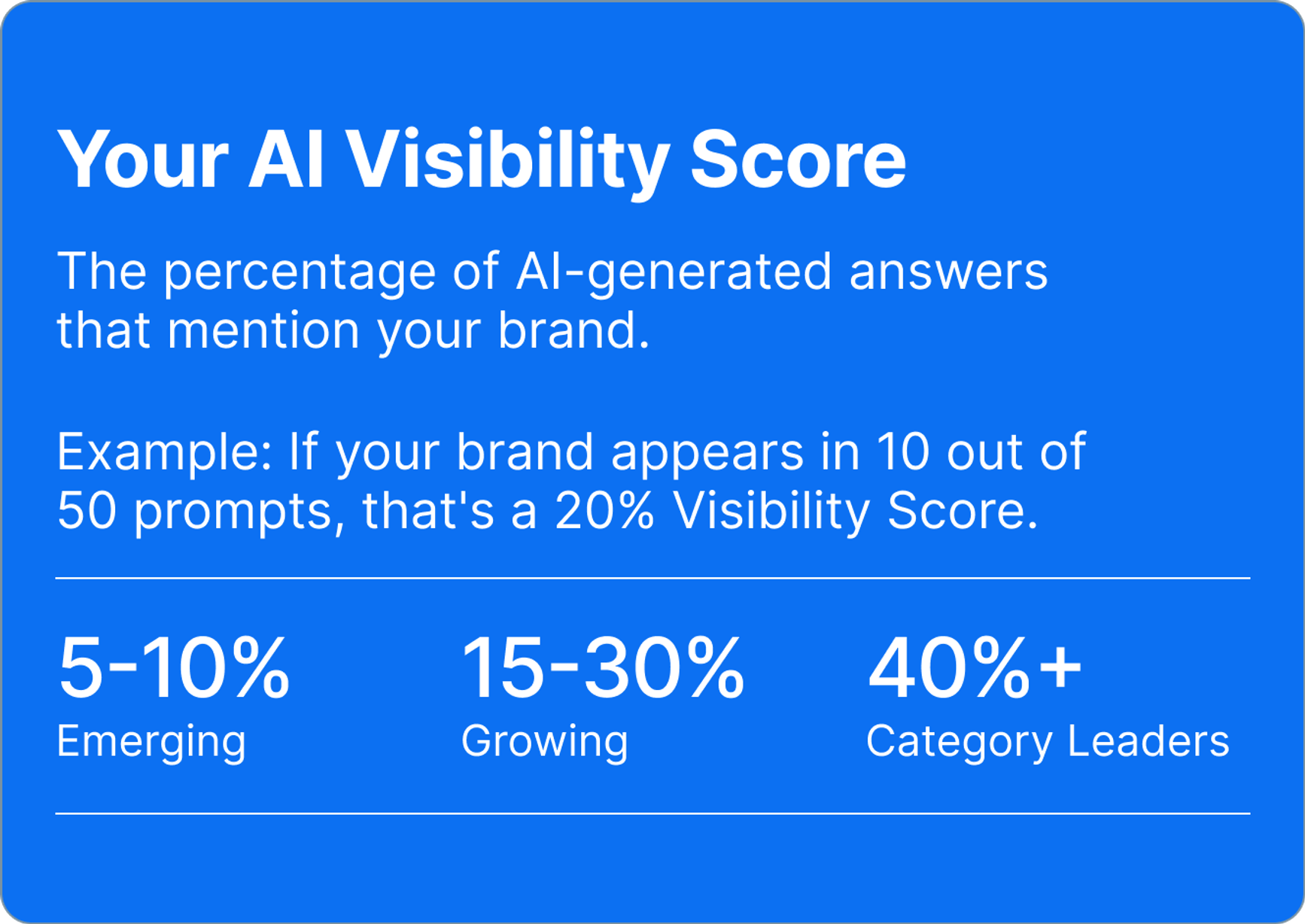
So if you and four competitors collectively receive 200 mentions across your prompt set, and your brand appears in 40 of them, your competitive SOV is 20%.
A few benchmarks worth keeping in mind:
- Newer or challenger brands typically see AI visibility rates in the 10–20% range.
- Growing brands see higher rates, anywhere from 15%-30% is normal.
- Established brands in competitive categories should be aiming higher, around 40% or above.
What to do with this number
A single SOV number tells you your current position. Tracked over time, it tells you whether you're gaining or losing ground — and whether any changes you make to content, technical structure, or off-site authority are actually moving the needle.
Most AI search tools calculate this for you, making it easier to have a birds-eye view of where you stand at any given moment.
Step 5: Technical Crawlability Check
You can have the best content in your category and still be invisible to AI models if your website isn't technically accessible to them. This step is about making sure nothing on the infrastructure side is blocking your visibility.
Check Your Robots.txt File
Your robots.txt file tells bots which parts of your site they can and can't access. The problem is that many e-commerce sites have configurations that inadvertently block AI crawlers.
The key AI user agents to make sure you're not blocking include GPTBot (OpenAI), Google-Extended, ClaudeBot (Anthropic), PerplexityBot, and cohere-ai. content. Connect with your IT or dev team to verify.
Test Your Pages With JavaScript Disabled
This one surprises a lot of e-commerce teams. "JavaScript is a challenge for AI bots,” says Steve McQuaide of Elk Marketing. “If you are serving your content through JavaScript, they're not gonna be able to read it. It's effectively invisible to them,” he adds.
This would mean a human visiting the page sees everything, but an AI crawler sees almost nothing.
Install the Toggle JavaScript extension for Chrome and compare what your pages look like with it on versus off. Any content that disappears is content AI can't read.
Audit Your Schema Markup
Schema markup is the native language of AI models. It's how you clearly label what's on a page and what it means. At minimum, you want schema applied consistently across your product pages, category pages, and blog content. P
Pay particular attention to product schema, FAQ schema, and review schema, as these are the types most commonly surfaced in AI-generated responses.
Chris Stout offers a practical starting point for catching gaps: "Log in to Search Console and review your merchant listing report — it'll provide you explicit areas for improvement or errors that it's encountering within your feed and schema on-site."
It's free, it's already connected to your site, and it will surface specific issues rather than general recommendations.
Check Your Page Speed
AI search is built around speed and efficiency. Slow-loading pages create friction at the crawl level, not just the user experience level.
Run your key pages through Google PageSpeed Insights and prioritize any Core Web Vitals issues flagged as poor or needs improvement. This one has downstream benefits for traditional SEO as well, so it's never wasted effort.
Free Tools to Audit Your AI Visibility
The manual audit above costs nothing and is a great starting point. But if you want to track your brand's AI visibility over time — across multiple prompts, competitors, and platforms — a tool removes the repetitive manual work and surfaces patterns you'd likely miss on a monthly check-in cadence.
Triple Whale
Triple Whale's AI Visibility tool is free to access, including on Triple Whale's free plan. It lives inside the same platform where you track revenue, ad spend, and attribution, you can connect AI visibility trends directly to business outcomes rather than treating it as a separate reporting workstream.
It also:
- Tracks mentions, citations, and sentiment automatically across multiple AI platforms, running your prompt library nightly and logging the results.
- Surfaces which publications are most frequently cited in your category, enabling a targeted PR and content outreach strategy.
- Overlays competitor data so you can monitor share of voice without manual calculation.
Ahrefs Brand Radar
Ahrefs Brand Radar tracks brand mentions across AI-generated responses including ChatGPT, Perplexity, and Google AI Overviews.
The free tier gives you a snapshot view of how often your brand appears in AI answers for a defined set of queries, making it a useful starting point for brands that want a quick read on their current visibility without committing to a paid plan.
It's more limited than a dedicated AEO tool in terms of prompt volume and historical tracking, but it's a solid complement to the manual audit steps above.
Semrush AI Visibility Checker
Semrush's AI Visibility Checker lets you test how your brand appears in AI Overviews directly within the Semrush interface.
The free version allows a limited number of queries and gives you a high-level view of whether your brand is being cited and by which sources.
It's particularly useful if you're already using Semrush for traditional SEO, since it lets you compare your AI visibility alongside your organic keyword data in one place.
What to Do After Your AI Visibility Audit
You've run your prompts, scored your mentions, checked your technical setup, and benchmarked your share of voice. Now what?
Once you have gathered these insights, you can begin the work of Answer Engine Optimization (AEO), which involves:
- Evolving an AI search for ecommerce strategy
- Refining your content for LLM extractability
- Securing placements in the third-party sources that AI models prioritize
- Ensuring your technical infrastructure doesn't lock the bots that drive this new wave of referral traffic.
The most important thing is to resist the urge to do everything at once. Steve McQuaide says that “the technical foundation is critical to build and have effective content strategies.” He recommends making sure that you are in tip top shape on the technical side “before really expanding into a robust content plan."
Optimize Content Structure
Once your site is technically accessible, look at how your existing content is structured.
The shift here is from writing for word count to writing for extractability.
That means clear heading hierarchies, direct answers to specific questions, FAQ sections marked up with schema, and content organized around topics rather than just keywords.
Start by refreshing your highest-traffic pages and your most important product pages.
Then Build Off-Site Authority
This is the longest play, but also the one with the most compounding upside. Identify which third-party sources are most frequently cited in your category's AI responses — your citation audit from Step 3 will tell you this.
Chris Stout puts it into perspective: "Are you engaged in thought leadership? Are you leveraging PR to help bolster up the overall reputation of your brand? Are you earning mass media coverage at scale?"
Thought leadership contributions, PR placements, community engagement, and YouTube presence all feed into how AI models assess your brand's trustworthiness as a citation source.
The goal is to be genuinely present in the places AI models have already decided are worth listening to.
How to Monitor Your AI Visibility Over Time
Running a one-time audit is a good diagnostic. But AI visibility is a moving target — models update, competitors make moves, and new content either earns or loses citations on a rolling basis. Monitoring is what turns a snapshot into a strategy.
Manual Monthly Checks
If you're running a lean operation, a structured monthly session using your prompt library is enough to catch the most important shifts. Run your full prompt set across AI models, log the results in a consistent format, and compare month over month.
Tool-Based Monitoring
For brands running more than 20 prompts or tracking more than three competitors, manual monitoring quickly becomes unwieldy. Automated tools run your queries nightly or weekly, log every response, and surface trends without requiring you to do the repetitive work yourself.
Triple Whale's AI Visibility tool is free to get started. Or if you'd like to see how it fits alongside the rest of your performance data, you can book a demo to see the full picture.
Your AI Visibility Audit Questions, Answered
How is an AI visibility audit different from an SEO audit?
An SEO audit focuses on your keyword rankings, backlinks, and technical crawlability for Google. An AI visibility audit measures whether your brand appears in AI-generated answers from AI search engines and LLMs. The two audits complement each other, but they measure different things and require different inputs to improve.
Which AI platforms should I audit my brand on?
Start with ChatGPT and Google AI Overviews — these currently drive the most referral traffic for e-commerce brands. Our data shows that around 97% of AI-attributed orders come from ChatGPT.
How often should I audit my AI visibility?
For most e-commerce brands, a monthly manual check using your prompt library is sufficient to catch meaningful shifts. Fast-moving brands in competitive categories may want to check weekly.
What's a good AI visibility score for my brand?
It depends on your category and brand maturity. Newer or challenger brands should aim for 10–20% visibility across their prompt set. Mid-market and established brands should be targeting 40–50%. National or category-leading brands with strong SEO foundations can realistically achieve 70–80% or higher.