By November, every ecommerce brand is fighting for the same inbox. Discounts stack up, urgency spikes, and generic blasts get deleted fast.
An effective Black Friday Cyber Monday (BFCM) email plan lets brands send more emails. This way, they don’t risk deliverability, margin, or customer trust. It creates demand before the sale, giving each audience a reason to buy.
The event also starts earlier than many teams think. Triple Whale’s BFCM 2025 data shows that brands made $1.77 billion before BFCM. Overall, they reached $2.9 million during the entire sales season.
This guide explains how to meet demand using a 2026 send calendar, better segmentation, prioritized campaigns, and a clear measurement plan.
Key Takeaways:
Start with last year’s performance, customer behavior, and margin — not a blank calendar
Protect deliverability before November by cleaning the list, warming engaged segments, and confirming authentication and consent
Target your message based on intent, customer value, and purchase status
Use Triple Whale to see how email and SMS boost revenue across the full marketing mix
What is BFCM email marketing?
BFCM email marketing uses promotional campaigns and automated lifecycle emails. This happens before, during, and after Black Friday and Cyber Monday.
A strong program is so much more than sending promotions. It creates demand before the event and converts shoppers quickly when offers start. Plus, it also recovers high-intent sessions and protects the customer experience during busy times.
Two types of email do this work. A campaign is a scheduled, one-time send, like a Black Friday launch. A flow starts with a behavior or event. For example, an event can be browsing a product, leaving a cart, finishing a purchase, or hitting a loyalty milestone. Flows continue to run while the team manages the campaign calendar.
Build your BFCM email strategy before you build the calendar
A send calendar only becomes useful once you know who you are sending to and why. Before mapping dates, define these three inputs:
What happened last year
What the business needs this year
What customers will receive in return for their attention
Analyze past BFCM data
Compare last year’s BFCM results with two baselines: 1) the weeks before the event and 2) the previous year’s BFCM results.
Repeat purchase behavior among BFCM- acquired customers
Triple Whale tracked $2.88 billion in BFCM 2025 revenue, with new customers contributing $1.4 billion, or 48%. That share dropped from 66% for brands with under $1 million in GMV to 45% for those over $10 million in GMV. Here, returning customers generated most of the revenue.
Smaller brands can use email to attract new customers. Larger brands should focus on keeping their existing customers and building loyalty.
Where Triple Whale helps: Triple Whale combines last year’s BFCM revenue, customer acquisition, channel performance, and post-purchase behavior into one view. This makes it easier to see what worked and what needs improvement.
Open and click rates show engagement, but BFCM success needs to connect to business results. These decisions keep the team from chasing revenue at the expense of profit. Set targets for:
Revenue, conversion, and new-customer acquisition
Margin after discounts, shipping, and returns
List growth and repeat purchase behavior
Then define guardrails before launch:
Discount ceiling and margin floor
Product exclusions, inventory limits, and shipping cutoffs
An approval owner for last-minute offer changes
Decide the offer and message architecture
Assign one clear task to each campaign, like announcing a new promo. This keeps the audience, message, and call to action focused.
To do so, you may want to map the core offer, VIP or loyalty treatment, featured products, bundles, gifts, urgency moments, and post-purchase promise. Then decide how those elements change across segments and channels.
Avoid unplanned offer escalation. If Black Friday opens at 25% off and Cyber Monday jumps to 35% without a clear reason, subscribers learn to wait.
Lastly, ensure the email promise matches the landing page, inventory, exclusions, and checkout process. A broad claim such as “50% off everything” should not lead to a page dominated by exceptions.
Prepare your list, segments, and flows for higher volume
Your BFCM email program depends on more than the campaigns on the calendar. Before volume ramps up, boost your audience and systems. Here’s how to get that into shape before the chaos ensues.
Clean and warm the email list
Suppress hard bounces, opted-out profiles, and long-term unengaged addresses. Check engagement by how recent it is. Also confirm authentication, one-click unsubscribe, sender info, and consent. Do this according to the latest Google, Yahoo, and FTC CAN-SPAM guidance.
Gradually increase volume in October and early November. Keep an eye on bounces, spam complaints, unsubscribes, and domain reputation. A cleaner, more engaged list helps your customers see the offer. This is important when inbox competition is high.
Grow email, SMS, and loyalty lists before BFCM
Give shoppers a clear reason to sign up, such as early access, a gift guide, a wish list, or a loyalty benefit. Place capture opportunities on high-intent pages without interrupting the shopping experience.
Coordinate email, SMS, and loyalty enrollment, but collect consent for each channel separately. Loyalty can add urgency without increasing the discount.
"Once your loyalty program is already up and running, you can keep that energy going by allowing customers to earn double points ahead of or during Black Friday," said Sarah Skolnik, Agency Partnerships Manager at Okendo.
Build the segments that change the message
A practical BFCM segmentation plan should consider engagement, purchase history, product interest, and customer value. Start with the audiences most likely to need different messaging:
Segment
What They Already Know
Message Angle
Treatment
Engaged Subscribers
The brand or recent campaign story
Preview, discovery, and offer details
Prioritize for higher-volume sends
VIP and High-Value Customers
The brand, products, and customer experience
Exclusive access, service, and availability
Offer early access or protected inventory
Prior BFCM Purchasers
The event and its typical offer
New products, bundles, or a stronger use case
Avoid generic brand education
Recent Purchasers
The current customer experience
Service, education, and complementary products
Suppress from redundant acquisition messages
Prospects Who Have Not Purchased
The brand, but not the ownership experience
Product proof, buying guidance, and risk reduction
Follow up based on browsing and engagement
Lapsed Customers
The brand, but not recent releases
What has changed and why return
Test a reactivation angle
Product or Category Affinity Groups
A specific product or use case
Relevant recommendations and availability
Merchandise around demonstrated interest
Unengaged Profiles
Little recent campaign activity
Re-permission or another consented channel
Avoid repeated promotional sends
The segment should change the message, not only the greeting. A VIP who bought last Black Friday needs different proof and access than a first-time prospect. Use customer segmentation to connect purchase history and customer value to each treatment. Don’t send acquisition messages to recent buyers, and separate lapsed customers from those who have never bought.
Audit and adapt automated flows
Review the flows that support each stage of the BFCM customer journey. Triple Whale tracked over 5.5 million email campaigns and 4.6 million email flows during BFCM 2025. Each automated message must have a clear role and shouldn’t compete with scheduled sends:
Welcome: Introduce the brand. Make sure the standard welcome offer doesn’t clash with the live BFCM promotion.
Browse abandonment: Get shoppers to revisit products they viewed. Skip the full campaign message.
Cart and checkout abandonment: Recover high-intent shoppers by providing clear pricing, availability, and shipping details.
Back in stock: Let interested shoppers know when items are available again, as long as the offer lasts.
Post-purchase: Confirm the order, set expectations, and provide useful product guidance.
Review and loyalty: Request feedback and introduce rewards after the initial purchase experience.
Replenishment: Place the next order when the product is due for restock based on its usage cycle.
Win-back: Re-engage lapsed customers with relevant products or a clear reason to return
Check each flow for:
Timing
Offer conflicts
Campaign overlap
Product availability
Shipping cutoffs
Purchaser suppression
Test changes against your purchase cycle rather than shortening every flow by default.
BFCM email marketing calendar for 2026
Our BFCM checklist includes everything in the production plan. It covers copy, creative, landing pages, and QA.
Timing
Primary Goal
Audience
Email Focus
Key Checks
September-Early October
Build the Foundation
Full Program
Audit, planning, and list hygiene
Authentication, margin, and inventory
Mid-October-Early November
Build Demand
Engaged Subscribers
Education, gift guides, and wish lists
Creative and landing pages
November 9-22
Preview and Segment
VIPs and High-Intent Shoppers
Event previews and product highlights
Links, tracking, parameters, and suppressions
November 23-26
Open Early Access
VIPs and Prior Customers
Early-access launch and merchandising
Inventory and purchase status
November 27-30
Convert
Engaged Non-Purchasers
Launch, product discovery, and credible urgency
Purchaser suppression and offer accuracy
December 1-7
Retain and Learn
BFCM Purchasers
Service, education, and loyalty
Cohorts and repeat purchase
Example: A mid-size apparel brand launches its Black Friday sale to 200,000 subscribers. The campaign produces a 38% open rate and a 4.1% click-through rate on the day of send. A week later, the team sees that its 12,000 VIP members earned almost three times the revenue per person compared to the general list. That finding should shape next year’s segmentation and guide inventory access.
September to early October: audit and build
BFCM performance depends on decisions made well before shoppers see the first promotion. This quieter planning window gives your team time to learn from last year’s customers, align the offer with margin and inventory realities, and fix technical issues before send volume rises. Start by analyzing last year’s performance and setting clear goals. Then define the offer and measurement plan, clean the list, confirm sender authentication, and begin creative and landing-page production.
Mid-October to early November: grow and educate
Shoppers start browsing weeks before they buy. This window gives you their attention before discounts create too much noise, so use it to build trust, help people choose, and grow the audience that will hear from you during BFCM.
Promote early access and loyalty benefits, then support discovery with gift education, buying guides, wish-list prompts, customer proof, and different merchandising angles for warm segments. Save urgency for the point when the deadline or inventory makes it credible.
November 9–22: preview and segment
As the event gets closer, shoppers want enough detail to decide whether to wait, join, or buy. A clear preview reduces uncertainty, while the engagement it creates helps you distinguish high-intent shoppers from the rest of the list.
Share the event timing, featured products, exclusions, and how VIP or loyalty access will work. Use those responses to refine segments, then confirm campaign and flow suppressions and check links, coupon logic, inventory, and mobile rendering.
November 23–26: open early access
Early access is no longer just a courtesy before the main event. From November 24–27, 2025, Triple Whale brands made $1.77 billion in revenue and spent $396.6 million on advertising, or 65% of their total BFCM ad spend.
That concentration makes this a meaningful revenue period with its own merchandising and measurement plan. Open access in stages instead of sending the same launch to everyone, beginning with VIPs, prior customers, and subscribers who engaged with preview content.
Friday, November 27: launch Black Friday
Black Friday brings the broadest attention and the highest operational pressure of the weekend. In 2025, it generated 33.9% of revenue during the four-day event, a useful benchmark for staffing and monitoring but not a reason to use one universal send time.
Make the first message easy to understand by leading with the offer, hero products or categories, and a direct path to shop. Adapt follow-ups to each shopper’s engagement, browsing, purchase status, inventory availability, and time zone.
Saturday–Sunday, November 28–29: sustain and differentiate
By the weekend, shoppers have seen a flood of similar sale messages. Repeating Friday’s launch creative makes it easier to tune out, while useful guidance gives people a new reason to return.
Shift the conversation to merchandising, FAQs, social proof, gift guidance, category stories, and inventory-aware reminders. For customers who have already purchased, reduce the sales pressure and move them into service and post-purchase journeys.
Monday, November 30: give Cyber Monday its own angle
Cyber Monday still represents a distinct buying moment: it accounted for 25.5% of four-day revenue in the 2025 Triple Whale data. Shoppers need a fresh reason to re-engage, not Friday’s message with a new label. Give the day its own product story, offer angle, or merchandising focus, and make the terms easy to understand:
Set clear deadlines
Mention the time zone
List any exclusions
Note shipping cutoffs
Include coupon terms
Final-hours messages work best when they reach engaged people who still have a reason to buy. Reserve them for non-purchasers showing intent, and let the size and behavior of your list determine send volume rather than following a universal number.
December 1–7: retain and learn
The sale may be over, but the experience is still shaping whether a BFCM buyer becomes a repeat customer. The first week after purchase is the time to replace promotional pressure with reassurance, useful product guidance, and relevant next steps. A post-purchase sequence can follow this rhythm:
Thank-you page: Confirm the order, set expectations, and collect zero-party feedback when useful
0–15 minutes: Offer a genuinely complementary item only when fulfillment and customer experience support it
2–6 hours: Send setup, care, sizing, or gifting guidance without adding another discount
24–48 hours: Customize messages about education, replenishment, loyalty, or reviews based on the product purchased
This is also when the campaign becomes a learning opportunity. Immediate email metrics arrive quickly, but customer quality, repeat behavior, returns, and margin need more time to develop. Start the performance readout now, separating first-time BFCM buyers from returning buyers and organizing results by offer, product, and source. Over time, track repeat purchase rate, time to second order, lifetime value, returns, and margins.
12 BFCM email marketing strategies to drive more profitable sales
Your BFCM email strategy should help shoppers go from interest to purchase. Use the tactics below to make each send more relevant, coordinated, and profitable.
1. Give VIP and loyalty customers meaningful early access
Make VIP treatment about access, service, or availability—not just a deeper discount. A dedicated shopping window or protected inventory can mean more to loyal customers.
2. Segment by intent, value, and purchase status
Adjust the approach for different groups:
High-intent browsers
Prior buyers
VIPs
Prospects
Lapsed customers
Recent purchasers
The offer might not change. However, the product selection, proof, and call to action should match what the segment already understands.
3. Build demand before the discount begins
Create buzz before the offer launches by using:
Product education
Gift guides
Founder or customer stories
Wish lists
Launch previews
Triple Whale’s 2025 data showed $1.77 billion in revenue in the four days before BFCM. This highlights the importance of having a solid pre-event plan.
4. Give each email one job
Decide whether each send will announce, educate, merchandise, convert, recover, or retain. The job should focus on shaping the audience, message, and call to action. It shouldn’t cram the launch, gift guide, FAQ, and final reminder into one email.
5. Merchandise products, not only discounts
Help shoppers decide what to buy. Curate your offers by recipient, use case, price point, category, bundle, and availability. This way, you avoid using the same percentage-off banner in every message.
6. Adapt campaigns to behavior
Use recent signals like engagement, browsing, cart activity, purchases, and inventory. This helps decide who gets a follow-up and what it says. A customer who has already bought something shouldn’t get the same final-hours messages as a browser who hasn’t made a purchase.
7. Optimize abandonment flows for BFCM conditions
Check the timing, campaign overlap, offer conflicts, product availability, and shipping cutoffs before the event. Test changes based on your purchase cycle. Don’t assume that every cart or checkout reminder needs to be sent right away.
8. Coordinate email with SMS, paid media, onsite, and loyalty
Give each channel a complementary role and keep offer terms consistent. Repeating the same content on every channel at once wastes reach. It can also overwhelm customers who follow multiple platforms.
9. Protect deliverability with engagement-based sending
Focus on engaged audiences. Limit messages to profiles that shouldn’t get them. And keep an eye on bounces, spam complaints, and unsubscribes. Full-list sending should be a deliberate decision, not the default for every campaign.
10. Use urgency honestly
Tie the urgency to a real deadline, inventory limit, shipping cutoff, or access window. False countdowns and unsupported scarcity claims can boost clicks at first. But they make later messages easier to ignore.
11. Suppress purchasers and improve post-purchase communication
Stop sending acquisition messages once someone buys. Guide buyers through:
Order updates
Product education
Loyalty programs
Second-purchase journeys
These should match what they ordered.
12. Measure business value beyond ESP credit
Check attribution views, track new customer results, and monitor the BFCM group after the event. Event-week revenue shows what happened during the event. Repeat purchases, returns, and lifetime value indicate whether the promotion generated durable growth.
How to write and design BFCM emails people can use quickly
BFCM shoppers move quickly, so every email should make the offer easy to understand at a glance. Clear copy, smart design, and a mobile-first layout make it easy for readers to find what they need and take action.
Lead with the offer or value
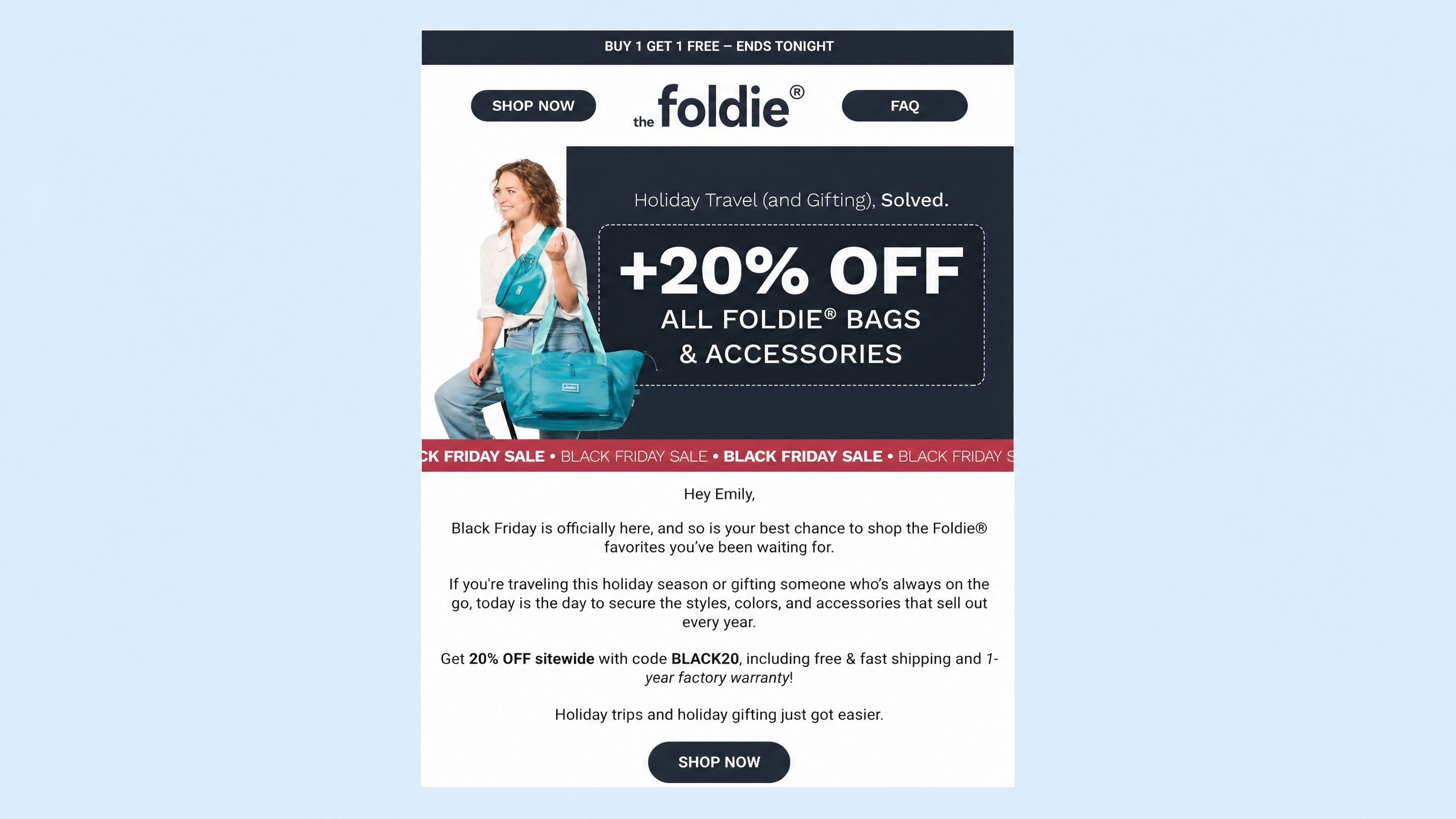
Make the main promise clear in the subject line, preview text, and first screen. Highlight urgency along with key details: what’s included, who can qualify, when it ends, and where to shop.
Use one primary call to action. Secondary links aid product discovery. However, they shouldn’t compete with the main choice.
Design for mobile and accessibility
About 70% of Cyber Week 2025 orders were placed on mobile, according to Salesforce data. Treat mobile as the primary canvas.
Use clear fonts, brief sections, small images, good contrast, descriptive alt text, and easy-to-tap buttons. Keep essential offer terms in live text rather than placing them solely in an image. Make sure to do this before every send:
Check mobile rendering
Use dark mode
Review dynamic fields
Verify coupon logic
Ensure landing page continuity
Write subject lines that match the message
Match the subject line to the email’s one job. Examples:
Preview: “Here’s what’s coming for Black Friday”
VIP: “Your early access starts now”
Launch: “It’s here: [offer] is live”
Product education: “The one question we get every BFCM”
Last chance: “Ends tonight: [offer] closes at [time] [time zone]”
Post-purchase: “Your order is on its way — here’s what’s next”
Don’t assume that one word, emoji, character count, or send time will improve results for every list. Test these variables with your own audience and offer.
Measure BFCM email performance
BFCM email performance is easy to overrate. A campaign might look strong in your email platform. But it can still fall short in profit, customer acquisition, or retention. The metrics below help separate immediate engagement from lasting business impact.
Metric
What It Tells You
What It Doesn't Tell You
When to Read It
Open Rate
Subject line and send-time relevance to that audience
Whether the message drove a purchase
Same Day
Click-Through Rate
Whether content and offer framing generated action
Downstream conversion or revenue quality
Same Day
Conversion Rate
Whether recipients or clickers purchased, depending on the denominator used
Whether those purchases were profitable or incremental
Within 24-48 Hours
Revenue Per Recipient
Revenue efficiency across a send or segment
How overlapping channels could share credit
Within a Few Days
Unsubscribe and Spam-Complaint Rate
List health and sending pressure
Long-term deliverability on their own
Throughout the Event
Repeat Purchase Rate
Post-purchase cohort quality
Immediate campaign performance
Weeks to Months Later
Bring your marketing data into one place
Triple Whale brings email, advertising, revenue, and store data into one view. Your team can view how paid and owned channels affected overall BFCM performance. This way, you won’t need to switch between platforms or compare conflicting reports.
The Klaviyo integration shows campaign and flow activity in a wider view, making it easier to compare lifecycle performance with your other marketing efforts.
Get a clearer view of attribution
Email platforms and advertising platforms may both claim credit for the same purchase. The overlap makes it hard to see email’s role in the buying process. It also makes it tough to compare email’s performance with other channels. During BFCM, shoppers quickly switch between paid and owned channels. So, results can vary a lot based on where you look.
Triple Whale provides one consistent attribution view across the customer journey. Comparing email with Meta, Google, and other touchpoints can show your team how these channels work together. That gives lifecycle and paid teams a shared view of performance when deciding what to repeat, change, or stop after BFCM.
Make better decisions with clearer data
The objective isn’t to produce one perfect revenue number. It is to match the measurement view to the decision.
ESP engagement metrics help improve subject lines, content, and sending pressure. Triple Pixel data shows the impact on revenue, purchases, conversion rates, and customer outcomes. It highlights the differences between new and repeat customers. A steady setup for Email/SMS, organic, and influencer tracking helps keep channel names and measurements aligned.
Track BFCM customer quality after the event
Make groups for first-time BFCM buyers, returning customers, offer types, products, and acquisition sources. Then track repeat purchase rate, time to second order, lifetime value, returns, refunds, and margin on an appropriate lag.
Use cohort analysis and customer retention analysis to identify which audiences and offers produced customers worth reacquiring. A campaign that brought in a large first order but had low repeat purchases might need less funding. In contrast, a smaller group with higher customer value could warrant greater investment.
Create a measurable BFCM strategy with Triple Whale
BFCM customers interact with ads, email, SMS, search, and onsite experiences. Each platform claims credit in its own way. Without a consistent view, it’s hard to know which channels drove purchases or attracted valuable customers.
Combining email and SMS data with paid media, revenue, and customer behavior helps clarify overlaps. Teams can compare different attribution views. They can study customer segments and cohorts. This helps them see what to repeat or change for next year.
Triple Whale is the AI operating system built for modern ecommerce, turning BFCM strategy into practical steps.
See how Triple Whale connects BFCM performance across paid and owned channels. Book a demo today.
BFCM email marketing is the coordinated use of promotional campaigns and automated lifecycle emails before, during, and after Black Friday and Cyber Monday. It builds demand, converts shoppers, recovers high-intent sessions, and supports retention after the event.
When should I start sending BFCM emails?
Most brands should begin list preparation and educational content in October, move into anticipation and early-access promotion in early November, and reserve the heaviest promotional volume for the final one to two weeks before Black Friday.
How many emails should I send during Black Friday and Cyber Monday?
There is no universal number. Set frequency based on engagement, audience size, offer complexity, purchase status, and the ability to suppress customers who have converted or opted out. Repeated full-list sends should not be the default.
Why does Klaviyo revenue differ from Triple Whale?
Klaviyo and Triple Whale can use different tracking logic, attribution models, windows, and date rules. Align the date range, attribution window, model, accounting mode, and order filters before comparing the two views.
Component Sales
5.32K
Benchmark your ecommerce brand against industry leaders
By November, every ecommerce brand is fighting for the same inbox. Discounts stack up, urgency spikes, and generic blasts get deleted fast.
An effective Black Friday Cyber Monday (BFCM) email plan lets brands send more emails. This way, they don’t risk deliverability, margin, or customer trust. It creates demand before the sale, giving each audience a reason to buy.
The event also starts earlier than many teams think. Triple Whale’s BFCM 2025 data shows that brands made $1.77 billion before BFCM. Overall, they reached $2.9 million during the entire sales season.
This guide explains how to meet demand using a 2026 send calendar, better segmentation, prioritized campaigns, and a clear measurement plan.
Key Takeaways:
Start with last year’s performance, customer behavior, and margin — not a blank calendar
Protect deliverability before November by cleaning the list, warming engaged segments, and confirming authentication and consent
Target your message based on intent, customer value, and purchase status
Use Triple Whale to see how email and SMS boost revenue across the full marketing mix
What is BFCM email marketing?
BFCM email marketing uses promotional campaigns and automated lifecycle emails. This happens before, during, and after Black Friday and Cyber Monday.
A strong program is so much more than sending promotions. It creates demand before the event and converts shoppers quickly when offers start. Plus, it also recovers high-intent sessions and protects the customer experience during busy times.
Two types of email do this work. A campaign is a scheduled, one-time send, like a Black Friday launch. A flow starts with a behavior or event. For example, an event can be browsing a product, leaving a cart, finishing a purchase, or hitting a loyalty milestone. Flows continue to run while the team manages the campaign calendar.
Build your BFCM email strategy before you build the calendar
A send calendar only becomes useful once you know who you are sending to and why. Before mapping dates, define these three inputs:
What happened last year
What the business needs this year
What customers will receive in return for their attention
Analyze past BFCM data
Compare last year’s BFCM results with two baselines: 1) the weeks before the event and 2) the previous year’s BFCM results.
Repeat purchase behavior among BFCM- acquired customers
Triple Whale tracked $2.88 billion in BFCM 2025 revenue, with new customers contributing $1.4 billion, or 48%. That share dropped from 66% for brands with under $1 million in GMV to 45% for those over $10 million in GMV. Here, returning customers generated most of the revenue.
Smaller brands can use email to attract new customers. Larger brands should focus on keeping their existing customers and building loyalty.
Where Triple Whale helps: Triple Whale combines last year’s BFCM revenue, customer acquisition, channel performance, and post-purchase behavior into one view. This makes it easier to see what worked and what needs improvement.
Open and click rates show engagement, but BFCM success needs to connect to business results. These decisions keep the team from chasing revenue at the expense of profit. Set targets for:
Revenue, conversion, and new-customer acquisition
Margin after discounts, shipping, and returns
List growth and repeat purchase behavior
Then define guardrails before launch:
Discount ceiling and margin floor
Product exclusions, inventory limits, and shipping cutoffs
An approval owner for last-minute offer changes
Decide the offer and message architecture
Assign one clear task to each campaign, like announcing a new promo. This keeps the audience, message, and call to action focused.
To do so, you may want to map the core offer, VIP or loyalty treatment, featured products, bundles, gifts, urgency moments, and post-purchase promise. Then decide how those elements change across segments and channels.
Avoid unplanned offer escalation. If Black Friday opens at 25% off and Cyber Monday jumps to 35% without a clear reason, subscribers learn to wait.
Lastly, ensure the email promise matches the landing page, inventory, exclusions, and checkout process. A broad claim such as “50% off everything” should not lead to a page dominated by exceptions.
Prepare your list, segments, and flows for higher volume
Your BFCM email program depends on more than the campaigns on the calendar. Before volume ramps up, boost your audience and systems. Here’s how to get that into shape before the chaos ensues.
Clean and warm the email list
Suppress hard bounces, opted-out profiles, and long-term unengaged addresses. Check engagement by how recent it is. Also confirm authentication, one-click unsubscribe, sender info, and consent. Do this according to the latest Google, Yahoo, and FTC CAN-SPAM guidance.
Gradually increase volume in October and early November. Keep an eye on bounces, spam complaints, unsubscribes, and domain reputation. A cleaner, more engaged list helps your customers see the offer. This is important when inbox competition is high.
Grow email, SMS, and loyalty lists before BFCM
Give shoppers a clear reason to sign up, such as early access, a gift guide, a wish list, or a loyalty benefit. Place capture opportunities on high-intent pages without interrupting the shopping experience.
Coordinate email, SMS, and loyalty enrollment, but collect consent for each channel separately. Loyalty can add urgency without increasing the discount.
"Once your loyalty program is already up and running, you can keep that energy going by allowing customers to earn double points ahead of or during Black Friday," said Sarah Skolnik, Agency Partnerships Manager at Okendo.
Build the segments that change the message
A practical BFCM segmentation plan should consider engagement, purchase history, product interest, and customer value. Start with the audiences most likely to need different messaging:
Segment
What They Already Know
Message Angle
Treatment
Engaged Subscribers
The brand or recent campaign story
Preview, discovery, and offer details
Prioritize for higher-volume sends
VIP and High-Value Customers
The brand, products, and customer experience
Exclusive access, service, and availability
Offer early access or protected inventory
Prior BFCM Purchasers
The event and its typical offer
New products, bundles, or a stronger use case
Avoid generic brand education
Recent Purchasers
The current customer experience
Service, education, and complementary products
Suppress from redundant acquisition messages
Prospects Who Have Not Purchased
The brand, but not the ownership experience
Product proof, buying guidance, and risk reduction
Follow up based on browsing and engagement
Lapsed Customers
The brand, but not recent releases
What has changed and why return
Test a reactivation angle
Product or Category Affinity Groups
A specific product or use case
Relevant recommendations and availability
Merchandise around demonstrated interest
Unengaged Profiles
Little recent campaign activity
Re-permission or another consented channel
Avoid repeated promotional sends
The segment should change the message, not only the greeting. A VIP who bought last Black Friday needs different proof and access than a first-time prospect. Use customer segmentation to connect purchase history and customer value to each treatment. Don’t send acquisition messages to recent buyers, and separate lapsed customers from those who have never bought.
Audit and adapt automated flows
Review the flows that support each stage of the BFCM customer journey. Triple Whale tracked over 5.5 million email campaigns and 4.6 million email flows during BFCM 2025. Each automated message must have a clear role and shouldn’t compete with scheduled sends:
Welcome: Introduce the brand. Make sure the standard welcome offer doesn’t clash with the live BFCM promotion.
Browse abandonment: Get shoppers to revisit products they viewed. Skip the full campaign message.
Cart and checkout abandonment: Recover high-intent shoppers by providing clear pricing, availability, and shipping details.
Back in stock: Let interested shoppers know when items are available again, as long as the offer lasts.
Post-purchase: Confirm the order, set expectations, and provide useful product guidance.
Review and loyalty: Request feedback and introduce rewards after the initial purchase experience.
Replenishment: Place the next order when the product is due for restock based on its usage cycle.
Win-back: Re-engage lapsed customers with relevant products or a clear reason to return
Check each flow for:
Timing
Offer conflicts
Campaign overlap
Product availability
Shipping cutoffs
Purchaser suppression
Test changes against your purchase cycle rather than shortening every flow by default.
BFCM email marketing calendar for 2026
Our BFCM checklist includes everything in the production plan. It covers copy, creative, landing pages, and QA.
Timing
Primary Goal
Audience
Email Focus
Key Checks
September-Early October
Build the Foundation
Full Program
Audit, planning, and list hygiene
Authentication, margin, and inventory
Mid-October-Early November
Build Demand
Engaged Subscribers
Education, gift guides, and wish lists
Creative and landing pages
November 9-22
Preview and Segment
VIPs and High-Intent Shoppers
Event previews and product highlights
Links, tracking, parameters, and suppressions
November 23-26
Open Early Access
VIPs and Prior Customers
Early-access launch and merchandising
Inventory and purchase status
November 27-30
Convert
Engaged Non-Purchasers
Launch, product discovery, and credible urgency
Purchaser suppression and offer accuracy
December 1-7
Retain and Learn
BFCM Purchasers
Service, education, and loyalty
Cohorts and repeat purchase
Example: A mid-size apparel brand launches its Black Friday sale to 200,000 subscribers. The campaign produces a 38% open rate and a 4.1% click-through rate on the day of send. A week later, the team sees that its 12,000 VIP members earned almost three times the revenue per person compared to the general list. That finding should shape next year’s segmentation and guide inventory access.
September to early October: audit and build
BFCM performance depends on decisions made well before shoppers see the first promotion. This quieter planning window gives your team time to learn from last year’s customers, align the offer with margin and inventory realities, and fix technical issues before send volume rises. Start by analyzing last year’s performance and setting clear goals. Then define the offer and measurement plan, clean the list, confirm sender authentication, and begin creative and landing-page production.
Mid-October to early November: grow and educate
Shoppers start browsing weeks before they buy. This window gives you their attention before discounts create too much noise, so use it to build trust, help people choose, and grow the audience that will hear from you during BFCM.
Promote early access and loyalty benefits, then support discovery with gift education, buying guides, wish-list prompts, customer proof, and different merchandising angles for warm segments. Save urgency for the point when the deadline or inventory makes it credible.
November 9–22: preview and segment
As the event gets closer, shoppers want enough detail to decide whether to wait, join, or buy. A clear preview reduces uncertainty, while the engagement it creates helps you distinguish high-intent shoppers from the rest of the list.
Share the event timing, featured products, exclusions, and how VIP or loyalty access will work. Use those responses to refine segments, then confirm campaign and flow suppressions and check links, coupon logic, inventory, and mobile rendering.
November 23–26: open early access
Early access is no longer just a courtesy before the main event. From November 24–27, 2025, Triple Whale brands made $1.77 billion in revenue and spent $396.6 million on advertising, or 65% of their total BFCM ad spend.
That concentration makes this a meaningful revenue period with its own merchandising and measurement plan. Open access in stages instead of sending the same launch to everyone, beginning with VIPs, prior customers, and subscribers who engaged with preview content.
Friday, November 27: launch Black Friday
Black Friday brings the broadest attention and the highest operational pressure of the weekend. In 2025, it generated 33.9% of revenue during the four-day event, a useful benchmark for staffing and monitoring but not a reason to use one universal send time.
Make the first message easy to understand by leading with the offer, hero products or categories, and a direct path to shop. Adapt follow-ups to each shopper’s engagement, browsing, purchase status, inventory availability, and time zone.
Saturday–Sunday, November 28–29: sustain and differentiate
By the weekend, shoppers have seen a flood of similar sale messages. Repeating Friday’s launch creative makes it easier to tune out, while useful guidance gives people a new reason to return.
Shift the conversation to merchandising, FAQs, social proof, gift guidance, category stories, and inventory-aware reminders. For customers who have already purchased, reduce the sales pressure and move them into service and post-purchase journeys.
Monday, November 30: give Cyber Monday its own angle
Cyber Monday still represents a distinct buying moment: it accounted for 25.5% of four-day revenue in the 2025 Triple Whale data. Shoppers need a fresh reason to re-engage, not Friday’s message with a new label. Give the day its own product story, offer angle, or merchandising focus, and make the terms easy to understand:
Set clear deadlines
Mention the time zone
List any exclusions
Note shipping cutoffs
Include coupon terms
Final-hours messages work best when they reach engaged people who still have a reason to buy. Reserve them for non-purchasers showing intent, and let the size and behavior of your list determine send volume rather than following a universal number.
December 1–7: retain and learn
The sale may be over, but the experience is still shaping whether a BFCM buyer becomes a repeat customer. The first week after purchase is the time to replace promotional pressure with reassurance, useful product guidance, and relevant next steps. A post-purchase sequence can follow this rhythm:
Thank-you page: Confirm the order, set expectations, and collect zero-party feedback when useful
0–15 minutes: Offer a genuinely complementary item only when fulfillment and customer experience support it
2–6 hours: Send setup, care, sizing, or gifting guidance without adding another discount
24–48 hours: Customize messages about education, replenishment, loyalty, or reviews based on the product purchased
This is also when the campaign becomes a learning opportunity. Immediate email metrics arrive quickly, but customer quality, repeat behavior, returns, and margin need more time to develop. Start the performance readout now, separating first-time BFCM buyers from returning buyers and organizing results by offer, product, and source. Over time, track repeat purchase rate, time to second order, lifetime value, returns, and margins.
12 BFCM email marketing strategies to drive more profitable sales
Your BFCM email strategy should help shoppers go from interest to purchase. Use the tactics below to make each send more relevant, coordinated, and profitable.
1. Give VIP and loyalty customers meaningful early access
Make VIP treatment about access, service, or availability—not just a deeper discount. A dedicated shopping window or protected inventory can mean more to loyal customers.
2. Segment by intent, value, and purchase status
Adjust the approach for different groups:
High-intent browsers
Prior buyers
VIPs
Prospects
Lapsed customers
Recent purchasers
The offer might not change. However, the product selection, proof, and call to action should match what the segment already understands.
3. Build demand before the discount begins
Create buzz before the offer launches by using:
Product education
Gift guides
Founder or customer stories
Wish lists
Launch previews
Triple Whale’s 2025 data showed $1.77 billion in revenue in the four days before BFCM. This highlights the importance of having a solid pre-event plan.
4. Give each email one job
Decide whether each send will announce, educate, merchandise, convert, recover, or retain. The job should focus on shaping the audience, message, and call to action. It shouldn’t cram the launch, gift guide, FAQ, and final reminder into one email.
5. Merchandise products, not only discounts
Help shoppers decide what to buy. Curate your offers by recipient, use case, price point, category, bundle, and availability. This way, you avoid using the same percentage-off banner in every message.
6. Adapt campaigns to behavior
Use recent signals like engagement, browsing, cart activity, purchases, and inventory. This helps decide who gets a follow-up and what it says. A customer who has already bought something shouldn’t get the same final-hours messages as a browser who hasn’t made a purchase.
7. Optimize abandonment flows for BFCM conditions
Check the timing, campaign overlap, offer conflicts, product availability, and shipping cutoffs before the event. Test changes based on your purchase cycle. Don’t assume that every cart or checkout reminder needs to be sent right away.
8. Coordinate email with SMS, paid media, onsite, and loyalty
Give each channel a complementary role and keep offer terms consistent. Repeating the same content on every channel at once wastes reach. It can also overwhelm customers who follow multiple platforms.
9. Protect deliverability with engagement-based sending
Focus on engaged audiences. Limit messages to profiles that shouldn’t get them. And keep an eye on bounces, spam complaints, and unsubscribes. Full-list sending should be a deliberate decision, not the default for every campaign.
10. Use urgency honestly
Tie the urgency to a real deadline, inventory limit, shipping cutoff, or access window. False countdowns and unsupported scarcity claims can boost clicks at first. But they make later messages easier to ignore.
11. Suppress purchasers and improve post-purchase communication
Stop sending acquisition messages once someone buys. Guide buyers through:
Order updates
Product education
Loyalty programs
Second-purchase journeys
These should match what they ordered.
12. Measure business value beyond ESP credit
Check attribution views, track new customer results, and monitor the BFCM group after the event. Event-week revenue shows what happened during the event. Repeat purchases, returns, and lifetime value indicate whether the promotion generated durable growth.
How to write and design BFCM emails people can use quickly
BFCM shoppers move quickly, so every email should make the offer easy to understand at a glance. Clear copy, smart design, and a mobile-first layout make it easy for readers to find what they need and take action.
Lead with the offer or value
Make the main promise clear in the subject line, preview text, and first screen. Highlight urgency along with key details: what’s included, who can qualify, when it ends, and where to shop.
Use one primary call to action. Secondary links aid product discovery. However, they shouldn’t compete with the main choice.
Design for mobile and accessibility
About 70% of Cyber Week 2025 orders were placed on mobile, according to Salesforce data. Treat mobile as the primary canvas.
Use clear fonts, brief sections, small images, good contrast, descriptive alt text, and easy-to-tap buttons. Keep essential offer terms in live text rather than placing them solely in an image. Make sure to do this before every send:
Check mobile rendering
Use dark mode
Review dynamic fields
Verify coupon logic
Ensure landing page continuity
Write subject lines that match the message
Match the subject line to the email’s one job. Examples:
Preview: “Here’s what’s coming for Black Friday”
VIP: “Your early access starts now”
Launch: “It’s here: [offer] is live”
Product education: “The one question we get every BFCM”
Last chance: “Ends tonight: [offer] closes at [time] [time zone]”
Post-purchase: “Your order is on its way — here’s what’s next”
Don’t assume that one word, emoji, character count, or send time will improve results for every list. Test these variables with your own audience and offer.
Measure BFCM email performance
BFCM email performance is easy to overrate. A campaign might look strong in your email platform. But it can still fall short in profit, customer acquisition, or retention. The metrics below help separate immediate engagement from lasting business impact.
Metric
What It Tells You
What It Doesn't Tell You
When to Read It
Open Rate
Subject line and send-time relevance to that audience
Whether the message drove a purchase
Same Day
Click-Through Rate
Whether content and offer framing generated action
Downstream conversion or revenue quality
Same Day
Conversion Rate
Whether recipients or clickers purchased, depending on the denominator used
Whether those purchases were profitable or incremental
Within 24-48 Hours
Revenue Per Recipient
Revenue efficiency across a send or segment
How overlapping channels could share credit
Within a Few Days
Unsubscribe and Spam-Complaint Rate
List health and sending pressure
Long-term deliverability on their own
Throughout the Event
Repeat Purchase Rate
Post-purchase cohort quality
Immediate campaign performance
Weeks to Months Later
Bring your marketing data into one place
Triple Whale brings email, advertising, revenue, and store data into one view. Your team can view how paid and owned channels affected overall BFCM performance. This way, you won’t need to switch between platforms or compare conflicting reports.
The Klaviyo integration shows campaign and flow activity in a wider view, making it easier to compare lifecycle performance with your other marketing efforts.
Get a clearer view of attribution
Email platforms and advertising platforms may both claim credit for the same purchase. The overlap makes it hard to see email’s role in the buying process. It also makes it tough to compare email’s performance with other channels. During BFCM, shoppers quickly switch between paid and owned channels. So, results can vary a lot based on where you look.
Triple Whale provides one consistent attribution view across the customer journey. Comparing email with Meta, Google, and other touchpoints can show your team how these channels work together. That gives lifecycle and paid teams a shared view of performance when deciding what to repeat, change, or stop after BFCM.
Make better decisions with clearer data
The objective isn’t to produce one perfect revenue number. It is to match the measurement view to the decision.
ESP engagement metrics help improve subject lines, content, and sending pressure. Triple Pixel data shows the impact on revenue, purchases, conversion rates, and customer outcomes. It highlights the differences between new and repeat customers. A steady setup for Email/SMS, organic, and influencer tracking helps keep channel names and measurements aligned.
Track BFCM customer quality after the event
Make groups for first-time BFCM buyers, returning customers, offer types, products, and acquisition sources. Then track repeat purchase rate, time to second order, lifetime value, returns, refunds, and margin on an appropriate lag.
Use cohort analysis and customer retention analysis to identify which audiences and offers produced customers worth reacquiring. A campaign that brought in a large first order but had low repeat purchases might need less funding. In contrast, a smaller group with higher customer value could warrant greater investment.
Create a measurable BFCM strategy with Triple Whale
BFCM customers interact with ads, email, SMS, search, and onsite experiences. Each platform claims credit in its own way. Without a consistent view, it’s hard to know which channels drove purchases or attracted valuable customers.
Combining email and SMS data with paid media, revenue, and customer behavior helps clarify overlaps. Teams can compare different attribution views. They can study customer segments and cohorts. This helps them see what to repeat or change for next year.
Triple Whale is the AI operating system built for modern ecommerce, turning BFCM strategy into practical steps.
See how Triple Whale connects BFCM performance across paid and owned channels. Book a demo today.
BFCM email marketing is the coordinated use of promotional campaigns and automated lifecycle emails before, during, and after Black Friday and Cyber Monday. It builds demand, converts shoppers, recovers high-intent sessions, and supports retention after the event.
When should I start sending BFCM emails?
Most brands should begin list preparation and educational content in October, move into anticipation and early-access promotion in early November, and reserve the heaviest promotional volume for the final one to two weeks before Black Friday.
How many emails should I send during Black Friday and Cyber Monday?
There is no universal number. Set frequency based on engagement, audience size, offer complexity, purchase status, and the ability to suppress customers who have converted or opted out. Repeated full-list sends should not be the default.
Why does Klaviyo revenue differ from Triple Whale?
Klaviyo and Triple Whale can use different tracking logic, attribution models, windows, and date rules. Align the date range, attribution window, model, accounting mode, and order filters before comparing the two views.
Share
Emily Kordys
Emily Kordys
Emily is a Content Writer at Triple Whale, where she creates data-driven content for ecommerce marketers. She has spent nearly a decade in content marketing across the B2B SaaS and ecommerce industries, helping brands turn complex topics into engaging, actionable content.
Body Copy: The following benchmarks compare advertising metrics from April 1-17 to the previous period. Considering President Trump first unveiled his tariffs on April 2, the timing corresponds with potential changes in advertising behavior among ecommerce brands (though it isn’t necessarily correlated).


 Moby AIAsk questions, analyze performance, and work with your business context.
 ActionsTake governed action across the tools that run your business.
 AutomationsSchedule recurring analysis and work that runs on your terms.
 Landing PagesCreative conversion-focused ecommerce pages with Moby.
 Creative StudioGenerate and refine creative grounded in your brand.








.webp)

.webp)
