Blog
Triple Whale vs. Polar Analytics: An In-Depth Feature Comparison for 2026

Triple Whale vs. Polar Analytics: An In-Depth Feature Comparison for 2026

Triple Whale and Polar Analytics are both ecommerce analytics platforms. Triple Whale and Polar Analytics both serve many of the same use cases for ecommerce brands looking to understand their businesses. For example, both platforms have first-party pixels, multi-touch attribution, AI features, and data warehouse capabilities. 

However, most retailers find Triple Whale to be the more complete, AI-powered platform — one that scales across DTC startups, growing SMBs, and enterprise brands alike. This comparison breaks down what each platform offers, where they differ, and where Triple Whale stands out.

Overview of Each Platform

Triple Whale is the AI operating system for ecommerce. It's designed for operators — the founders, media buyers, and growth leads who need clean, fast, actionable data every day without relying on an analyst or data engineer to surface it. 

The platform consolidates best-in-class attribution and advanced marketing measurement (MMM & incrementality testing), creative analytics, profit tracking, web analytics, product analytics, data enrichment, and AI automation into a single interface. 

It's trusted by 60,000+ brands from early-stage Shopify stores to enterprises doing $250M+ in annual revenue.

Polar Analytics positions itself as "the all-in-one data stack for omnichannel DTC brands." It's a BI-forward platform built around a unified data layer and, on higher tiers, a dedicated Snowflake warehouse. 

Polar is designed for brands with operational complexity, such as multi-store setups, multiple markets, and cross-channel marketing. It’s also for teams that want deep customization alongside their analytics.

Feature Triple Whale Polar Analytics
Brands Served 60,000 4,000
Highlight AI operating platform for ecommerce brands BI & data warehouse for DTC/omnichannel brands
Best For Brands $1M–$250M seeking a unified platform Shopify brands with multi-store or data-team complexity
Ratings (G2) 4.5 (470+ reviews) 4.7 (Only 21 reviews)
Price Free & tiered plans Tiered plans only
Standout Features Moby AI, Creative Analytics, Compass (MMM, MTA + Incrementality), AI Visibility Snowflake warehouse, semantic data layer, AI agents
AI Capabilities Moby, for automated analysis, creative generation, ad management, email campaigns, landing page generation, and more. Ask Polar, for automated analysis
Real-Time Data Yes, all tiers No (not highlighted)
CAPI Coverage Meta, Google, TikTok, Snapchat, Pinterest, Reddit, X Meta and Google only
Email/SMS Flow Enrichment Klaviyo, Attentive, and Omnisend Klaviyo-only
Official Shopify Partner Yes Yes

Attribution, Measurement, and Enrichment

Attribution is the foundation of every spending decision you make, and the two platforms take different approaches. Triple Whale offers multiple attribution models plus MMM and incrementality testing for unified measurement. The platform has server-side CAPI coverage across seven paid social channels. Polar covers the fundamentals well with solid first-party tracking and deterministic attribution, but lacks native MMM and limits CAPI to Meta and Google only.

Triple Whale

Triple Whale has seven attribution models, including first-click, last-click, linear, Total Impact, and Clicks & Deterministic Views. Its Compass solution goes further, combining multi-touch attribution (MTA), marketing mix modeling (MMM), and incrementality testing into one continuously calibrating system — giving brands a complete measurement picture without needing a separate vendor for each layer.

Triple Whale's Triple Pixel is a proprietary first-party tracking infrastructure built specifically for ecommerce, with identity resolution to stitch together cross-device journeys. Sonar Send — included with every paid Triple Whale plan — enriches your email and SMS flows with first-party data, capturing the shoppers default pixels miss across Klaviyo, Attentive and Omnisend, so your abandonment flows reach more customers they were built meant to reach and drive more incremental revenue.

Sonar Optimize sends first-party customer and conversion data to Meta, Google, TikTok, Snapchat, Pinterest, Reddit, and X — covering the full modern paid social mix, not just the two largest platforms. It also sends your attribution signals back to your ad platforms automatically, so these same platforms optimize for the metrics that map to your business growth, not just platform-reported conversions.

Polar Analytics

Polar deploys its own Polar Pixel for first-party tracking and supports server-side CAPI for Meta and Google. Its attribution approach combines deterministic and modeled signals, and its incrementality testing module lets brands run structured lift tests to validate channel and campaign impact. Polar does not include native MMM — brands that need it would require a separate tool.

Feature Triple Whale Polar Analytics
First-Party Pixel Triple Pixel (with identity resolution) Polar Pixel
Server-Side CAPI Meta, Google, TikTok, Snapchat, Pinterest, Reddit, X Meta and Google only
Attribution Passback Meta (open beta), more coming soon No
Attribution Models First Click, Last Click, Linear (All & Paid), Total Impact, Triple Attribution, Clicks & Deterministic Views First Click, Last Click, Linear (All, Paid), Full-Paid Overlap, Full Paid Overlap + Facebook Views, U-shaped, Full Impact (Paid & Non-paid)
MMM Yes (Compass) No
Incrementality Testing Yes (Compass) Yes (add-on)
Real-Time Data Yes, all tiers Not highlighted

Analytics, Reporting, and Business Intelligence

Both platforms offer dashboards and custom reporting, but they're built for different users. Polar is a strong fit for data teams that want warehouse-backed flexibility and deep BI customization. Triple Whale is built for operators who need fast, daily answers — with creative intelligence and web analytics (and many more) included out of the box, plus advanced BI capabilities if you want to go deeper.

Triple Whale

Triple Whale brings enterprise-grade BI to the entire business. From marketing to ops to data teams, anyone can build custom reports and visualizations. 

Sub-3-second report load times, real-time data at every tier, and an interface designed for operators rather than analysts. The platform covers profit tracking, acquisition analytics, retention metrics, product analytics, web analytics, and creative performance — all in one place.

For power users who want more than just dashboards, Triple Whale provides full SQL access so you can build, query, and customize your data however you want.

Polar Analytics

Polar's BI layer is its strength. The platform offers a library of pre-built dashboards for performance, acquisition, retention, merchandising, and profitability, plus a drag-and-drop custom reporting interface for building views. Combined with direct Snowflake access on higher tiers, Polar gives data teams flexibility.

Feature Triple Whale Polar Analytics
Real-Time Dashboards Yes, all tiers Not highlighted
Custom Reporting Yes Yes
Creative Analytics Deep (hooks, format, UGC vs studio) Ad-level reporting only
Web Analytics Yes No
Product Analytics Yes Yes
Profit & Loss Yes Yes
Mobile App Yes No
Industry Benchmarks Yes (60,000+ brands) No
SQL / Raw Data Access Yes Yes (higher tiers)
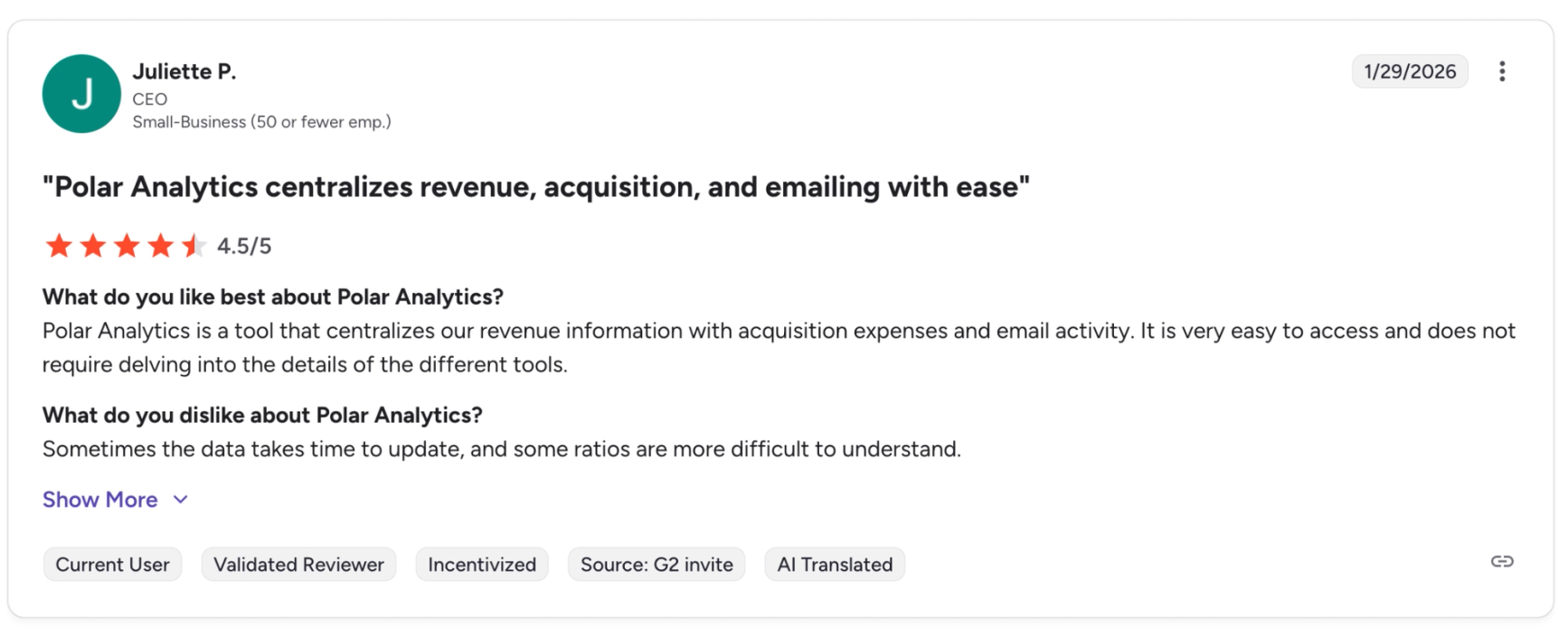
“Polar Analytics is a tool that centralizes our revenue information with acquisition expenses and email activity. It is very easy to access and does not require delving into the details of the different tools. Sometimes the data takes time to update, and some ratios are more difficult to understand.” - Juliette P, G2 User

AI and Automation

AI tools in analytics platforms detect patterns, surface anomalies, and generate recommendations, but the best ones go further and take action. Triple Whale's Moby AI can execute budget changes, generate creative variants, and act directly inside the platform. Polar offers six AI agents including Ask Polar for natural-language data queries, but its AI is oriented around analysis and recommendations rather than execution.

Triple Whale

Triple Whale has Moby, the co-pilot of Triple Whale, designed to deliver the smartest insights and solve complex data questions effortlessly.

Moby is trained on data from 60,000+ brands and $82B in GMV — which means its benchmarks and recommendations are grounded in real ecommerce performance, not generic models. It’s also connected to your real-time data, with the context and tools to take action. 

For example, Moby can:

  • Autonomously manage Meta ads, optimize for ROAS, and adjust bids in real time as performance shifts.
  • Build and send a full Klaviyo campaign — then monitor results and trigger follow-ups automatically.
  • Forecast inventory across your entire catalog, flag what needs restocking, and help you place the PO.
  • Analyze your top creatives, generate new variants, launch them, and feed performance data back to generate the next round, automatically.
  • Build customer segments, sync to any ad platform, and continuously refine them based on how they perform.
  • Get alerted to anomalies the moment they happen — Slack, email, and more — and have Moby diagnose and recommend a fix before you even ask.
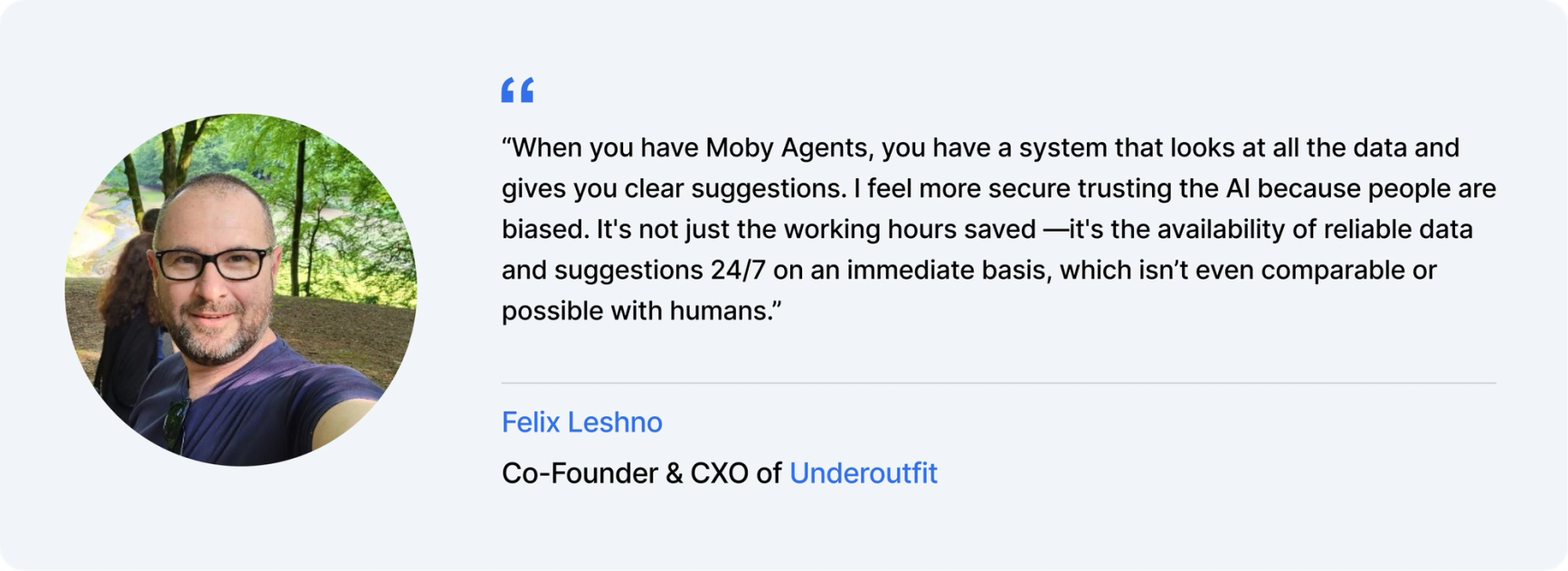
"With Moby, you have a system that looks at all the data and gives you clear suggestions. I feel more secure trusting the AI because people are biased. It's not just the working hours saved — it's the availability of reliable data and suggestions 24/7." – Felix Leshno, Co-Founder & CXO, Underoutfit

Polar

Polar has Ask Polar (a natural-language data analyst), and other agentic solutions. Their AI layer can provide analysis, recommendations, and report generation. While that’s a good start, Triple Whale's Moby can analyze, recommend, report, and act

Feature Triple Whale Polar Analytics
AI Assistant Yes, Moby (live store data) Yes, Ask Polar (natural language)
Agentic Automation Yes Recommends only
Creative Generation Yes No
Alerting & Anomaly Detection Yes Yes

Pricing

Both platforms use GMV-based pricing, so costs scale as your revenue grows. But the more useful comparison isn't just the platform fee — its total cost of ownership, including the additional tools you'll still need alongside each platform. On that basis, Triple Whale's cost of ownership is typically lower, even before accounting for the time saved through consolidation.

Triple Whale

Triple Whale offers a free plan to get started. Paid tiers scale based on your store's needs, with Sonar Send (email and SMS flow enrichment) included free for all paying customers. Advanced multi-touch attribution, Compass (MMM and incrementality), AI capabilities, and dedicated customer success unlock at higher tiers. For current pricing, visit triplewhale.com/pricing.

Polar Analytics

Polar's GMV-based pricing isn’t listed, but it features gated tiers. Incrementality testing, AI agents, and additional activations are reserved for higher plans.

Strengths and Limitations

Every platform has a sweet spot — and an honest answer about where it falls short. Here's a clear-eyed breakdown of both.

Triple Whale

Strengths:

  • Real-time, operator-friendly dashboards built for daily use
  • Seamless Shopify setup — live in under a day, no engineering required
  • Complete measurement suite: MTA, MMM, and incrementality in one platform
  • Broadest CAPI coverage across paid social (7 platforms)
  • An AI layer tied to your data that acts, not just advises
  • AI visibility and social monitoring for the new era of AI search
  • Creative analytics and generation included
  • Mobile app, web analytics, and industry benchmarks included
  • 60,000+ brand dataset powers benchmarks and AI recommendations

Limitations:

  • Teams that want customer-owned Snowflake infrastructure as a primary deliverable will prefer Polar's dedicated warehouse model.
  • Triple Whale is built as an AI-powered operating platform rather than a pure BI layer. It prioritizes speed-to-insight and operator workflows over deep warehouse-level customization (which suits most ecommerce teams well).

Polar Analytics

Strengths:

  • Dedicated Snowflake database per customer (higher tiers)
  • Warehouse-native semantic modeling gives analytics engineers a consistent, extendable data model
  • Strong BI customization and drag-and-drop reporting
  • Multi-store and multi-brand support with global rollups

Limitations:

  • More analytics stack than operating platform. Polar excels at dashboards and SQL access — Triple Whale goes further with attribution, creative analysis, CAPI/Sonar, incrementality, and action-taking.
  • Less execution-oriented AI. Ask Polar adds a Q&A and reporting layer on top of your existing platform. Moby integrates natively with your real-time data, enabling seamless analysis, recommendations, and action across your business.
  • Weaker media-buyer workflow depth. Polar reports on paid performance; Triple Whale is purpose-built for growth teams needing attribution, creative diagnostics, and execution in one place.
  • Insight without built-in action. Polar centralizes data well, but teams may still need separate tools to act on it. Triple Whale is more opinionated about what to do next.
  • Custom integration friction. Non-standard integrations can become support-dependent, with longer lead times noted in reviews.
  • Data refresh latency. Polar data can lag — a limitation for teams needing intraday reads on spend and performance.
  • Steeper learning curve. Polar's BI flexibility is powerful but less plug-and-play for marketers and founders who want answers without building a reporting layer.
  • Narrower tool consolidation. Polar replaces dashboards and spreadsheets. Triple Whale consolidates attribution, forecasting, creative intelligence, data enrichment, post-purchase surveys, and action workflows.

Ideal Use Cases

Choose Triple Whale if:

  • You want measurement, analytics, AI, and creative intelligence in one place
  • Real-time data drives your daily decision-making
  • You're running paid social across multiple channels and need full CAPI coverage
  • You want AI that ships decisions and produces beautiful artifacts and creative, not just surfaces insights
  • You need MMM alongside MTA and incrementality without a separate vendor
  • You're at any stage — Triple Whale scales from early DTC to $250M+ enterprise

Choose Polar Analytics if:

  • Your team is data-mature and wants a dedicated Snowflake instance with SQL access
  • Klaviyo is your primary lifecycle tool and you don't need multi-ESP activation
  • You're comfortable managing a broader set of point solutions around your analytics core
  • Deep BI customization matters more than speed of daily operation

Final Verdict

Both platforms are serious products. Polar Analytics is well-built for data teams that want warehouse-native infrastructure and deep BI flexibility. If that's your primary requirement, it delivers.

But for most Shopify brands in 2026 — especially those who want to move fast, consolidate tools, and have AI that does more than generate a to-do list — Triple Whale is the stronger choice. 

Triple Whale unifies measurement, creative, web analytics, reverse ETL, retention, and AI automation in one platform. One vendor, one contract — with role-based permissions so agencies, marketing, and leadership each see exactly what they need.

Book a demo with Triple Whale

FAQ: Triple Whale vs. Polar

Does Polar have more accurate attribution than Triple Whale?

Triple Whale's attribution is built on three pillars competitors can't match: Triple Pixel for server-side tracking, post-purchase surveys for zero-party data, and deterministic order-level attribution. 

While other tools rely on modeled estimates or client-side pixels that break when browsers clear cookies, Triple Whale captures the full customer journey with precision — and enriches it with direct customer input that no pixel alone can provide.

I heard Triple Whale's data is locked in the platform — is that true?

Not at all. Triple Whale supports full data portability with warehouse exports to BigQuery, Snowflake, AWS S3, and Google Cloud Storage, on a one-time or scheduled basis. It works as a standalone layer or as part of a broader data stack — your data, your infrastructure.

Polar says its open MCP lets you build custom AI agents. Can Triple Whale compete with that?

We see why brands want direct access to their data for building custom AI workflows. We’re building toward that same flexibility at Triple Whale with MCP access connected to our first-party data foundation. Plus, with a key difference: Our MCP access is powered by reconciled first-party data across Shopify, ads, email, and the Triple Pixel. That means Moby can act on a trusted source of truth, not just platform-reported metrics.

Is Triple Whale really built for enterprise, or is it mainly for small DTC brands?

Triple Whale serves over 60,000 brands across the full growth spectrum — from early-stage DTC to enterprise. A first-party pixel combined with a unified data model delivers full-funnel visibility across channels and devices, making complex, cross-channel data usable in real time at any scale.
Component Sales
5.32K
Attribution
Artificial Intelligence

Triple Whale vs. Polar Analytics: An In-Depth Feature Comparison for 2026

Last Updated: 
May 28, 2026

Triple Whale and Polar Analytics are both ecommerce analytics platforms. Triple Whale and Polar Analytics both serve many of the same use cases for ecommerce brands looking to understand their businesses. For example, both platforms have first-party pixels, multi-touch attribution, AI features, and data warehouse capabilities. 

However, most retailers find Triple Whale to be the more complete, AI-powered platform — one that scales across DTC startups, growing SMBs, and enterprise brands alike. This comparison breaks down what each platform offers, where they differ, and where Triple Whale stands out.

Overview of Each Platform

Triple Whale is the AI operating system for ecommerce. It's designed for operators — the founders, media buyers, and growth leads who need clean, fast, actionable data every day without relying on an analyst or data engineer to surface it. 

The platform consolidates best-in-class attribution and advanced marketing measurement (MMM & incrementality testing), creative analytics, profit tracking, web analytics, product analytics, data enrichment, and AI automation into a single interface. 

It's trusted by 60,000+ brands from early-stage Shopify stores to enterprises doing $250M+ in annual revenue.

Polar Analytics positions itself as "the all-in-one data stack for omnichannel DTC brands." It's a BI-forward platform built around a unified data layer and, on higher tiers, a dedicated Snowflake warehouse. 

Polar is designed for brands with operational complexity, such as multi-store setups, multiple markets, and cross-channel marketing. It’s also for teams that want deep customization alongside their analytics.

Feature Triple Whale Polar Analytics
Brands Served 60,000 4,000
Highlight AI operating platform for ecommerce brands BI & data warehouse for DTC/omnichannel brands
Best For Brands $1M–$250M seeking a unified platform Shopify brands with multi-store or data-team complexity
Ratings (G2) 4.5 (470+ reviews) 4.7 (Only 21 reviews)
Price Free & tiered plans Tiered plans only
Standout Features Moby AI, Creative Analytics, Compass (MMM, MTA + Incrementality), AI Visibility Snowflake warehouse, semantic data layer, AI agents
AI Capabilities Moby, for automated analysis, creative generation, ad management, email campaigns, landing page generation, and more. Ask Polar, for automated analysis
Real-Time Data Yes, all tiers No (not highlighted)
CAPI Coverage Meta, Google, TikTok, Snapchat, Pinterest, Reddit, X Meta and Google only
Email/SMS Flow Enrichment Klaviyo, Attentive, and Omnisend Klaviyo-only
Official Shopify Partner Yes Yes

Attribution, Measurement, and Enrichment

Attribution is the foundation of every spending decision you make, and the two platforms take different approaches. Triple Whale offers multiple attribution models plus MMM and incrementality testing for unified measurement. The platform has server-side CAPI coverage across seven paid social channels. Polar covers the fundamentals well with solid first-party tracking and deterministic attribution, but lacks native MMM and limits CAPI to Meta and Google only.

Triple Whale

Triple Whale has seven attribution models, including first-click, last-click, linear, Total Impact, and Clicks & Deterministic Views. Its Compass solution goes further, combining multi-touch attribution (MTA), marketing mix modeling (MMM), and incrementality testing into one continuously calibrating system — giving brands a complete measurement picture without needing a separate vendor for each layer.

Triple Whale's Triple Pixel is a proprietary first-party tracking infrastructure built specifically for ecommerce, with identity resolution to stitch together cross-device journeys. Sonar Send — included with every paid Triple Whale plan — enriches your email and SMS flows with first-party data, capturing the shoppers default pixels miss across Klaviyo, Attentive and Omnisend, so your abandonment flows reach more customers they were built meant to reach and drive more incremental revenue.

Sonar Optimize sends first-party customer and conversion data to Meta, Google, TikTok, Snapchat, Pinterest, Reddit, and X — covering the full modern paid social mix, not just the two largest platforms. It also sends your attribution signals back to your ad platforms automatically, so these same platforms optimize for the metrics that map to your business growth, not just platform-reported conversions.

Polar Analytics

Polar deploys its own Polar Pixel for first-party tracking and supports server-side CAPI for Meta and Google. Its attribution approach combines deterministic and modeled signals, and its incrementality testing module lets brands run structured lift tests to validate channel and campaign impact. Polar does not include native MMM — brands that need it would require a separate tool.

Feature Triple Whale Polar Analytics
First-Party Pixel Triple Pixel (with identity resolution) Polar Pixel
Server-Side CAPI Meta, Google, TikTok, Snapchat, Pinterest, Reddit, X Meta and Google only
Attribution Passback Meta (open beta), more coming soon No
Attribution Models First Click, Last Click, Linear (All & Paid), Total Impact, Triple Attribution, Clicks & Deterministic Views First Click, Last Click, Linear (All, Paid), Full-Paid Overlap, Full Paid Overlap + Facebook Views, U-shaped, Full Impact (Paid & Non-paid)
MMM Yes (Compass) No
Incrementality Testing Yes (Compass) Yes (add-on)
Real-Time Data Yes, all tiers Not highlighted

Analytics, Reporting, and Business Intelligence

Both platforms offer dashboards and custom reporting, but they're built for different users. Polar is a strong fit for data teams that want warehouse-backed flexibility and deep BI customization. Triple Whale is built for operators who need fast, daily answers — with creative intelligence and web analytics (and many more) included out of the box, plus advanced BI capabilities if you want to go deeper.

Triple Whale

Triple Whale brings enterprise-grade BI to the entire business. From marketing to ops to data teams, anyone can build custom reports and visualizations. 

Sub-3-second report load times, real-time data at every tier, and an interface designed for operators rather than analysts. The platform covers profit tracking, acquisition analytics, retention metrics, product analytics, web analytics, and creative performance — all in one place.

For power users who want more than just dashboards, Triple Whale provides full SQL access so you can build, query, and customize your data however you want.

Polar Analytics

Polar's BI layer is its strength. The platform offers a library of pre-built dashboards for performance, acquisition, retention, merchandising, and profitability, plus a drag-and-drop custom reporting interface for building views. Combined with direct Snowflake access on higher tiers, Polar gives data teams flexibility.

Feature Triple Whale Polar Analytics
Real-Time Dashboards Yes, all tiers Not highlighted
Custom Reporting Yes Yes
Creative Analytics Deep (hooks, format, UGC vs studio) Ad-level reporting only
Web Analytics Yes No
Product Analytics Yes Yes
Profit & Loss Yes Yes
Mobile App Yes No
Industry Benchmarks Yes (60,000+ brands) No
SQL / Raw Data Access Yes Yes (higher tiers)
“Polar Analytics is a tool that centralizes our revenue information with acquisition expenses and email activity. It is very easy to access and does not require delving into the details of the different tools. Sometimes the data takes time to update, and some ratios are more difficult to understand.” - Juliette P, G2 User

AI and Automation

AI tools in analytics platforms detect patterns, surface anomalies, and generate recommendations, but the best ones go further and take action. Triple Whale's Moby AI can execute budget changes, generate creative variants, and act directly inside the platform. Polar offers six AI agents including Ask Polar for natural-language data queries, but its AI is oriented around analysis and recommendations rather than execution.

Triple Whale

Triple Whale has Moby, the co-pilot of Triple Whale, designed to deliver the smartest insights and solve complex data questions effortlessly.

Moby is trained on data from 60,000+ brands and $82B in GMV — which means its benchmarks and recommendations are grounded in real ecommerce performance, not generic models. It’s also connected to your real-time data, with the context and tools to take action. 

For example, Moby can:

  • Autonomously manage Meta ads, optimize for ROAS, and adjust bids in real time as performance shifts.
  • Build and send a full Klaviyo campaign — then monitor results and trigger follow-ups automatically.
  • Forecast inventory across your entire catalog, flag what needs restocking, and help you place the PO.
  • Analyze your top creatives, generate new variants, launch them, and feed performance data back to generate the next round, automatically.
  • Build customer segments, sync to any ad platform, and continuously refine them based on how they perform.
  • Get alerted to anomalies the moment they happen — Slack, email, and more — and have Moby diagnose and recommend a fix before you even ask.
"With Moby, you have a system that looks at all the data and gives you clear suggestions. I feel more secure trusting the AI because people are biased. It's not just the working hours saved — it's the availability of reliable data and suggestions 24/7." – Felix Leshno, Co-Founder & CXO, Underoutfit

Polar

Polar has Ask Polar (a natural-language data analyst), and other agentic solutions. Their AI layer can provide analysis, recommendations, and report generation. While that’s a good start, Triple Whale's Moby can analyze, recommend, report, and act

Feature Triple Whale Polar Analytics
AI Assistant Yes, Moby (live store data) Yes, Ask Polar (natural language)
Agentic Automation Yes Recommends only
Creative Generation Yes No
Alerting & Anomaly Detection Yes Yes

Pricing

Both platforms use GMV-based pricing, so costs scale as your revenue grows. But the more useful comparison isn't just the platform fee — its total cost of ownership, including the additional tools you'll still need alongside each platform. On that basis, Triple Whale's cost of ownership is typically lower, even before accounting for the time saved through consolidation.

Triple Whale

Triple Whale offers a free plan to get started. Paid tiers scale based on your store's needs, with Sonar Send (email and SMS flow enrichment) included free for all paying customers. Advanced multi-touch attribution, Compass (MMM and incrementality), AI capabilities, and dedicated customer success unlock at higher tiers. For current pricing, visit triplewhale.com/pricing.

Polar Analytics

Polar's GMV-based pricing isn’t listed, but it features gated tiers. Incrementality testing, AI agents, and additional activations are reserved for higher plans.

Strengths and Limitations

Every platform has a sweet spot — and an honest answer about where it falls short. Here's a clear-eyed breakdown of both.

Triple Whale

Strengths:

  • Real-time, operator-friendly dashboards built for daily use
  • Seamless Shopify setup — live in under a day, no engineering required
  • Complete measurement suite: MTA, MMM, and incrementality in one platform
  • Broadest CAPI coverage across paid social (7 platforms)
  • An AI layer tied to your data that acts, not just advises
  • AI visibility and social monitoring for the new era of AI search
  • Creative analytics and generation included
  • Mobile app, web analytics, and industry benchmarks included
  • 60,000+ brand dataset powers benchmarks and AI recommendations

Limitations:

  • Teams that want customer-owned Snowflake infrastructure as a primary deliverable will prefer Polar's dedicated warehouse model.
  • Triple Whale is built as an AI-powered operating platform rather than a pure BI layer. It prioritizes speed-to-insight and operator workflows over deep warehouse-level customization (which suits most ecommerce teams well).

Polar Analytics

Strengths:

  • Dedicated Snowflake database per customer (higher tiers)
  • Warehouse-native semantic modeling gives analytics engineers a consistent, extendable data model
  • Strong BI customization and drag-and-drop reporting
  • Multi-store and multi-brand support with global rollups

Limitations:

  • More analytics stack than operating platform. Polar excels at dashboards and SQL access — Triple Whale goes further with attribution, creative analysis, CAPI/Sonar, incrementality, and action-taking.
  • Less execution-oriented AI. Ask Polar adds a Q&A and reporting layer on top of your existing platform. Moby integrates natively with your real-time data, enabling seamless analysis, recommendations, and action across your business.
  • Weaker media-buyer workflow depth. Polar reports on paid performance; Triple Whale is purpose-built for growth teams needing attribution, creative diagnostics, and execution in one place.
  • Insight without built-in action. Polar centralizes data well, but teams may still need separate tools to act on it. Triple Whale is more opinionated about what to do next.
  • Custom integration friction. Non-standard integrations can become support-dependent, with longer lead times noted in reviews.
  • Data refresh latency. Polar data can lag — a limitation for teams needing intraday reads on spend and performance.
  • Steeper learning curve. Polar's BI flexibility is powerful but less plug-and-play for marketers and founders who want answers without building a reporting layer.
  • Narrower tool consolidation. Polar replaces dashboards and spreadsheets. Triple Whale consolidates attribution, forecasting, creative intelligence, data enrichment, post-purchase surveys, and action workflows.

Ideal Use Cases

Choose Triple Whale if:

  • You want measurement, analytics, AI, and creative intelligence in one place
  • Real-time data drives your daily decision-making
  • You're running paid social across multiple channels and need full CAPI coverage
  • You want AI that ships decisions and produces beautiful artifacts and creative, not just surfaces insights
  • You need MMM alongside MTA and incrementality without a separate vendor
  • You're at any stage — Triple Whale scales from early DTC to $250M+ enterprise

Choose Polar Analytics if:

  • Your team is data-mature and wants a dedicated Snowflake instance with SQL access
  • Klaviyo is your primary lifecycle tool and you don't need multi-ESP activation
  • You're comfortable managing a broader set of point solutions around your analytics core
  • Deep BI customization matters more than speed of daily operation

Final Verdict

Both platforms are serious products. Polar Analytics is well-built for data teams that want warehouse-native infrastructure and deep BI flexibility. If that's your primary requirement, it delivers.

But for most Shopify brands in 2026 — especially those who want to move fast, consolidate tools, and have AI that does more than generate a to-do list — Triple Whale is the stronger choice. 

Triple Whale unifies measurement, creative, web analytics, reverse ETL, retention, and AI automation in one platform. One vendor, one contract — with role-based permissions so agencies, marketing, and leadership each see exactly what they need.

Book a demo with Triple Whale

FAQ: Triple Whale vs. Polar

Does Polar have more accurate attribution than Triple Whale?

Triple Whale's attribution is built on three pillars competitors can't match: Triple Pixel for server-side tracking, post-purchase surveys for zero-party data, and deterministic order-level attribution. 

While other tools rely on modeled estimates or client-side pixels that break when browsers clear cookies, Triple Whale captures the full customer journey with precision — and enriches it with direct customer input that no pixel alone can provide.

I heard Triple Whale's data is locked in the platform — is that true?

Not at all. Triple Whale supports full data portability with warehouse exports to BigQuery, Snowflake, AWS S3, and Google Cloud Storage, on a one-time or scheduled basis. It works as a standalone layer or as part of a broader data stack — your data, your infrastructure.

Polar says its open MCP lets you build custom AI agents. Can Triple Whale compete with that?

We see why brands want direct access to their data for building custom AI workflows. We’re building toward that same flexibility at Triple Whale with MCP access connected to our first-party data foundation. Plus, with a key difference: Our MCP access is powered by reconciled first-party data across Shopify, ads, email, and the Triple Pixel. That means Moby can act on a trusted source of truth, not just platform-reported metrics.

Is Triple Whale really built for enterprise, or is it mainly for small DTC brands?

Triple Whale serves over 60,000 brands across the full growth spectrum — from early-stage DTC to enterprise. A first-party pixel combined with a unified data model delivers full-funnel visibility across channels and devices, making complex, cross-channel data usable in real time at any scale.
Kaleena Stroud

Kaleena Stroud is a copywriter for SaaS and DTC businesses.

Kaleena Stroud

Kaleena Stroud is a content writer at Triple Whale, bringing data stories to life. She spent many years running an online copywriting business, where she helped brands launch and revamp their Shopify stores. Her work has been featured in Practical Ecommerce, Convert, and Create & Cultivate.

Body Copy: The following benchmarks compare advertising metrics from April 1-17 to the previous period. Considering President Trump first unveiled 
his tariffs on April 2, the timing corresponds with potential changes in advertising behavior among ecommerce brands (though it isn’t necessarily correlated).

Ready to make confident, data-driven decisions faster than ever?

Thank you! Your submission has been received!
Oops! Something went wrong while submitting the form.