BFCM 2025 shattered records. Triple Whale brands alone tracked $2.8 billion in revenue across the sale season — representing 19.7% of total Shopify merchant sales. Read the full breakdown in the BFCM 2025 Retrospective Report.
So, how does a brand win BFCM? The first step is to plan ahead. But sometimes even when you plan, you can run into things you didn't anticipate.
In this article, we'll explore some ways that AI can significantly impact your business, from task automation to dynamic ad creatives and more.
Are you ready to win BFCM with AI? Let's get into it.
1. AI-powered ad campaign optimization
Running ads means generating plenty of data, from clicks to purchases to customers who bounce off the page. A brand is often running ads on multiple platforms, and it's difficult to get a glimpse of how all of its ads are performing simultaneously.
Triple Whale empowers you, the brand owner, with a comprehensive view of data from all platforms at once, and AI is used to analyze data and provide actionable insights in a few ways:
Dynamic creative optimization
Moby, Triple Whale's AI operator, is trained on your business's data. From industry trends to company-specific queries, there's no wrong question for Moby. It understands your business and your data, like a well-informed team member who's always available.
You can ask Moby questions to understand how your business performed during BFCM last year, so you can make better-informed decisions about 2026.
Ask Moby: "What were my top performing ads over BFCM 2025?" to get a clear picture of what drove results. Moby can also generate new copy for ads based on the best-performing ones, giving you fresh, dynamic creative options grounded in what already worked.
Beyond analysis, Moby Actions lets you execute decisions directly — pause underperforming campaigns, adjust budgets, and act on insights across ad platforms without ever leaving Triple Whale.
You can then conduct A/B tests within the platform to determine which ad versions are most effective, enabling you to iterate and improve using Triple Whale's performance analytics.
2. Manage inventory during peak periods
In 2025, Triple Whale brands processed 26 million orders over the BFCM weekend alone. That kind of volume demands inventory infrastructure that can keep up.
Demand forecasting
Analyzing historical data is a great way to predict future demand. This knowledge helps ensure you have the right amount of stock for BFCM ahead of time, minimizing the risk of stockouts or overstocking the wrong products.
Real-time sales tracking
You can monitor your sales in real time on Triple Whale, allowing you to quickly identify which products are flying off the shelves. This enables you to make swift decisions about reordering or reallocating stock.
If you're running an ad for a product that's running low, you can quickly identify this and adjust ads to promote products with more available inventory.
Product-specific performance insights
A clear view of which products are your best sellers and which are lagging behind can make or break your BFCM. Triple Whale helps you prioritize inventory for the high-demand products that will be your winners for the event.
Cross-channel inventory management
When selling across multiple channels, stock levels and ad performance data can get murky unless you track it all in one place. Triple Whale provides an all-encompassing view of every sales channel to ensure consistency and prevent overselling.
3. AI-enhanced customer support
Chatbots and virtual assistants like Gorgias can handle the high volume of customer inquiries you'll receive during BFCM. By simplifying the customer experience and providing 24/7 access to support, you'll be able to lift the burden of common questions that bog down your live agents.
For reference, Gorgias's customer Topicals used their Quick Response Flows feature in the chat widget and were able to deflect 69% of tickets that would have required a live agent's attention, along with associated wait times.
4. Real-time data analysis and decision making
One of the biggest benefits of using Triple Whale during BFCM is the ability to monitor sales and performance in real time, adapting marketing strategies on the fly based on AI insights. During BFCM 2025, Triple Whale brands sent 24,631 messages to Moby over the weekend — querying spend allocation, cannibalization, scaling decisions, and more.
Real-time dashboards
Aggregating all of your data from various sources in one place allows you to monitor sales, ad performance, and customer behavior events as they happen. This enables you to quickly identify trends and make the necessary adjustments to improve.
Attribution insights
Triple Whale's comprehensive view of all marketing channels allows you to understand and track which channels are driving the most conversions in real time. With these critical insights, you can allocate your ad budget more effectively during the high-traffic period to capitalize on more sales.
5. Custom dashboards built specifically for BFCM
There are many metrics to track and many decisions that need to be made quickly with the correct information at your fingertips.
That's why we built these two boards specifically for mastering BFCM:
- BFCM Mission Control Board
- Hourly Performance Dashboard
BFCM Mission Control Board
The BFCM Mission Control Board should act exactly as it sounds: your anchor in the craziness of BFCM. It's full of useful widgets that cover everything you'll need to keep track of during the event. Use it first and foremost to look at your metrics from last year and set goals for how you expect to perform in 2026.
Hourly Performance Dashboard
What better way to analyze your performance and stay quick with your decisions than with an hourly performance review? Here's an easy way to see cumulative revenue, cumulative contribution dollars, and total revenue, hour by hour, throughout the day.
As you're spending money, you'll have a clear view of your top line metrics. As you are running ads, you can analyze performance and understand which of your ads are performing well to iterate and improve on them.
6. Benchmark your performance against the competition
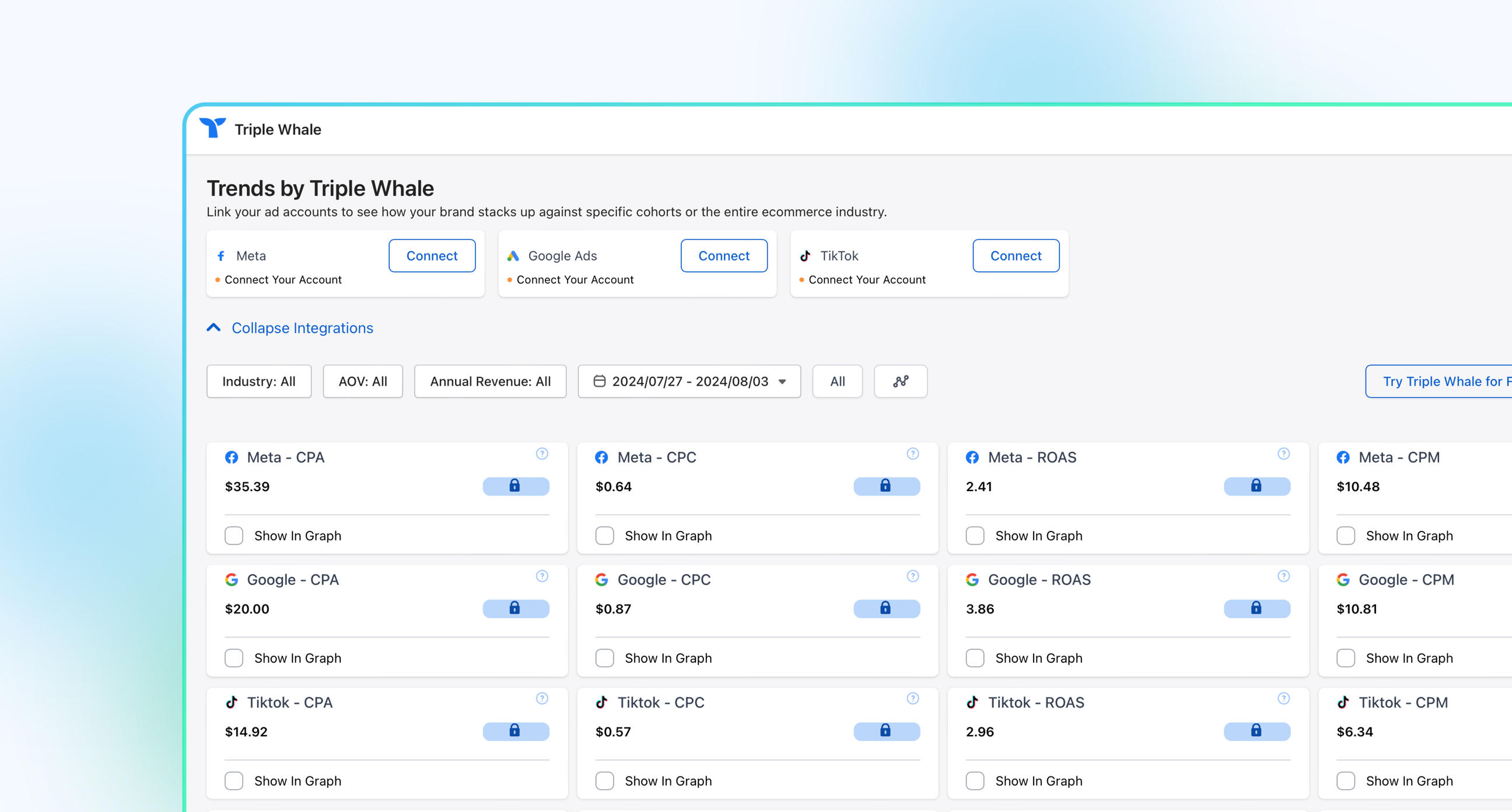
Compare your performance against real peer benchmarks to see exactly where you stack up. Ads Benchmarks is built on real performance data from 60,000+ ecommerce brands in Triple Whale, giving you a true reference point for metrics like ROAS, CPA, CTR, and more.
You can filter by AOV segment, industry, GMV segment, and ad channel to get granular insights. Going into BFCM knowing whether your ROAS is competitive — or has room to improve — is a significant strategic advantage.
7. Ask Moby for help
You have a lot of data. Moby has many of the answers. Here are a few sample queries you can use with Moby to get actionable insights ahead of and during BFCM:
"What were the top-selling products from last year's BFCM? Show me key product analytics, including total sales, total revenue, AOV, gross profit, and contribution margin per item."
"During the 2025 holiday shopping season (November - December 2025), which hours of the day saw the most website visitors? Which hours had the highest conversion rates and sales?"
Or
"Analyze which BFCM 2025 creatives maintained or improved efficiency when we increased spend. Identify:
- Creatives with the best scaling potential
- Audience segments most responsive to winning creative themes
- Budget levels where performance remained stable
- Creative elements that predict scalability
Recommend which creative themes have the highest scaling potential for BFCM 2026 and optimal budget allocation strategies."
Or
"During BFCM, alert me if any active campaign's ROAS drops below [threshold] and suggest which budget to reallocate."
8. Maximize campaign revenue with Sonar
Triple Whale can push enriched first-party data back to your marketing platforms, enhancing targeting, increasing ROI, and capturing every touchpoint that may have previously fallen through the cracks. By combining website event data with platform data, you get a more complete picture of every customer journey.
Meta: enriched event data through Sonar Optimize
Sonar Optimize sends enriched data back to Meta via the Conversions API (CAPI), enabling brands to drive improved campaign results through better targeting. This is especially critical during BFCM when you need detailed customer information to inform campaign targeting that can be adjusted in real time.
Klaviyo: enriched data to trigger more flows with Sonar Send
The holiday season is prime time for cart and browse abandonments. When Sonar Send pushes enriched data back to Klaviyo — including active on-site events, viewed product events, and add-to-cart events — Klaviyo customers can get their message in front of the right people at the right time. With more complete data, you'll capture revenue that would have otherwise been lost.
Get to winning BFCM
With these eight strategies for mastering AI-based tools, you'll be ready to take BFCM 2026 by the horns — both in the lead-up and during the event itself. Stay agile, stay informed, and keep the revenue flowing.
Need more inspiration for dominating BFCM 2026? Check out our BFCM Resource Hub for guides, checklists, and resources.


 Moby AIAsk questions, analyze performance, and work with your business context.
 ActionsTake governed action across the tools that run your business.
 AutomationsSchedule recurring analysis and work that runs on your terms.
 Landing PagesCreative conversion-focused ecommerce pages with Moby.
 Creative StudioGenerate and refine creative grounded in your brand.




.jpg)





.webp)

.webp)
