Socials. YouTube. CTV. Shopping is increasingly beginning with video. In fact, 43% of shoppers said video played a role in their path to purchase, sparking their interest in buying a product, according to a recent study.
Most attribution setups weren't built for that. If you're only counting clicks, you're missing the top-of-funnel story — exactly where video lives. This post covers the attribution model that’s here to solve this problem — Clicks & Deterministic Views (C&DV) — including how to set it up and why it’s useful.
We’ll also hear from TikTok, Vibe, and ecommerce brand Pressed Juicery to answer key questions, including how you can measure video's true impact using C&DV.
What is deterministic view-through attribution?
The Clicks & Deterministic Views attribution model blends high-intent actions (clicks) with qualified exposures (views), from supported platforms (Meta, TikTok, Pinterest, Vibe, AppLovin) to give a more complete and balanced picture of channel influence across the customer journey.
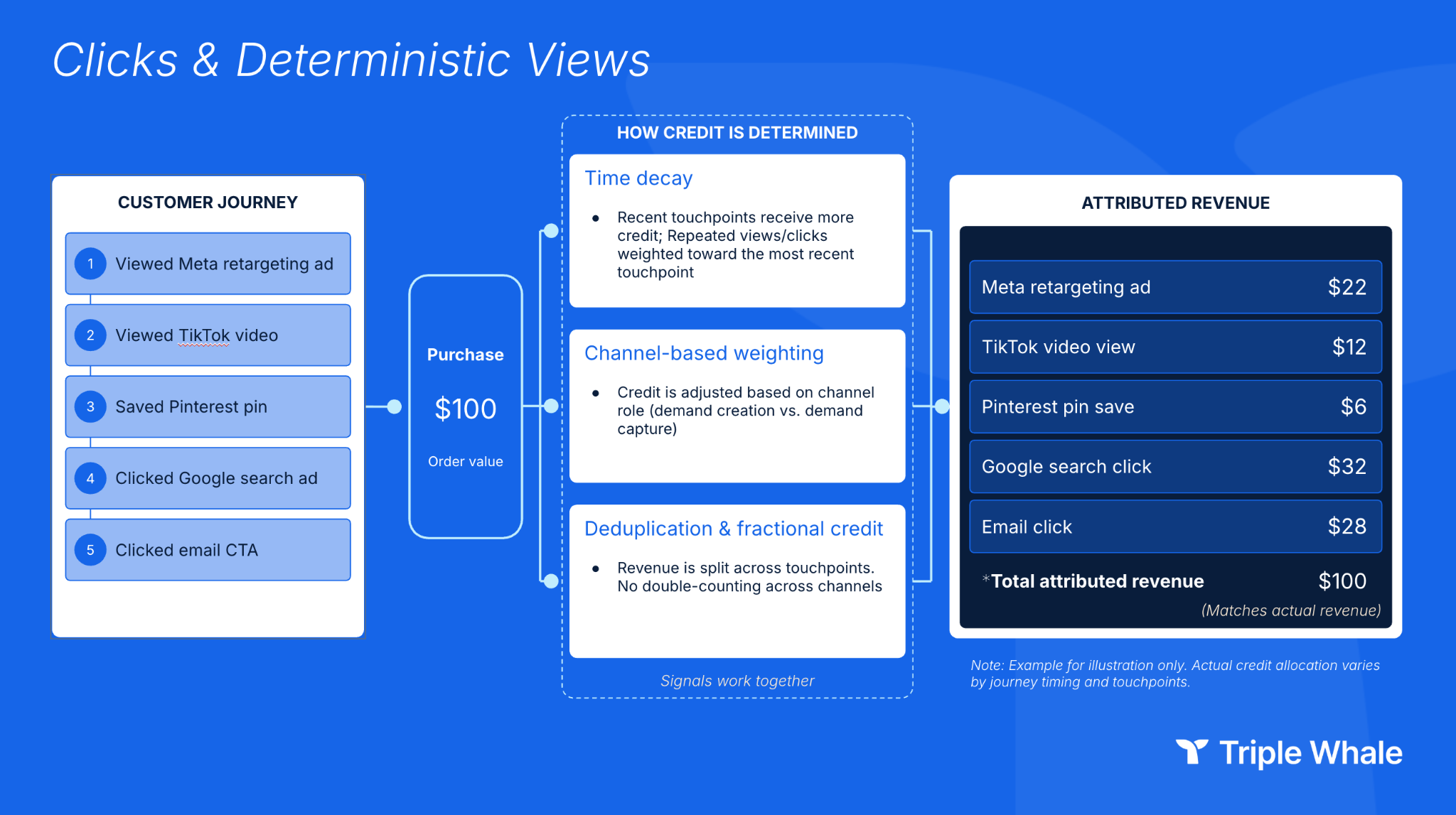
The model applies a time-decay algorithm that distributes credit based on how close each touchpoint is to the conversion:
Single-touch models (first-click, last-click) used to be the default. They made sense when the path to purchase was relatively linear. That's no longer the case.
"That's not how shopping works anymore," explains Caitlin Hassinger, Customer & Field Marketing Director at Vibe. "No one watches an ad, clicks an ad, and purchases."
What actually happens is that attention accumulates. People scroll past ads, absorb brands passively, and return when they're ready to buy. The familiar option wins — but the touchpoints that built that familiarity almost never get credit.
TikTok sees this play out at scale. "Fifty-eight percent of users will delay visiting a website or app because they're engrossed in a stream of content," explains Mohit Arora, Global Product Marketing Measurement at TikTok.
"But does that mean they won't purchase? Quite the contrary — users exposed to TikTok ads are 1.5x more likely to make a purchase. But is that purchase getting captured in last-click attribution? Not really. 90% of TikTok's impact is not getting captured,” he adds, noting that view-through attribution closes that gap.
How deterministic view-through attribution works
A pixel, like Triple Pixel, is the foundation — an advanced identity graph backed by server-side technology that captures every customer interaction across devices and channels.
Once connected, the model runs a match-back against each ad channel to identify which devices saw an ad, then ties those exposures to purchases captured by Triple Pixel.
Credit is distributed based on proximity to conversion and touchpoint type, with clicks weighted higher than views to reflect stronger purchase intent. So if you’re wondering: How should ecommerce brands measure view-through conversions without over-crediting ads? There’s no need to sweat it.
So, what does this look like in day-to-day life? Let’s take a look at a couple of examples.
Example A: Cross-channel Pinterest View & Meta Click
A shopper sees a Pinterest ad, then clicks a Meta ad before purchasing. Both touchpoints get credit: the Meta click receives the larger share, the Pinterest view receives a smaller assist.
Example B: Paid View & Direct Visit
A shopper views a TikTok ad, then navigates directly to the site and purchases without clicking any ad. The direct visit receives no credit; the TikTok view receives full credit as the only eligible paid touchpoint.
So what’s the difference between platform-reported views and deterministic views?
Platform-reported views are self-reported by the ad platforms themselves — meaning Meta is telling you how many people saw your Meta ad, TikTok is telling you how many saw your TikTok ad. There's no independent verification, and no cross-channel visibility.
Deterministic views work differently:
The Triple Pixel observes the actual purchase event on your site
Triple Whale matches that event against verified ad exposure data from each channel
Credit is only assigned when the match is confirmed — not estimated
In summary, platform-reported numbers tend to inflate performance because every platform is measuring in its own silo. Deterministic views are conservative by design — if the match isn't there, the credit isn't either.
When view-through measurement is most useful
This model is most valuable for brands where the customer journey spans more than a single platform or session. That's most ecommerce brands operating today.
Daniel Washburn, Director of Ecommerce at Pressed Juicery, runs 80+ store locations alongside online sales and retail placements at Sprouts and Target. For a brand like that, connecting a social impression to an in-store purchase requires a different kind of measurement infrastructure.
"Having a data point that shows directionally what social is truly contributing is critical when explaining things to the CFO or CEO," says Daniel.
Specifically, this model is especially useful for:
Paid social-heavy advertisers (Meta video, TikTok, Pinterest, AppLovin): capture influence from impressions that never result in direct clicks.
Multi-channel marketers: prevent email or direct from claiming all credit when paid ads influenced the journey.
Growth-stage brands investing in awareness: attribute upper-funnel campaigns that drive incremental new customers.
Creative and video-focused advertisers: measure campaigns where engagement is visual, not click-based.
What to do differently once you can see views
Measurement alone doesn't move the needle. Here's how leading brands are acting on the data.
Measure the halo effect
View-through data reveals influence that click-based attribution buries. At Vibe, a head-to-head test showed that once CTV was turned on and its impact became visible across other channels, overall retargeting CAC dropped 57%. "Our benchmarks are 3-5x ROAS across campaign types," says Caitlin Hassinger, "and now we're able to see that on reliable platforms." That kind of visibility doesn't change your spend — it changes how you interpret what's working.
Multiply models by campaign type
Not every campaign should be measured the same way. "Ask yourself: What is my new customer purchase percentage by campaign type?" says Zach Rego. "Leveraging not only different models per campaign type, but different signals of what performance looks like for those campaign types is key." A top-of-funnel awareness push and a retargeting campaign are doing different jobs — your attribution model should reflect that.
Optimize your audiences
Once you can see the full journey, you can act on it. Sync segments back to your ad platforms and build exclusion audiences that update in real time — for example, excluding high-LTV customers from top-of-funnel campaigns. It gives platforms better targeting signals, drives down NC-CAC, and prevents budget from working against itself.
How Hat Club uncovered a 413% lift in TikTok-attributed revenue
As Hat Club scaled its marketing mix, TikTok became an increasingly important — yet difficult-to-measure — channel. The platform was clearly driving engagement and top-of-funnel attention, but traditional click-based attribution consistently underrepresented its contribution to conversions. Layering in deterministic view-through data changed that.
"Clicks & Deterministic Views has caused us to see TikTok as an entirely separate emerging channel, instead of a similar audience to Instagram with a large amount of crossover," says Steve Berman, Director of Performance Marketing at Hat Club.
Get a clearer picture of cross-channel performance
If your TikTok, Meta video, or Vibe spend keeps underperforming on paper while your team's instinct says otherwise, the gap is probably in your attribution model — not your creative. Book a demo today and see what Clicks & Deterministic Views reveals about your funnel.
FAQ
Is view-through attribution reliable?
When it's deterministic — matched to actual device-level data — yes. The risk of unreliability comes from modeled views, which are estimated rather than observed. Triple Whale's Clicks & Deterministic Views model uses verified match-backs, not probabilistic modeling.
What's the difference between click-through and view-through attribution?
Click-through attribution credits a conversion only when a user explicitly clicks an ad. View-through attribution credits an ad when a user sees the impression and converts later without clicking — capturing influence that click-only models miss entirely.
What's the difference between a modeled view and a deterministic view?
Modeled views are estimated by the ad platform based on statistical inference. Deterministic views are verified — the Triple Pixel confirms the device saw the ad and ties that exposure directly to a purchase event.
Does it replace last-click?
It replaces last-click as your primary decision-making model, yes. Last-click will still show up in your data, but optimizing it alone means systematically underfunding the channels doing the hardest awareness work.
Component Sales
5.32K
Benchmark your ecommerce brand against industry leaders
Socials. YouTube. CTV. Shopping is increasingly beginning with video. In fact, 43% of shoppers said video played a role in their path to purchase, sparking their interest in buying a product, according to a recent study.
Most attribution setups weren't built for that. If you're only counting clicks, you're missing the top-of-funnel story — exactly where video lives. This post covers the attribution model that’s here to solve this problem — Clicks & Deterministic Views (C&DV) — including how to set it up and why it’s useful.
We’ll also hear from TikTok, Vibe, and ecommerce brand Pressed Juicery to answer key questions, including how you can measure video's true impact using C&DV.
What is deterministic view-through attribution?
The Clicks & Deterministic Views attribution model blends high-intent actions (clicks) with qualified exposures (views), from supported platforms (Meta, TikTok, Pinterest, Vibe, AppLovin) to give a more complete and balanced picture of channel influence across the customer journey.
The model applies a time-decay algorithm that distributes credit based on how close each touchpoint is to the conversion:
Single-touch models (first-click, last-click) used to be the default. They made sense when the path to purchase was relatively linear. That's no longer the case.
"That's not how shopping works anymore," explains Caitlin Hassinger, Customer & Field Marketing Director at Vibe. "No one watches an ad, clicks an ad, and purchases."
What actually happens is that attention accumulates. People scroll past ads, absorb brands passively, and return when they're ready to buy. The familiar option wins — but the touchpoints that built that familiarity almost never get credit.
TikTok sees this play out at scale. "Fifty-eight percent of users will delay visiting a website or app because they're engrossed in a stream of content," explains Mohit Arora, Global Product Marketing Measurement at TikTok.
"But does that mean they won't purchase? Quite the contrary — users exposed to TikTok ads are 1.5x more likely to make a purchase. But is that purchase getting captured in last-click attribution? Not really. 90% of TikTok's impact is not getting captured,” he adds, noting that view-through attribution closes that gap.
How deterministic view-through attribution works
A pixel, like Triple Pixel, is the foundation — an advanced identity graph backed by server-side technology that captures every customer interaction across devices and channels.
Once connected, the model runs a match-back against each ad channel to identify which devices saw an ad, then ties those exposures to purchases captured by Triple Pixel.
Credit is distributed based on proximity to conversion and touchpoint type, with clicks weighted higher than views to reflect stronger purchase intent. So if you’re wondering: How should ecommerce brands measure view-through conversions without over-crediting ads? There’s no need to sweat it.
So, what does this look like in day-to-day life? Let’s take a look at a couple of examples.
Example A: Cross-channel Pinterest View & Meta Click
A shopper sees a Pinterest ad, then clicks a Meta ad before purchasing. Both touchpoints get credit: the Meta click receives the larger share, the Pinterest view receives a smaller assist.
Example B: Paid View & Direct Visit
A shopper views a TikTok ad, then navigates directly to the site and purchases without clicking any ad. The direct visit receives no credit; the TikTok view receives full credit as the only eligible paid touchpoint.
So what’s the difference between platform-reported views and deterministic views?
Platform-reported views are self-reported by the ad platforms themselves — meaning Meta is telling you how many people saw your Meta ad, TikTok is telling you how many saw your TikTok ad. There's no independent verification, and no cross-channel visibility.
Deterministic views work differently:
The Triple Pixel observes the actual purchase event on your site
Triple Whale matches that event against verified ad exposure data from each channel
Credit is only assigned when the match is confirmed — not estimated
In summary, platform-reported numbers tend to inflate performance because every platform is measuring in its own silo. Deterministic views are conservative by design — if the match isn't there, the credit isn't either.
When view-through measurement is most useful
This model is most valuable for brands where the customer journey spans more than a single platform or session. That's most ecommerce brands operating today.
Daniel Washburn, Director of Ecommerce at Pressed Juicery, runs 80+ store locations alongside online sales and retail placements at Sprouts and Target. For a brand like that, connecting a social impression to an in-store purchase requires a different kind of measurement infrastructure.
"Having a data point that shows directionally what social is truly contributing is critical when explaining things to the CFO or CEO," says Daniel.
Specifically, this model is especially useful for:
Paid social-heavy advertisers (Meta video, TikTok, Pinterest, AppLovin): capture influence from impressions that never result in direct clicks.
Multi-channel marketers: prevent email or direct from claiming all credit when paid ads influenced the journey.
Growth-stage brands investing in awareness: attribute upper-funnel campaigns that drive incremental new customers.
Creative and video-focused advertisers: measure campaigns where engagement is visual, not click-based.
What to do differently once you can see views
Measurement alone doesn't move the needle. Here's how leading brands are acting on the data.
Measure the halo effect
View-through data reveals influence that click-based attribution buries. At Vibe, a head-to-head test showed that once CTV was turned on and its impact became visible across other channels, overall retargeting CAC dropped 57%. "Our benchmarks are 3-5x ROAS across campaign types," says Caitlin Hassinger, "and now we're able to see that on reliable platforms." That kind of visibility doesn't change your spend — it changes how you interpret what's working.
Multiply models by campaign type
Not every campaign should be measured the same way. "Ask yourself: What is my new customer purchase percentage by campaign type?" says Zach Rego. "Leveraging not only different models per campaign type, but different signals of what performance looks like for those campaign types is key." A top-of-funnel awareness push and a retargeting campaign are doing different jobs — your attribution model should reflect that.
Optimize your audiences
Once you can see the full journey, you can act on it. Sync segments back to your ad platforms and build exclusion audiences that update in real time — for example, excluding high-LTV customers from top-of-funnel campaigns. It gives platforms better targeting signals, drives down NC-CAC, and prevents budget from working against itself.
How Hat Club uncovered a 413% lift in TikTok-attributed revenue
As Hat Club scaled its marketing mix, TikTok became an increasingly important — yet difficult-to-measure — channel. The platform was clearly driving engagement and top-of-funnel attention, but traditional click-based attribution consistently underrepresented its contribution to conversions. Layering in deterministic view-through data changed that.
"Clicks & Deterministic Views has caused us to see TikTok as an entirely separate emerging channel, instead of a similar audience to Instagram with a large amount of crossover," says Steve Berman, Director of Performance Marketing at Hat Club.
Get a clearer picture of cross-channel performance
If your TikTok, Meta video, or Vibe spend keeps underperforming on paper while your team's instinct says otherwise, the gap is probably in your attribution model — not your creative. Book a demo today and see what Clicks & Deterministic Views reveals about your funnel.
FAQ
Is view-through attribution reliable?
When it's deterministic — matched to actual device-level data — yes. The risk of unreliability comes from modeled views, which are estimated rather than observed. Triple Whale's Clicks & Deterministic Views model uses verified match-backs, not probabilistic modeling.
What's the difference between click-through and view-through attribution?
Click-through attribution credits a conversion only when a user explicitly clicks an ad. View-through attribution credits an ad when a user sees the impression and converts later without clicking — capturing influence that click-only models miss entirely.
What's the difference between a modeled view and a deterministic view?
Modeled views are estimated by the ad platform based on statistical inference. Deterministic views are verified — the Triple Pixel confirms the device saw the ad and ties that exposure directly to a purchase event.
Does it replace last-click?
It replaces last-click as your primary decision-making model, yes. Last-click will still show up in your data, but optimizing it alone means systematically underfunding the channels doing the hardest awareness work.
Share
Kaleena Stroud
Kaleena Stroud is a copywriter for SaaS and DTC businesses.
Kaleena Stroud
Kaleena Stroud is a content writer at Triple Whale, bringing data stories to life. She spent many years running an online copywriting business, where she helped brands launch and revamp their Shopify stores. Her work has been featured in Practical Ecommerce, Convert, and Create & Cultivate.
Body Copy: The following benchmarks compare advertising metrics from April 1-17 to the previous period. Considering President Trump first unveiled his tariffs on April 2, the timing corresponds with potential changes in advertising behavior among ecommerce brands (though it isn’t necessarily correlated).


 Moby AIAsk questions, analyze performance, and work with your business context.
 ActionsTake governed action across the tools that run your business.
 AutomationsSchedule recurring analysis and work that runs on your terms.
 Landing PagesCreative conversion-focused ecommerce pages with Moby.
 Creative StudioGenerate and refine creative grounded in your brand.












.webp)

.webp)
