CPM is one of the most common pricing models in digital marketing. It’s a go-to model for companies who want their ads to reach a wide audience (and who doesn’t?).
But even though CPM seems to be everywhere, it’s often misunderstood. So what is CPM and when should you use it? Keep reading for answers to these questions — and more.
Key Takeaways
CPM stands for cost per mille, or the cost a marketer pays for every 1,000 impressions of a digital ad. It’s one of the most common pricing models in digital advertising.
Impressions aren’t page views. CPM is a measure of reach, not engagement, making it a better fit for brand awareness, retargeting, and early-stage campaigns.
A low CPM isn’t necessarily “good”; CPM fluctuates widely based on factors such as audience targeting, ad placement, creative quality, and competition.
It’s important to consider CPM in the context of other downstream metrics like CPC and CPA to avoid common CPM mistakes like ignoring audience quality or viewability.
What is CPM?
What does CPM stand for? That would be cost per mille, sometimes called cost per thousand or cost per 1,000 impressions. This ecommerce metric represents how much money an advertiser pays for 1,000 impressions of their ads on a web page. It’s expressed as a dollar amount.
“Mille” is a Latin-derived French word meaning “thousand.” Traditional print and broadcast advertisers paid per thousand readers or viewers, and when digital advertising began in the 1990s, marketers adopted this terminology, according to a Journal of Economic Perspectives article.
What is an impression?
In order to use CPM in advertising, you have to first understand what an impression actually is.
Some people use impressions, page views, and even clicks interchangeably. But these are three entirely different metrics.
Impressions count every time an element of a web page (usually an ad) loaded and appeared for a viewer. Google defines impressions as viewable if “at least 50 percent of its area is visible for at least 1 second for display ads, or at least 2 seconds for video ads.”
Page views count every time a user visits or loads a web page. Clicks count every time a user clicks an ad or another digital element and visits another page. Both of these are measures of deeper engagement or performance. Impressions are instead about visibility. In other words, CPM is a measure of how much you’re paying for visibility, not for traffic or conversions.
Visibility is still important, though. Impressions tell you how often your ad appeared in a place where potential customers might notice it. That reach helps drive awareness, and it also comes in handy for retargeting campaigns. It’s also typically how video, display, and programmatic advertising are sold in media buying.
How to Calculate CPM
Now that you know the CPM definition, it’s time to learn how to find yours.
To calculate CPM, divide your total campaign cost by the number of impressions it received. Then multiply that number by 1,000.
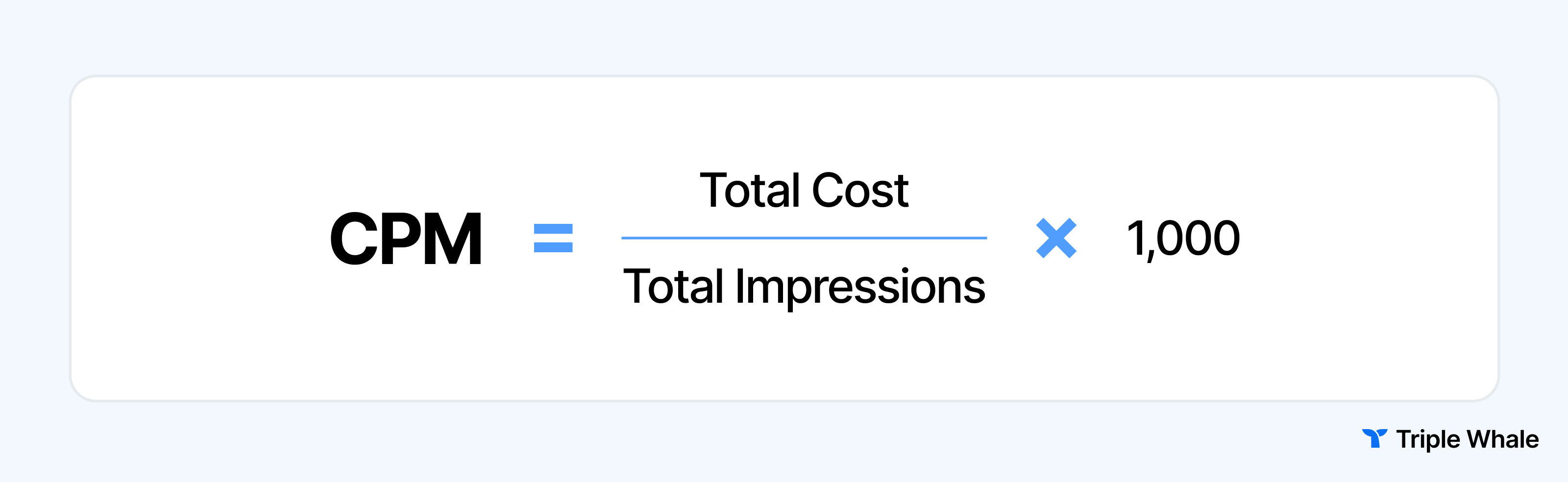
Here’s the CPM formula: CPM = (Total Cost ÷ Total Impressions) × 1,000
CPM Formula Breakdown
By focusing on the total cost and total impressions in a single campaign, CPM standardizes cost across campaigns of different sizes. No matter how big or small your campaign, you’ll always get that standardized result of the cost of 1,000 impressions.
Let’s take a closer look at each variable in the CPM formula:
Total cost: This value should represent everything you spent on advertising for a specific campaign.
Total impressions: This is the number of impressions that campaign received.
Multiplying by 1,000: This is what gives you that essential cost per mille output.
You can also easily rearrange these variables to solve for total spend or total impressions, which can help you with campaign planning. Here’s how those revised formulas look:
Total cost = CPM × Impressions ÷ 1,000
Total impressions = Total cost ÷ CPM × 1,000
Worked Example: Calculating CPM Step by Step
Picture a small ecommerce business that sells handmade scented candles online and runs digital ads on social media. They launch a new campaign to promote a seasonal scent, and they want to track how efficiently they’re reaching new customers using CPM.
Gather the data: Their first step is to find the values for the CPM formula. Let’s say they spent $250 on ads and received 50,000 impressions.
Divide cost by impressions: The first part of their CPM calculation is dividing 250 by 50,000, which equals 0.005.
Multiply by 1,000: To see the cost per thousand impressions, multiply 0.005 by 1,000, which equals 5.
Interpret the results: In this example, this brand’s CPM is $5, meaning they pay $5 for every 1,000 ad impressions for their seasonal candle campaign.
When Should You Use CPM?
CPM advertising works best when your goal is exposure and awareness from a large audience. That makes it ideal for:
Brand awareness campaigns: CPM is a relatively low-cost way to reach a large audience, and it doesn’t rely on engagement, just exposure. This makes it ideal for campaigns focused on raising awareness.
Retargeting campaigns: Retargeting campaigns show ads to users who have engaged with your business before. They’re already familiar with your brand, so the idea is your ad might remind them to make that purchase they’ve been thinking about. These retargeting ads are often run on CPM to reach a wide audience of people who have already considered your business.
Video and display ads: Both of these are typically sold on CPM. They both rely on showing the creative to a large group of people.
Social media campaigns: If you want your social media ads shown to as many users as possible, you’ll likely opt for the awareness-driving CPM approach on those platforms.
Early-stage campaigns without conversion data: If you don’t yet have conversion data, you’re likely focused on raising brand awareness. CPM helps you maximize that visibility and can also enable you to experiment with your creative at a low cost as you develop your marketing strategy.
CPM vs. CPC vs. CPA vs. CPL: What’s the Difference?
Take a look at these ad pricing models at a glance.
Pricing Model
What You Pay For
Best For
Funnel Stage
CPM (cost per thousand impressions)
Impressions (by the thousand)
Brand awareness, high-volume reach
Awareness
CPC (cost per click)
Each click completed
Engagement
Consideration
CPA (cost per action or acquisition)
Each action completed
Conversion
Conversion
CPL (cost per lead)
Each valid lead collected
Capturing contact information
Consideration
CPM isn’t the only way ecommerce businesses can price digital advertising. Here’s how it measures up against some other popular options, according to Foundations in Digital Marketing.
CPM vs. CPC (Cost per Click)
Cost per click, or CPC, is the cost to your business for every click on an ad, not an impression like in CPM. This means it’s more directly tied to engagement than CPM, which is all about visibility and charges you for your ads whether or not anyone interacts with them.
That makes CPM a better choice for reaching a large audience and building brand awareness. CPC, on the other hand, is a better choice for driving traffic, lead generation, and any other campaigns where click intent is more important.
CPM vs. CPA (Cost per Action)
Cost per action (also sometimes called cost per acquisition) or CPA is the cost to your business per a specific action. That action might be a purchase, a download, or a sign-up — you can think of it as any desired action you want a user to take — not just a click, like in CPC, or an impression, like in CPM. That makes it much more performance-oriented than the other two.
CPA usually costs more because conversions can take multiple steps, but the conversions may be worth the cost, depending on your business goals and resources. They also typically require more data (such as conversion history) to run compared to CPM campaigns, which you can launch without knowing much about previous performance.
What is a Good CPM? Benchmarks by Platform
Of course, like any metric, your CPM meaning will be clearer with some context. You’re probably wondering: What is a good CPM?
There is no universal “good” CPM for all brands. That’s because CPM varies widely based on your industry, campaign objective, audience, and platform. For example, if your audience skews younger, you’ll likely have a very different TikTok CPM than your Facebook CPM.
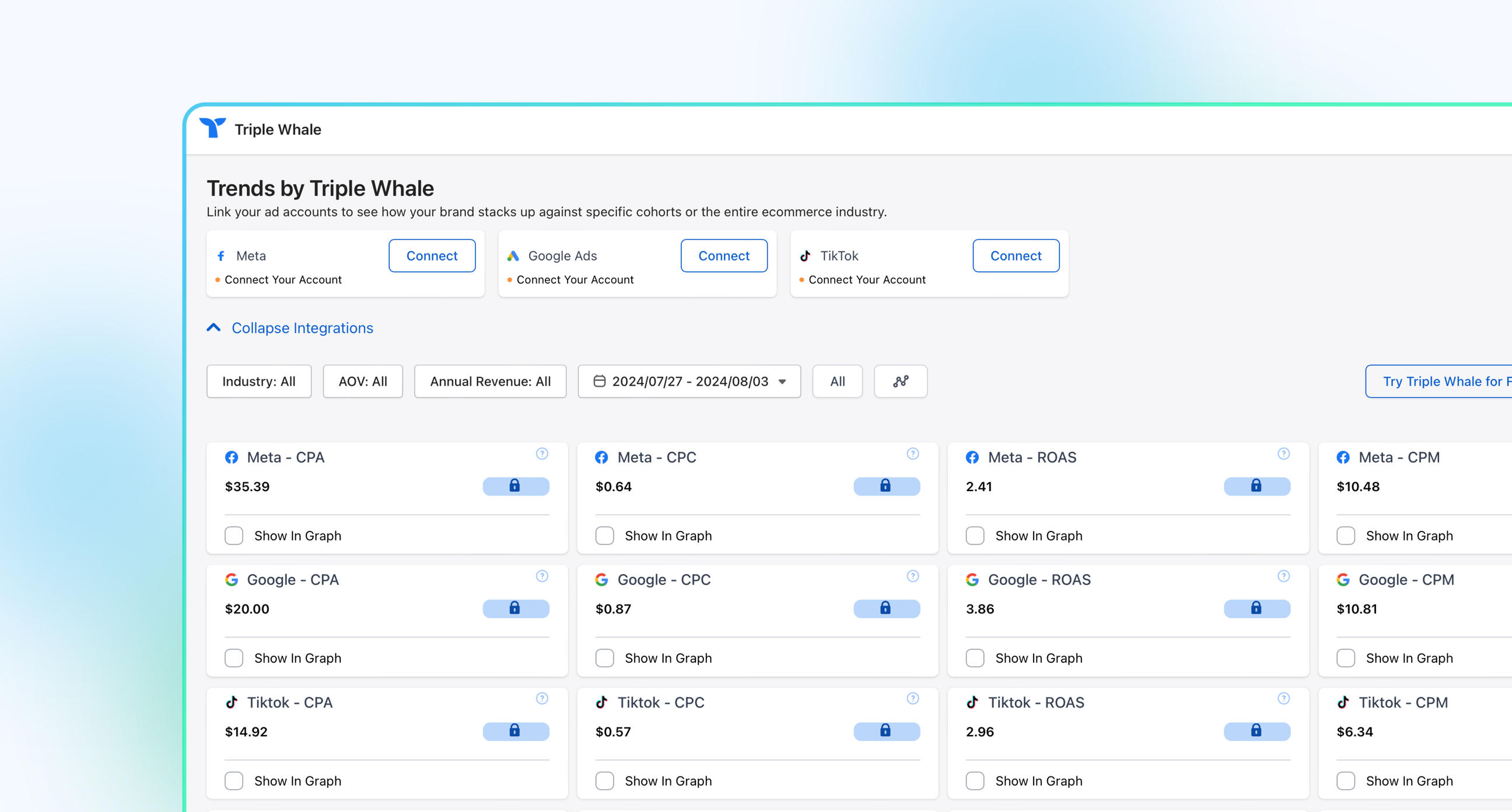
That said, there are still some CPM benchmarks to keep in mind on different platforms to help guide your decisions about where you stand. We pulled together the following averages from brands using Triple Whale.
Take a look at the average CPM benchmarks.
Platform
Average CPM
Facebook/Instagram
$14.19
TikTok
$13.26
Google Display
$14.07
YouTube
$3.50
These numbers can also vary from campaign to campaign. That’s normal: A “good” CPM depends on your industry, how you’re targeting your audience, seasonality, and the placement of your ads, which we’ll take a closer look at in the next section.
What Factors Affect CPM?
CPM isn’t a fixed rate. Instead, it fluctuates based on a range of factors. Understanding how these factors shape your CPM will help you interpret your own data and set realistic expectations for your ads.
Here are some of the things that affect your CPM:
Competition and auction dynamics: Digital ads are bought and sold based on supply and demand, which can either drive up or reduce competition among advertisers. If demand is high for the type and category of ad you’re trying to place, your CPM will be higher, for example. These ads are often sold to the highest bidder at auction, which can drive up CPM, too.
Audience targeting: More specific targeting tends to cost more. A broad audience such as “all adults over 25” typically has a lower CPM because there’s lower competition among advertisers for these impressions. Niche audiences like “35- to 44-year-old cat owners in New Jersey” typically have higher CPMs because the competition is steeper for high-value users.
Industry: Certain sectors are generally considered more competitive than others, such as legal, tech, and financial services. Ads in these industries will generally have higher CPM rates. Ads in smaller, less competitive industries like local businesses have lower demand and lower CPMs.
Ad placement: Ads placed above the fold — meaning they’re visible on a web page without scrolling down — typically have higher CPMs. They get more attention because of their prominent placement. Ads placed below the fold often have lower CPMs because they’re not as visible.
Ad format: Whether your ad is video or static matters, too. Video ads usually have a higher CPM because they typically lead to higher engagement than static ads.
Creative quality: CPM is usually lower for basic ads (like a typical banner ad) compared to interactive, animated, or other high-quality creative.
Seasonality: Seasonal trends like the holiday shopping, Black Friday, or back-to-school sales affect competition, increasing CPM in the process.
So what does this all mean for your business? You could have a $2 CPM for one low-demand campaign and a $18 CPM for a high-demand campaign and neither figure would be inherently “bad” or “wrong” — just different.
How to improve CPM (and Lower Your Costs)
That said, you may still want to improve your CPM. It ultimately helps lower costs and support your bottom line.
But it’s not just about lowering costs. Improving CPM is about improving the efficiency of each impression.
Here are some of the strategies you can try right now:
Refine audience targeting: More strategic audience targeting helps ensure your ads get seen by the potential shoppers most likely to engage with them. Triple Whale’s Triple Pixel can help you collect and analyze the first-party data you need to optimize your targeting.
Improve ad creative: High-quality, engaging ads are likely to attract more attention from your audience, meaning the impressions are worth more. Plus, the platforms where you place your ads often prioritize high-quality creative, so you might get better placement for a lower CPM. Make sure your ads are mobile-friendly, too!
Test formats and placements: A/B test different creative and placements for your ads and see how those tweaks affect engagement. A quippier headline or a simpler photo on your ad might make a big difference, for example.
Use retargeting strategically: Potential customers who have engaged with your brand before are more likely to do so again, compared to someone interacting with your business for the first time. Retargeting campaigns are more effective (aka less expensive) than brand-new customer acquisition.
Monitor frequency and engagement: Like with any ecommerce benchmarks, if you make changes to optimize CPM and then don’t measure the effects, you won’t know if any of your efforts are helping. Regularly monitor ad frequency, engagement, click-through rate, and viewability, among other performance metrics — in addition to CPM — to make sure your ads are working for you.
CPM vs. performance: How it connects to other metrics
CPM alone doesn’t paint a complete picture of your brand’s performance. Instead, it fits into a broader vision of performance when you look at it in relationship with other metrics.
In fact, you can think of CPM as the start of a chain reaction in your metrics.
CPM is what you pay for attention to your ads. Click-through rate is how relevant your ads are. When you look at CPM and CTR together, you can calculate your cost per click, or what you pay for actual interest in your business.
When you look at your CPC and your conversion rate together, you can calculate your cost per acquisition. This number factors heavily into your return on ad spend (ROAS), which is essentially a measure of how efficient your marketing efforts are on a specific platform.
CPM is, clearly, only one small part of this chain reaction. That means a low CPM doesn’t necessarily mean success and a high CPM doesn’t necessarily mean failure. Instead, it’s a starting point that can help you optimize your efforts from the very beginning.
Pros and Cons of CPM Advertising
CPM is widely used because of its potential perks, but it’s not without downsides.
Pros
Cons
Strong for reach and brand awareness
No guarantee of engagement
Predictable cost structure
Viewability concerns
Easy to plan budgets
Risk of ad fraud
Measurable results
Vulnerable to poor targeting
The Benefits of CPM
Good for awareness: CPM is particularly helpful if you’re looking to build visibility with a large audience.
Scalable reach: That awareness means CPM is easily scalable at a relatively low cost when you’re not focused on immediate conversion.
Predictable cost: Advertisers know exactly how much they'll pay for a given number of impressions, making budget planning straightforward.
Measurable results: Clear impression metrics make CPM simple to track and analyze regularly.
The Challenges of CPM
No guarantee of engagement: Impressions aren’t action. Paying for impressions means your ads can be served without being seen, clicked, or remembered.
Viewability concerns: An impression is counted when the ad loads. But if it loads below the fold and a potential shopper never scrolls to it, the impression has no real value.
Risk of ad fraud: Bot traffic can inflate impression counts, meaning you end up paying for exposures that were never seen by a human.
Vulnerable to poor targeting: You don’t always know where a platform will place your ad or if they’ll show it to an audience if interest is low. Plus, if you haven’t segmented your audience appropriately, you might not be targeting the right audience to begin with.
Common CPM Mistakes to Avoid
Even though CPM marketing can be relatively straightforward, it’s also easy to fall into some common traps. Here are the most frequent CPM mistakes to watch out for.
Optimizing for low CPM without considering quality
Wanting to keep your costs low is understandable. But if you cut back so far that it affects the quality of the creative for your campaigns, your ads likely won’t be as effective. It’s important to strike the right balance between optimizing for low CPM and keeping ad quality high.
Ignoring audience quality
Similarly, a low CPM might look good on balance sheets, but if your audience quality is low, that money isn’t getting you the reach you’d hoped for. CPM is often lower in broader audiences, which means you could end up with low engagement or traffic from users who won’t turn into customers.
Not tracking downstream metrics
As mentioned above, CPM is a starting point for a chain reaction of other downstream metrics. If you’re not tracking those, too, you’re not getting the full picture of your performance.
Ignoring viewability and ad placement
It’s tempting to keep CPM low by opting for below-the-fold ad placement or placement on low-viewability (aka low-traffic) websites. But if your ads aren’t seen, it doesn’t matter how low CPM is: You won’t get the brand awareness you’re looking for.
Neglecting frequency capping
Frequency capping is a way of regulating how many times a user sees your ad. You might think more is always better, but if they see your creative too frequently, they might ignore it or even get frustrated with your brand. That said, low ad frequency might not make them familiar enough with your brand the next time they encounter you. It may take some trial and error to find the perfect balance that also aligns with what you’re hoping your CPM to be.
Final Thoughts
CPM in advertising — which stands for cost per mille, or the cost per 1,000 impressions — is an effective strategy for increasing awareness and visibility for your brand, especially when you’re hoping your ads reach a large audience.
It’s not only about optimizing for the lowest possible CPM, though. It’s really about making sure the impressions you get work for you.
This can be a time-consuming process without the right support. Triple Whale’s all-in-one, customizable dashboards can help you streamline your data, monitor your KPIs, and ultimately optimize your CPM. Book a demo today!
FAQs
What does CPM stand for?
The CPM meaning in marketing is “cost per mille” or the cost to an advertiser for 1,000 impressions of their ad on a web page.
How is CPM different from CPC?
CPM is the cost per 1,000 impressions on a digital ad. CPC, or cost per click, is the cost per click on an ad. That means CPC is a better metric for engagement than CPM, which is all about awareness and reach.
Does a high CPM mean my campaign is performing well?
CPM doesn’t tell you much about campaign performance because it only reflects visibility. For better insight into campaign performance, you’ll need to look at your CPC, CPA, and ROAS.
How do I lower my CPM?
You may be able to lower your CPM by targeting a more specific audience, improving your creative, making your ads more mobile-friendly, retargeting more effectively, and experimenting with where your ads are placed.
Component Sales
5.32K
Benchmark your ecommerce brand against industry leaders
CPM is one of the most common pricing models in digital marketing. It’s a go-to model for companies who want their ads to reach a wide audience (and who doesn’t?).
But even though CPM seems to be everywhere, it’s often misunderstood. So what is CPM and when should you use it? Keep reading for answers to these questions — and more.
Key Takeaways
CPM stands for cost per mille, or the cost a marketer pays for every 1,000 impressions of a digital ad. It’s one of the most common pricing models in digital advertising.
Impressions aren’t page views. CPM is a measure of reach, not engagement, making it a better fit for brand awareness, retargeting, and early-stage campaigns.
A low CPM isn’t necessarily “good”; CPM fluctuates widely based on factors such as audience targeting, ad placement, creative quality, and competition.
It’s important to consider CPM in the context of other downstream metrics like CPC and CPA to avoid common CPM mistakes like ignoring audience quality or viewability.
What is CPM?
What does CPM stand for? That would be cost per mille, sometimes called cost per thousand or cost per 1,000 impressions. This ecommerce metric represents how much money an advertiser pays for 1,000 impressions of their ads on a web page. It’s expressed as a dollar amount.
“Mille” is a Latin-derived French word meaning “thousand.” Traditional print and broadcast advertisers paid per thousand readers or viewers, and when digital advertising began in the 1990s, marketers adopted this terminology, according to a Journal of Economic Perspectives article.
What is an impression?
In order to use CPM in advertising, you have to first understand what an impression actually is.
Some people use impressions, page views, and even clicks interchangeably. But these are three entirely different metrics.
Impressions count every time an element of a web page (usually an ad) loaded and appeared for a viewer. Google defines impressions as viewable if “at least 50 percent of its area is visible for at least 1 second for display ads, or at least 2 seconds for video ads.”
Page views count every time a user visits or loads a web page. Clicks count every time a user clicks an ad or another digital element and visits another page. Both of these are measures of deeper engagement or performance. Impressions are instead about visibility. In other words, CPM is a measure of how much you’re paying for visibility, not for traffic or conversions.
Visibility is still important, though. Impressions tell you how often your ad appeared in a place where potential customers might notice it. That reach helps drive awareness, and it also comes in handy for retargeting campaigns. It’s also typically how video, display, and programmatic advertising are sold in media buying.
How to Calculate CPM
Now that you know the CPM definition, it’s time to learn how to find yours.
To calculate CPM, divide your total campaign cost by the number of impressions it received. Then multiply that number by 1,000.
Here’s the CPM formula: CPM = (Total Cost ÷ Total Impressions) × 1,000
CPM Formula Breakdown
By focusing on the total cost and total impressions in a single campaign, CPM standardizes cost across campaigns of different sizes. No matter how big or small your campaign, you’ll always get that standardized result of the cost of 1,000 impressions.
Let’s take a closer look at each variable in the CPM formula:
Total cost: This value should represent everything you spent on advertising for a specific campaign.
Total impressions: This is the number of impressions that campaign received.
Multiplying by 1,000: This is what gives you that essential cost per mille output.
You can also easily rearrange these variables to solve for total spend or total impressions, which can help you with campaign planning. Here’s how those revised formulas look:
Total cost = CPM × Impressions ÷ 1,000
Total impressions = Total cost ÷ CPM × 1,000
Worked Example: Calculating CPM Step by Step
Picture a small ecommerce business that sells handmade scented candles online and runs digital ads on social media. They launch a new campaign to promote a seasonal scent, and they want to track how efficiently they’re reaching new customers using CPM.
Gather the data: Their first step is to find the values for the CPM formula. Let’s say they spent $250 on ads and received 50,000 impressions.
Divide cost by impressions: The first part of their CPM calculation is dividing 250 by 50,000, which equals 0.005.
Multiply by 1,000: To see the cost per thousand impressions, multiply 0.005 by 1,000, which equals 5.
Interpret the results: In this example, this brand’s CPM is $5, meaning they pay $5 for every 1,000 ad impressions for their seasonal candle campaign.
When Should You Use CPM?
CPM advertising works best when your goal is exposure and awareness from a large audience. That makes it ideal for:
Brand awareness campaigns: CPM is a relatively low-cost way to reach a large audience, and it doesn’t rely on engagement, just exposure. This makes it ideal for campaigns focused on raising awareness.
Retargeting campaigns: Retargeting campaigns show ads to users who have engaged with your business before. They’re already familiar with your brand, so the idea is your ad might remind them to make that purchase they’ve been thinking about. These retargeting ads are often run on CPM to reach a wide audience of people who have already considered your business.
Video and display ads: Both of these are typically sold on CPM. They both rely on showing the creative to a large group of people.
Social media campaigns: If you want your social media ads shown to as many users as possible, you’ll likely opt for the awareness-driving CPM approach on those platforms.
Early-stage campaigns without conversion data: If you don’t yet have conversion data, you’re likely focused on raising brand awareness. CPM helps you maximize that visibility and can also enable you to experiment with your creative at a low cost as you develop your marketing strategy.
CPM vs. CPC vs. CPA vs. CPL: What’s the Difference?
Take a look at these ad pricing models at a glance.
Pricing Model
What You Pay For
Best For
Funnel Stage
CPM (cost per thousand impressions)
Impressions (by the thousand)
Brand awareness, high-volume reach
Awareness
CPC (cost per click)
Each click completed
Engagement
Consideration
CPA (cost per action or acquisition)
Each action completed
Conversion
Conversion
CPL (cost per lead)
Each valid lead collected
Capturing contact information
Consideration
CPM isn’t the only way ecommerce businesses can price digital advertising. Here’s how it measures up against some other popular options, according to Foundations in Digital Marketing.
CPM vs. CPC (Cost per Click)
Cost per click, or CPC, is the cost to your business for every click on an ad, not an impression like in CPM. This means it’s more directly tied to engagement than CPM, which is all about visibility and charges you for your ads whether or not anyone interacts with them.
That makes CPM a better choice for reaching a large audience and building brand awareness. CPC, on the other hand, is a better choice for driving traffic, lead generation, and any other campaigns where click intent is more important.
CPM vs. CPA (Cost per Action)
Cost per action (also sometimes called cost per acquisition) or CPA is the cost to your business per a specific action. That action might be a purchase, a download, or a sign-up — you can think of it as any desired action you want a user to take — not just a click, like in CPC, or an impression, like in CPM. That makes it much more performance-oriented than the other two.
CPA usually costs more because conversions can take multiple steps, but the conversions may be worth the cost, depending on your business goals and resources. They also typically require more data (such as conversion history) to run compared to CPM campaigns, which you can launch without knowing much about previous performance.
What is a Good CPM? Benchmarks by Platform
Of course, like any metric, your CPM meaning will be clearer with some context. You’re probably wondering: What is a good CPM?
There is no universal “good” CPM for all brands. That’s because CPM varies widely based on your industry, campaign objective, audience, and platform. For example, if your audience skews younger, you’ll likely have a very different TikTok CPM than your Facebook CPM.
That said, there are still some CPM benchmarks to keep in mind on different platforms to help guide your decisions about where you stand. We pulled together the following averages from brands using Triple Whale.
Take a look at the average CPM benchmarks.
Platform
Average CPM
Facebook/Instagram
$14.19
TikTok
$13.26
Google Display
$14.07
YouTube
$3.50
These numbers can also vary from campaign to campaign. That’s normal: A “good” CPM depends on your industry, how you’re targeting your audience, seasonality, and the placement of your ads, which we’ll take a closer look at in the next section.
What Factors Affect CPM?
CPM isn’t a fixed rate. Instead, it fluctuates based on a range of factors. Understanding how these factors shape your CPM will help you interpret your own data and set realistic expectations for your ads.
Here are some of the things that affect your CPM:
Competition and auction dynamics: Digital ads are bought and sold based on supply and demand, which can either drive up or reduce competition among advertisers. If demand is high for the type and category of ad you’re trying to place, your CPM will be higher, for example. These ads are often sold to the highest bidder at auction, which can drive up CPM, too.
Audience targeting: More specific targeting tends to cost more. A broad audience such as “all adults over 25” typically has a lower CPM because there’s lower competition among advertisers for these impressions. Niche audiences like “35- to 44-year-old cat owners in New Jersey” typically have higher CPMs because the competition is steeper for high-value users.
Industry: Certain sectors are generally considered more competitive than others, such as legal, tech, and financial services. Ads in these industries will generally have higher CPM rates. Ads in smaller, less competitive industries like local businesses have lower demand and lower CPMs.
Ad placement: Ads placed above the fold — meaning they’re visible on a web page without scrolling down — typically have higher CPMs. They get more attention because of their prominent placement. Ads placed below the fold often have lower CPMs because they’re not as visible.
Ad format: Whether your ad is video or static matters, too. Video ads usually have a higher CPM because they typically lead to higher engagement than static ads.
Creative quality: CPM is usually lower for basic ads (like a typical banner ad) compared to interactive, animated, or other high-quality creative.
Seasonality: Seasonal trends like the holiday shopping, Black Friday, or back-to-school sales affect competition, increasing CPM in the process.
So what does this all mean for your business? You could have a $2 CPM for one low-demand campaign and a $18 CPM for a high-demand campaign and neither figure would be inherently “bad” or “wrong” — just different.
How to improve CPM (and Lower Your Costs)
That said, you may still want to improve your CPM. It ultimately helps lower costs and support your bottom line.
But it’s not just about lowering costs. Improving CPM is about improving the efficiency of each impression.
Here are some of the strategies you can try right now:
Refine audience targeting: More strategic audience targeting helps ensure your ads get seen by the potential shoppers most likely to engage with them. Triple Whale’s Triple Pixel can help you collect and analyze the first-party data you need to optimize your targeting.
Improve ad creative: High-quality, engaging ads are likely to attract more attention from your audience, meaning the impressions are worth more. Plus, the platforms where you place your ads often prioritize high-quality creative, so you might get better placement for a lower CPM. Make sure your ads are mobile-friendly, too!
Test formats and placements: A/B test different creative and placements for your ads and see how those tweaks affect engagement. A quippier headline or a simpler photo on your ad might make a big difference, for example.
Use retargeting strategically: Potential customers who have engaged with your brand before are more likely to do so again, compared to someone interacting with your business for the first time. Retargeting campaigns are more effective (aka less expensive) than brand-new customer acquisition.
Monitor frequency and engagement: Like with any ecommerce benchmarks, if you make changes to optimize CPM and then don’t measure the effects, you won’t know if any of your efforts are helping. Regularly monitor ad frequency, engagement, click-through rate, and viewability, among other performance metrics — in addition to CPM — to make sure your ads are working for you.
CPM vs. performance: How it connects to other metrics
CPM alone doesn’t paint a complete picture of your brand’s performance. Instead, it fits into a broader vision of performance when you look at it in relationship with other metrics.
In fact, you can think of CPM as the start of a chain reaction in your metrics.
CPM is what you pay for attention to your ads. Click-through rate is how relevant your ads are. When you look at CPM and CTR together, you can calculate your cost per click, or what you pay for actual interest in your business.
When you look at your CPC and your conversion rate together, you can calculate your cost per acquisition. This number factors heavily into your return on ad spend (ROAS), which is essentially a measure of how efficient your marketing efforts are on a specific platform.
CPM is, clearly, only one small part of this chain reaction. That means a low CPM doesn’t necessarily mean success and a high CPM doesn’t necessarily mean failure. Instead, it’s a starting point that can help you optimize your efforts from the very beginning.
Pros and Cons of CPM Advertising
CPM is widely used because of its potential perks, but it’s not without downsides.
Pros
Cons
Strong for reach and brand awareness
No guarantee of engagement
Predictable cost structure
Viewability concerns
Easy to plan budgets
Risk of ad fraud
Measurable results
Vulnerable to poor targeting
The Benefits of CPM
Good for awareness: CPM is particularly helpful if you’re looking to build visibility with a large audience.
Scalable reach: That awareness means CPM is easily scalable at a relatively low cost when you’re not focused on immediate conversion.
Predictable cost: Advertisers know exactly how much they'll pay for a given number of impressions, making budget planning straightforward.
Measurable results: Clear impression metrics make CPM simple to track and analyze regularly.
The Challenges of CPM
No guarantee of engagement: Impressions aren’t action. Paying for impressions means your ads can be served without being seen, clicked, or remembered.
Viewability concerns: An impression is counted when the ad loads. But if it loads below the fold and a potential shopper never scrolls to it, the impression has no real value.
Risk of ad fraud: Bot traffic can inflate impression counts, meaning you end up paying for exposures that were never seen by a human.
Vulnerable to poor targeting: You don’t always know where a platform will place your ad or if they’ll show it to an audience if interest is low. Plus, if you haven’t segmented your audience appropriately, you might not be targeting the right audience to begin with.
Common CPM Mistakes to Avoid
Even though CPM marketing can be relatively straightforward, it’s also easy to fall into some common traps. Here are the most frequent CPM mistakes to watch out for.
Optimizing for low CPM without considering quality
Wanting to keep your costs low is understandable. But if you cut back so far that it affects the quality of the creative for your campaigns, your ads likely won’t be as effective. It’s important to strike the right balance between optimizing for low CPM and keeping ad quality high.
Ignoring audience quality
Similarly, a low CPM might look good on balance sheets, but if your audience quality is low, that money isn’t getting you the reach you’d hoped for. CPM is often lower in broader audiences, which means you could end up with low engagement or traffic from users who won’t turn into customers.
Not tracking downstream metrics
As mentioned above, CPM is a starting point for a chain reaction of other downstream metrics. If you’re not tracking those, too, you’re not getting the full picture of your performance.
Ignoring viewability and ad placement
It’s tempting to keep CPM low by opting for below-the-fold ad placement or placement on low-viewability (aka low-traffic) websites. But if your ads aren’t seen, it doesn’t matter how low CPM is: You won’t get the brand awareness you’re looking for.
Neglecting frequency capping
Frequency capping is a way of regulating how many times a user sees your ad. You might think more is always better, but if they see your creative too frequently, they might ignore it or even get frustrated with your brand. That said, low ad frequency might not make them familiar enough with your brand the next time they encounter you. It may take some trial and error to find the perfect balance that also aligns with what you’re hoping your CPM to be.
Final Thoughts
CPM in advertising — which stands for cost per mille, or the cost per 1,000 impressions — is an effective strategy for increasing awareness and visibility for your brand, especially when you’re hoping your ads reach a large audience.
It’s not only about optimizing for the lowest possible CPM, though. It’s really about making sure the impressions you get work for you.
This can be a time-consuming process without the right support. Triple Whale’s all-in-one, customizable dashboards can help you streamline your data, monitor your KPIs, and ultimately optimize your CPM. Book a demo today!
FAQs
What does CPM stand for?
The CPM meaning in marketing is “cost per mille” or the cost to an advertiser for 1,000 impressions of their ad on a web page.
How is CPM different from CPC?
CPM is the cost per 1,000 impressions on a digital ad. CPC, or cost per click, is the cost per click on an ad. That means CPC is a better metric for engagement than CPM, which is all about awareness and reach.
Does a high CPM mean my campaign is performing well?
CPM doesn’t tell you much about campaign performance because it only reflects visibility. For better insight into campaign performance, you’ll need to look at your CPC, CPA, and ROAS.
How do I lower my CPM?
You may be able to lower your CPM by targeting a more specific audience, improving your creative, making your ads more mobile-friendly, retargeting more effectively, and experimenting with where your ads are placed.
Body Copy: The following benchmarks compare advertising metrics from April 1-17 to the previous period. Considering President Trump first unveiled his tariffs on April 2, the timing corresponds with potential changes in advertising behavior among ecommerce brands (though it isn’t necessarily correlated).


 Moby AIAsk questions, analyze performance, and work with your business context.
 ActionsTake governed action across the tools that run your business.
 AutomationsSchedule recurring analysis and work that runs on your terms.
 Landing PagesCreative conversion-focused ecommerce pages with Moby.
 Creative StudioGenerate and refine creative grounded in your brand.


.png)




.webp)





.webp)

.webp)
