My wife and I started building Shopify stores in 2016. We were expecting our second kid at the time, had no safety net, and scrutinized every dollar we spent on every tool. I remember the specific feeling when a platform we'd built our workflow around sent one of those "exciting changes to your plan" emails. That mix of dread and frustration and quiet betrayal — are they still building for me, or are they just building for themselves?
That feeling is exactly what I was thinking about when we made the decision to change how we price Moby AI and Creative Generation. And it's why I'm writing this myself.
Note: pricing for our core plans — your dashboards, attribution, analytics, enrichment, and more, are not changing as part of this.
What’s changed: Moby is a different product than it was a year ago
When we first launched Moby, it was a chat assistant that could answer questions about your data. Useful, but limited. We priced it that way — as a feature add-on. Pay for Moby AI Pro, get unlimited access.
That made sense for what it was. But it's not what Moby is anymore.
Moby 2 is a complete rebuild. It queries your data across every connected platform — Shopify, Meta, Klaviyo, Google, Amazon — to take action for your business. It generates and publishes ad creatives directly to your ad channels, creates weekly reports, recommends and pushes campaign optimizations, it identifies audiences with whom you should be speaking. It's not answering questions anymore. It's doing real work.
When the product changes that fundamentally, the pricing has to evolve with it. Keeping the old model would have meant one of two things: slow down what we're building, or price it in a way that doesn't reflect reality. We didn't want to do either.
What wasn't working
I want to be straightforward about what we saw.
We had a choice: keep pricing flat and limit what we were willing to build, or change the model and go all in on making Moby the best AI product in ecommerce. We chose to go all in. Moby 2 is that bet.
Here's why that choice became unavoidable.
Under flat pricing, some customers used Moby once a week for a quick data check. Others used it as their primary analyst, running dozens of queries a day and generating hundreds of creatives. Both paid the same. For the lighter user, that put them in a bad spot: they were either paying for capacity they didn't need, or walking away from a tool that was creating real business value for them. Neither is acceptable to us.
The harder truth is that the flat rate model wasn't working for our business — and on a long enough timeline, that becomes a problem for our users. Every time Moby runs a query, it costs real money. These aren't cached lookups — Moby is translating natural language into SQL, scanning trillions of rows of live data across your entire tech stack, running analysis with reasoning models, and returning structured results. Creative generation adds another layer. Every improvement we made increased those costs with no way to sustain the investment. A product that can't fund its own development stops getting better.
How credits work
They're a usage-based system that powers Moby AI and Creative Generation. They only apply when Moby is doing real work on your behalf.
What uses credits: Asking Moby a question that queries your data. Generating or publishing a creative. Running an automation. These are the moments where Moby is doing something a person would otherwise spend real time on.
What doesn't use credits: General Moby questions that don't pull data, and follow-up analysis after data is already loaded. Your core dashboards — Summary, Attribution, Creative Analysis, Website Conversion, Customer Retention, Sonar. Custom dashboards you build. SQL Builder. Table Builder. All included in your plan, unchanged.
We drew this line intentionally. If Moby isn't doing heavy lifting, you're not spending credits. We want you in the product constantly — credits only apply to the moments where something real is being created.
Every paid plan comes with credits: Starter plans get 3,000 credits/month. Advanced plans get 6,000 credits/month. These refresh every billing cycle and they're yours to use however you want.
For teams that need more: Credit packages start at $250/month and scale up, with the cost per credit decreasing at every tier. $500/month and above includes access to our Context Engineering team — real people who help you get the most out of Moby.
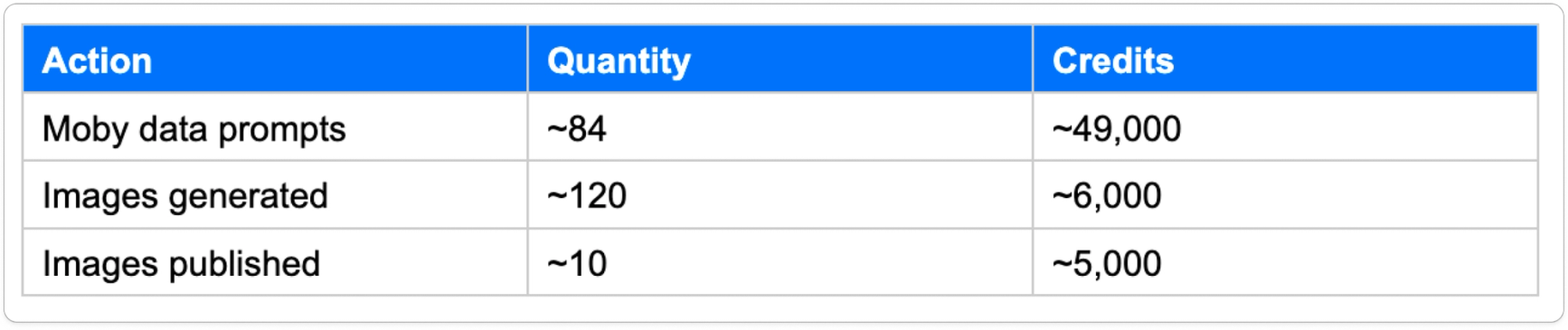
For a sense of what that looks like in practice, here's what your team can do for $1,000/month (60,000 credits):
The commitments we're making
We designed this model around a set of principles, and I'm listing them publicly so that you can give us feedback on how we're achieving against these principles.
Predictability. As much as possible, we believe you should always be able to anticipate your costs. We offer flexible credit packages and you’ll never receive any unexpected charges. Every credit-consuming action is tracked in your usage dashboard — what you've spent, what drove the spend, how you're trending. No surprises. Credits are only consumed during specific actions.
Transparency. We want you to understand not just what we changed, but the thinking behind it. The credit system is designed so you can see exactly where every credit goes. And we'll keep sharing how our thinking evolves as the model matures.
No gotchas. When credits run out, AI features pause. We don't auto-charge overages. You see a clear message with your options — top up or upgrade — and you decide on your timeline. Unused credits roll over. Credits are shared across your whole team.
We protect your downside. No automatic overages. No charges for failed queries — if Moby doesn't return results, you don't pay. You have credits included with every paid plan so you can experience Moby before spending a dollar on credits. Also, we're giving every customer a bonus lump sum of credits to help you explore Moby 2. If something doesn't feel right — if you feel you were charged for something that didn't deliver value — just reach out to our team and we will make it right. That's not a policy buried somewhere. It's a promise.
We want you to experience this before you pay for it
This is important to us: every customer getting credits also gets a generous lump sum of bonus credits, completely on us. No strings. No expiration. No charge to get started.
We did this because we believe the best way to understand the value of Moby 2 is to use it on your own data, with your own questions, for your own business. Not a demo. Not a pitch deck. The real thing.
We've seen what happens when customers actually dig in — when Moby surfaces an insight they didn't know was there, or generates a creative that outperforms their existing library, or automates a report that used to take an entire afternoon. Once that moment clicks, the value speaks for itself.
Once your bonus credits are used, you continue receiving your monthly credit allotment included with your plan at no extra cost.
What we're still improving
I'd rather be upfront about where we're still working than pretend everything is perfect.
Credit estimates before a query runs. Some customers told us they want to know how many credits a query will cost before they run it. That's fair, and we're building toward it. Today, consumption varies based on query complexity — how many platforms, how much data, how deep the reasoning. Better upfront visibility and is on the roadmap.
Accuracy. If Moby returns an incorrect result, credits are still consumed because the computational work still happened. We know that doesn't feel right. Moby 2 is a significant accuracy improvement, and we're investing heavily in continuing to close that gap, but it’s still technology that’s evolving. In the meantime, if you get a result that doesn't feel right, tell our team. We'll make it right. No runaround.
How the rollout works
We're not flipping a switch. Thousands of customers are already using credits, and the transition is happening in phases.
Every customer getting credits also gets a generous lump sum of bonus credits, completely on us. No strings. No expiration. No charge to get started.
We're being deliberate about this pace because trust matters more than speed. The rollout reflects how seriously we take the relationship.
Why I'm writing this
We built Triple Whale because we believe that if you have an idea, a passion, a curiosity, a drive for relentless improvement, you can build the business of your dreams. Our platform lets you focus on that — the uniquely human business of building — with powerful technology that handles the rest.
That's what this change is in service of. We don't take pricing changes lightly. They're a real transition. But we believe this is the right thing to do. It aligns what we charge with the value Moby actually creates, and it's what lets us keep building. The alternative — a pricing model that can't support the product we're building — doesn't serve anyone well.
What's good for your business and what's good for ours should point in the same direction. This is how we get there.
If something doesn't feel right, reach out. Your CSM, our support team, or me directly. We're going to keep listening, keep adjusting, and keep earning your trust.
– Maxx