
Blog
Your Creative is Now Your Targeting: How AI-Driven Delivery Flipped the Script on Ecommerce Advertising

Your Creative is Now Your Targeting: How AI-Driven Delivery Flipped the Script on Ecommerce Advertising

By 

For years, the paid media playbook was straightforward: build tight audiences, test a handful of creatives, optimize bids manually, and scale what worked. The advertiser decided who saw the ad. The creative was just the message.

Well, that model is over. 

With the rollout of Meta’s Andromeda retrieval engine — officially announced in December 2024 and deployed globally by October 2025 — the relationship between creative and targeting has fundamentally reversed. Your ad creative now serves as the primary input the platform uses to decide  what the audience should be. 

What Andromeda actually changed

Andromeda is Meta’s AI-powered ads retrieval system, and it governs the first stage of ad delivery: determining which ads even have a chance of being shown to a given user. The previous retrieval architecture evaluated a limited pool of eligible ads based on advertiser-defined targeting inputs. Andromeda processes vastly more ad candidates in real time, using deep neural networks to match creative variations with individual user preferences based on behavioral signals.

According to Meta’s own engineering disclosures, Andromeda enabled a 10,000x increase in model complexity at the retrieval stage, delivering measurable improvements in ad quality — approximately 8% on selected segments. Andromeda now evaluates historical engagement, ad copy, creative format, and visual signals before considering advertiser-defined audiences, essentially flipping the legacy model on its head.

The system’s core question is now “which ad should this person see?” with creative signals driving that decision. 

From audience-led to creative-led

The transition started several years ago with the gradual deprecation of detailed interest targeting. As audience signals weakened, Meta’s algorithm compensated by leaning harder on creative signals — the images, hooks, copy, and thematic framing of each ad — to infer who should see it. 

Today, your creative is both a message to your customer and the primary input the delivery system uses to determine what the audience should be. A skincare ad built around a busy mother’s morning routine will find busy mothers. One built around a dermatologist’s recommendation will reach a different person entirely. The industry has moved from campaign-led to creative-led, where AI understands the depth, message, and context of an ad and matches it to individuals using an algorithm.

Meta itself now officially recommends broad targeting and Advantage+ placements, letting the algorithm optimize delivery. It’s recommended that advertisers stop chasing the perfect combination of copy and creative, because Andromeda personalizes delivery so the right person sees the right ad. The “winner” for one person may underperform for another. 

Why micro-variants don’t create real differentiation

The natural response to declining ad performance has always been to spin up variations: swap the headline, change the background color, reorder the benefit bullets, tweak the CTA button. In an audience-targeting world, this made sense because you were A/B testing against the same defined pool of people.

In a creative-led delivery world, these cosmetic changes aren’t registering as new creative. Andromeda reads intent and context, so word count and surface-level changes are invisible to it. A new headline with the same underlying message, a reordered set of the same benefit claims, or a different background color with the same visual identity all get clustered as the same concept by the algorithm. You get marginal differentiation at best, and you’re spending test budget on noise.

Meta formalized this thinking under the concept of the creative portfolio: the idea that your ad account should be evaluated as a system of structurally distinct concepts working together. A portfolio with 30 micro-variants of the same idea is, in Meta’s eyes, a portfolio of one. The platform’s guidance now pushes brands toward fewer, more differentiated concepts. Each concept should reach a genuinely different person rather than churning out volume for volume’s sake.

What structural diversity actually looks like
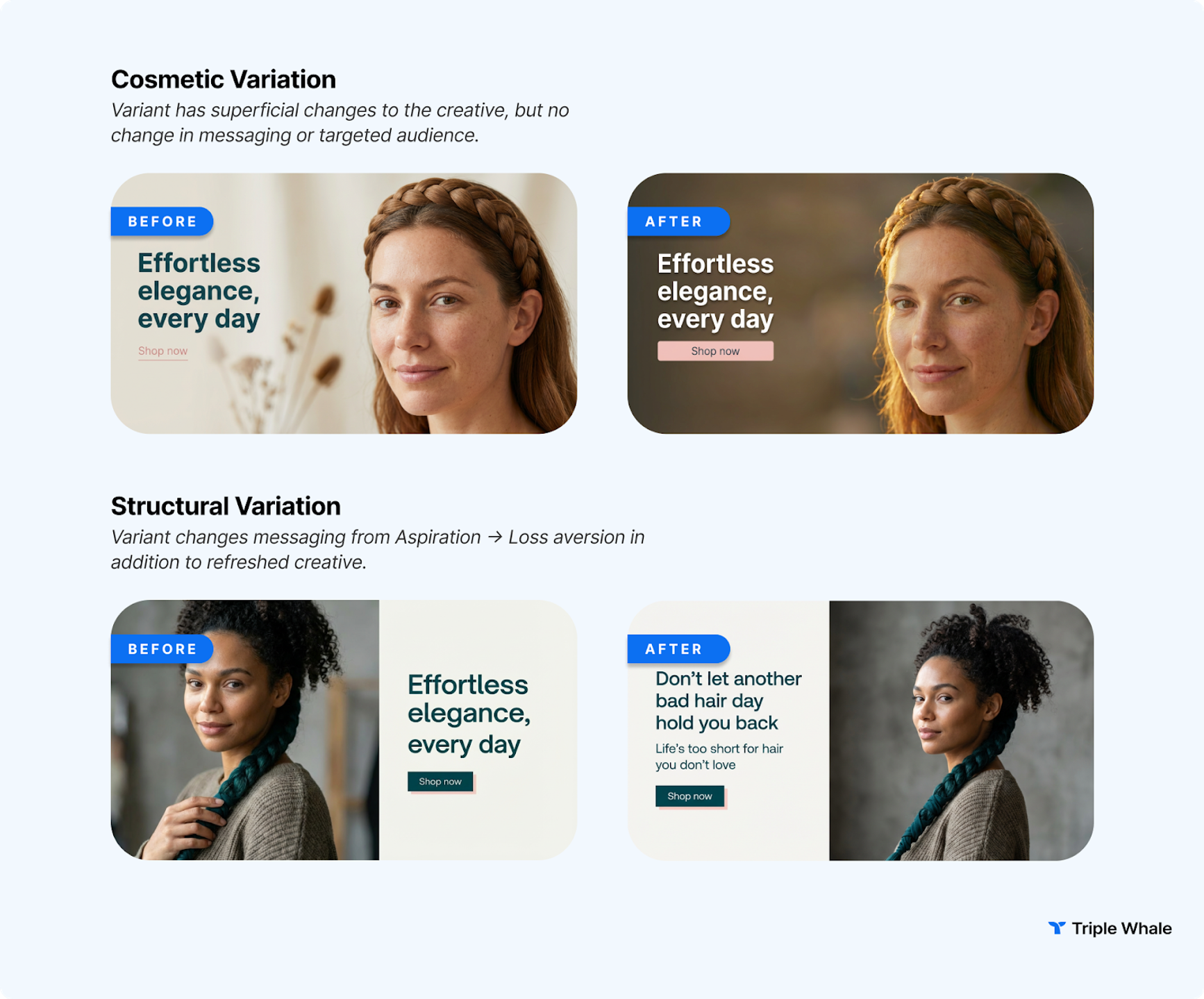
If cosmetic variation is changing the surface of an ad, structural diversity means changing what the ad fundamentally communicates and to whom. The algorithm sees the following as genuinely new:

  • A new persona target. Creative built around a different customer with a different life stage, identity, or relationship to the problem.
  • A new problem framing. Leading with a different challenge the customer faces.
  • A new mechanism. Explaining the solution differently, like ingredient science versus community proof, for example. 
  • A new emotional trigger. Aspiration and fear avoidance are structurally different emotional entry points. An ad built around relief lands differently than one built around pride.
  • A new identity style. The visual world, tone, and cultural context signals relevance to a meaningfully different audience slice3.

For most accounts, 5 structurally different ads will outperform 30 micro-variants. Each distinct concept can expand your audience, reduce overlap, and create more resilient delivery. 

What brands should do about it

The shift from audience-led to creative-led delivery is already the operating reality. Andromeda and its companion system GEM (Generative Engine Model), which began broad deployment in mid-2025, are now the infrastructure powering every Meta ad account. 

The brands adapting successfully are doing a few things consistently. They’re simplifying campaign structures, often down to one or two campaigns with broad targeting. They're investing in creative production that prioritizes meaningfully diverse concepts over raw volume. And they’re treating their ad account as a portfolio of distinct ideas, with each one earning its place by reaching a different person. 

As Bryant Garvin, Operator in Residence at Triple Whale, observed: most DTC brands were essentially pixel chasers — just following the data. The new environment is forcing them to actually become marketers, to understand consumer behavior, psychology, and the customer journey.

The creative is the targeting. The brands that adapt will be rewarded, and the ones who don’t will be left wondering why their costs continue to climb.


Component Sales
5.32K
Ecommerce Strategies
Ecommerce Metrics

Your Creative is Now Your Targeting: How AI-Driven Delivery Flipped the Script on Ecommerce Advertising

Last Updated: 
April 8, 2026

For years, the paid media playbook was straightforward: build tight audiences, test a handful of creatives, optimize bids manually, and scale what worked. The advertiser decided who saw the ad. The creative was just the message.

Well, that model is over. 

With the rollout of Meta’s Andromeda retrieval engine — officially announced in December 2024 and deployed globally by October 2025 — the relationship between creative and targeting has fundamentally reversed. Your ad creative now serves as the primary input the platform uses to decide  what the audience should be. 

What Andromeda actually changed

Andromeda is Meta’s AI-powered ads retrieval system, and it governs the first stage of ad delivery: determining which ads even have a chance of being shown to a given user. The previous retrieval architecture evaluated a limited pool of eligible ads based on advertiser-defined targeting inputs. Andromeda processes vastly more ad candidates in real time, using deep neural networks to match creative variations with individual user preferences based on behavioral signals.

According to Meta’s own engineering disclosures, Andromeda enabled a 10,000x increase in model complexity at the retrieval stage, delivering measurable improvements in ad quality — approximately 8% on selected segments. Andromeda now evaluates historical engagement, ad copy, creative format, and visual signals before considering advertiser-defined audiences, essentially flipping the legacy model on its head.

The system’s core question is now “which ad should this person see?” with creative signals driving that decision. 

From audience-led to creative-led

The transition started several years ago with the gradual deprecation of detailed interest targeting. As audience signals weakened, Meta’s algorithm compensated by leaning harder on creative signals — the images, hooks, copy, and thematic framing of each ad — to infer who should see it. 

Today, your creative is both a message to your customer and the primary input the delivery system uses to determine what the audience should be. A skincare ad built around a busy mother’s morning routine will find busy mothers. One built around a dermatologist’s recommendation will reach a different person entirely. The industry has moved from campaign-led to creative-led, where AI understands the depth, message, and context of an ad and matches it to individuals using an algorithm.

Meta itself now officially recommends broad targeting and Advantage+ placements, letting the algorithm optimize delivery. It’s recommended that advertisers stop chasing the perfect combination of copy and creative, because Andromeda personalizes delivery so the right person sees the right ad. The “winner” for one person may underperform for another. 

Why micro-variants don’t create real differentiation

The natural response to declining ad performance has always been to spin up variations: swap the headline, change the background color, reorder the benefit bullets, tweak the CTA button. In an audience-targeting world, this made sense because you were A/B testing against the same defined pool of people.

In a creative-led delivery world, these cosmetic changes aren’t registering as new creative. Andromeda reads intent and context, so word count and surface-level changes are invisible to it. A new headline with the same underlying message, a reordered set of the same benefit claims, or a different background color with the same visual identity all get clustered as the same concept by the algorithm. You get marginal differentiation at best, and you’re spending test budget on noise.

Meta formalized this thinking under the concept of the creative portfolio: the idea that your ad account should be evaluated as a system of structurally distinct concepts working together. A portfolio with 30 micro-variants of the same idea is, in Meta’s eyes, a portfolio of one. The platform’s guidance now pushes brands toward fewer, more differentiated concepts. Each concept should reach a genuinely different person rather than churning out volume for volume’s sake.

What structural diversity actually looks like

If cosmetic variation is changing the surface of an ad, structural diversity means changing what the ad fundamentally communicates and to whom. The algorithm sees the following as genuinely new:

  • A new persona target. Creative built around a different customer with a different life stage, identity, or relationship to the problem.
  • A new problem framing. Leading with a different challenge the customer faces.
  • A new mechanism. Explaining the solution differently, like ingredient science versus community proof, for example. 
  • A new emotional trigger. Aspiration and fear avoidance are structurally different emotional entry points. An ad built around relief lands differently than one built around pride.
  • A new identity style. The visual world, tone, and cultural context signals relevance to a meaningfully different audience slice3.

For most accounts, 5 structurally different ads will outperform 30 micro-variants. Each distinct concept can expand your audience, reduce overlap, and create more resilient delivery. 

What brands should do about it

The shift from audience-led to creative-led delivery is already the operating reality. Andromeda and its companion system GEM (Generative Engine Model), which began broad deployment in mid-2025, are now the infrastructure powering every Meta ad account. 

The brands adapting successfully are doing a few things consistently. They’re simplifying campaign structures, often down to one or two campaigns with broad targeting. They're investing in creative production that prioritizes meaningfully diverse concepts over raw volume. And they’re treating their ad account as a portfolio of distinct ideas, with each one earning its place by reaching a different person. 

As Bryant Garvin, Operator in Residence at Triple Whale, observed: most DTC brands were essentially pixel chasers — just following the data. The new environment is forcing them to actually become marketers, to understand consumer behavior, psychology, and the customer journey.

The creative is the targeting. The brands that adapt will be rewarded, and the ones who don’t will be left wondering why their costs continue to climb.
Allie Mistakidis

Allie Mistakidis is a Content Writer at Triple Whale, silversmith at Aloraflora Jewelry, and retail store co-owner at Whiskeyjack Boutique in Windsor, ON, Canada. She has a Masters degree in plumage evolution in birds, and spent several years doing technical support, including at Shopify. You can connect with her on LinkedIn.

Explains how Meta's Andromeda retrieval engine has fundamentally shifted ad delivery from audience-led to creative-led, why micro-variants don't work anymore, what structural diversity means, and how brands should adapt their creative strategy.

Body Copy: The following benchmarks compare advertising metrics from April 1-17 to the previous period. Considering President Trump first unveiled 
his tariffs on April 2, the timing corresponds with potential changes in advertising behavior among ecommerce brands (though it isn’t necessarily correlated).

Ready to make confident, data-driven decisions faster than ever?

Thank you! Your submission has been received!
Oops! Something went wrong while submitting the form.