You check TikTok Ads Manager, and your CPM jumped again. Ten dollars. Fifteen. Maybe it doubled overnight. Your first instinct may be to panic, kill the campaign, or start slashing your bid. Don’t do any of that just yet.
A rising CPM isn’t a verdict on your ads. TikTok’s auction runs like a live market, and prices move with demand. When more advertisers want the same audience at the same time, your CPM climbs right along with theirs.
That kind of spike comes from market pressure in the moment. Ask yourself one question before you touch anything: can your results still absorb that higher price?
This guide breaks down how to calculate CPM, what counts as a good TikTok CPM in 2026, and how to lower it.
Key Takeaways
- TikTok CPM is what you pay for every 1,000 times your ad shows up. It measures reach cost, not how well the ad performs.
- Don’t compare your CPM to numbers you see online. Benchmark it against your industry’s own median. Across Triple Whale customers who use TikTok ads, that median ranges from $3.58 to $6.70.
- Pair every CPM change with cost per acquisition (CPA) and return on ad spend (ROAS). A rising cost that holds or improves those two numbers is buying something worth having. Triple Whale shows you all three together, tied to your real orders.
What is TikTok CPM (cost per mille)?
CPM stands for cost per mille. “Mille” is just Latin for thousand. It’s the price TikTok charges you every time your ad is shown 1,000 times. Clicks and sales don't factor into those numbers. It’s an entry fee for showing up in someone’s feed.
How to calculate TikTok CPM
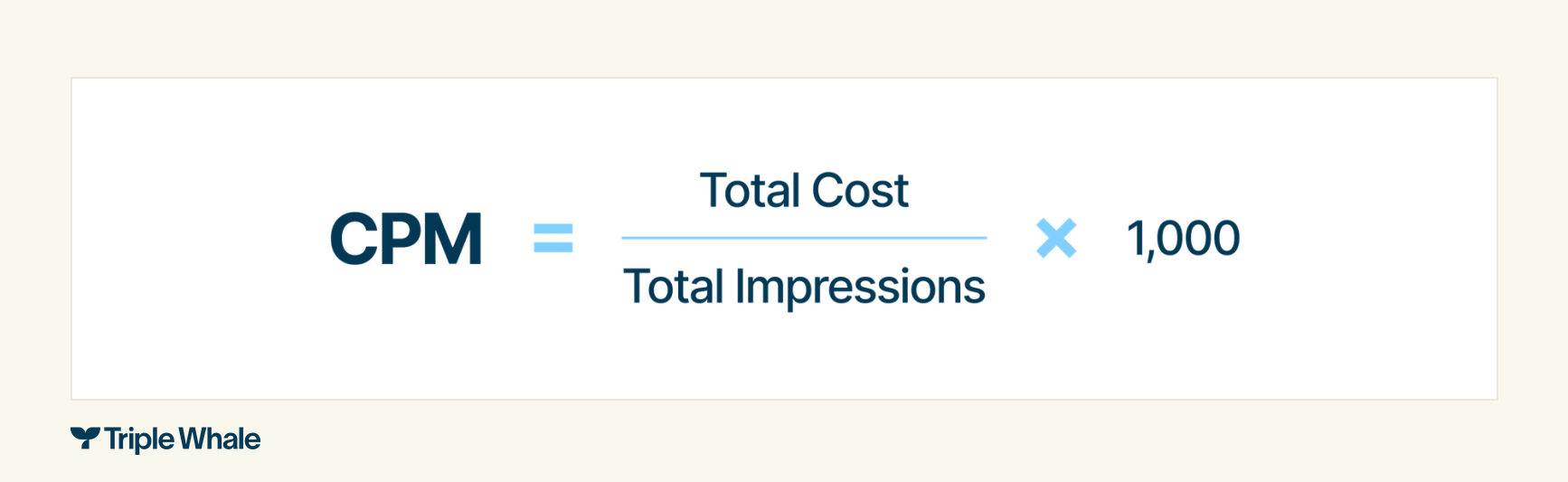
To calculate TikTok CPM, take your total ad spend, divide it by your total impressions, and multiply the result by 1,000.
The formula: CPM = (Total Spend ÷ Total Impressions) × 1,000
For example, say you spend $500, and your ad gets shown 100,000 times. This means CPM costs you $5.
CPM = ($500 ÷ 100,000) × 1,000 = $5
Average TikTok CPM in 2026
There’s no single “good” number for every brand. From October 2025 to September 2026, the blended median TikTok CPM for Triple Whale users is $4.07.
Your own number may land somewhere in the $3.58 to $6.70 range, depending on your industry (full breakdown below). A CPM close to your own industry’s median is normal and expected.
But normal doesn’t mean good. Say two stores both pay a $4 CPM and get the same number of clicks and sales. Each pays about $20 in ads to win one customer. The first store sells a $120 product and keeps most of each sale, so it earns a healthy profit. But the second sells a $25 product with thin margins, so it loses money on every order. The CPM is the same, but the results are opposite.
That’s why a good CPM is one your CPA and ROAS can absorb.
How to tell what a good TikTok CPM is
So how do you know if your CPM is good? Read it next to the numbers that come after it. Here are four checks from the first click to the money you get back.
- Click-through rate (CTR): CTR is the share of people who click your ad after they see it. Say your CPM goes up, but more people click. You’re paying more for viewers who are actually interested, and that can be a good trade. If your CPM drops and your clicks drop with it, you’re buying cheap views that nobody wants.
- Conversion rate: Conversion rate is the share of clickers who buy. A high CPM can still work if your page turns many clicks into sales. A low CPM won’t help if people click and then leave. When results slip, this number tells you whether to look at your ad or your page.
- CPA: CPM, CTR, and conversion rate all roll up into your CPA, the amount you pay in ads to win one customer. Compare it to what one sale is worth to you: the price minus what it costs you to make and ship the product. If your CPA is lower, you make money. If it’s higher, you lose money, even when your CPM looks cheap.
- ROAS: ROAS is how many dollars of sales you get for each dollar of ads. How much you need depends on how much you keep from each sale. If you keep half, you need $2 back for every $1 you spend. Anything about that is profit, so ROAS and CPA tell the same story from two sides.
TikTok CPM by industry
Here’s where Triple Whale’s industry number lands: over 6,000 stores running TikTok ads between October 1, 2025 and September 30, 2026. That adds up to $962.4 million in tracked spend and 137 billion impressions behind every figure below.
| Industry | Median CPM |
|---|---|
| Sports and Outdoors | $3.58 |
| Health and Wellness | $3.77 |
| Health and Beauty | $3.83 |
| Food and Beverage | $4.09 |
| Apparel and Accessories | $4.25 |
| Consumer Electronics | $4.30 |
| Home and Garden | $4.43 |
| Pets and Animals | $4.50 |
| Baby | $6.37 |
| Travel Accessories and Luggage | $6.70 |
Why the two largest categories shape the blended number
Health and Beauty and Apparel and Accessories make up close to 70% of all TikTok ad spend in this dataset: 45% from Health and Beauty, 24% from Apparel and Accessories. Because they account for so much of the spend, they pull the $4.07 blended median toward their own numbers. Health and Beauty sits just under that median at $3.83, while Apparel runs slightly above at $4.25.
If you sell in a smaller category like Travel or Baby, don’t panic when your CPM runs a few dollars higher than the blended median. Those are thinner markets with less advertiser competition driving prices, so comparing them to the overall blend isn’t a fair fight.
TikTok vs. Meta vs. Google CPM comparison
Every platform charges for the same thing: a thousand impressions. In this data set and range, Meta and Google charge almost four times as much as TikTok for that thousand.
| Platforms | Median CPM | Tracked Spend |
|---|---|---|
| TikTok | $4.07 | $962.54M |
| Meta | $15.48 | $17.89B |
| $15.93 | $5.89B |
Why is TikTok so much cheaper? Meta and Google are much bigger platforms. More advertisers bid on them, and more advertisers mean a higher price per impression.
The table shows the scale: in this dataset, Meta’s tracked spend is about 19 times TikTok’s, and Google’s is about 6 times. Their audiences also cost more to reach, because advertisers have spent on them for years and know those audiences buy. TikTok has fewer advertisers bidding, so the same thousand impressions cost less.
What causes high CPMs on TikTok?
A high TikTok CPM rarely has one cause. Auction competition, audience size, creative, bid strategy, and placement setup can all push the number at once, and each calls for a different response.
1. Auction competition and timing
Every time your ad enters an auction, TikTok ranks it in real time based on your bid and how relevant it thinks the ad will be to that person. When more advertisers chase the same audience, like a big retail event or a competitor’s new launch, CPM climbs for everyone bidding in that auction. That part of the increase comes from the market itself, and no amount of account optimization changes it.
2. Audience size and overlap
Narrow targeting and heavy exclusions shrink the pool of people TikTok can actually show your ad to. And a shrinking pool raises the price. Running several ad sets aimed at nearly the same audience makes this worse: you end up bidding against your own campaigns. Watch for rising frequency alongside rising CPM, as that combination means your audience has run out of room.
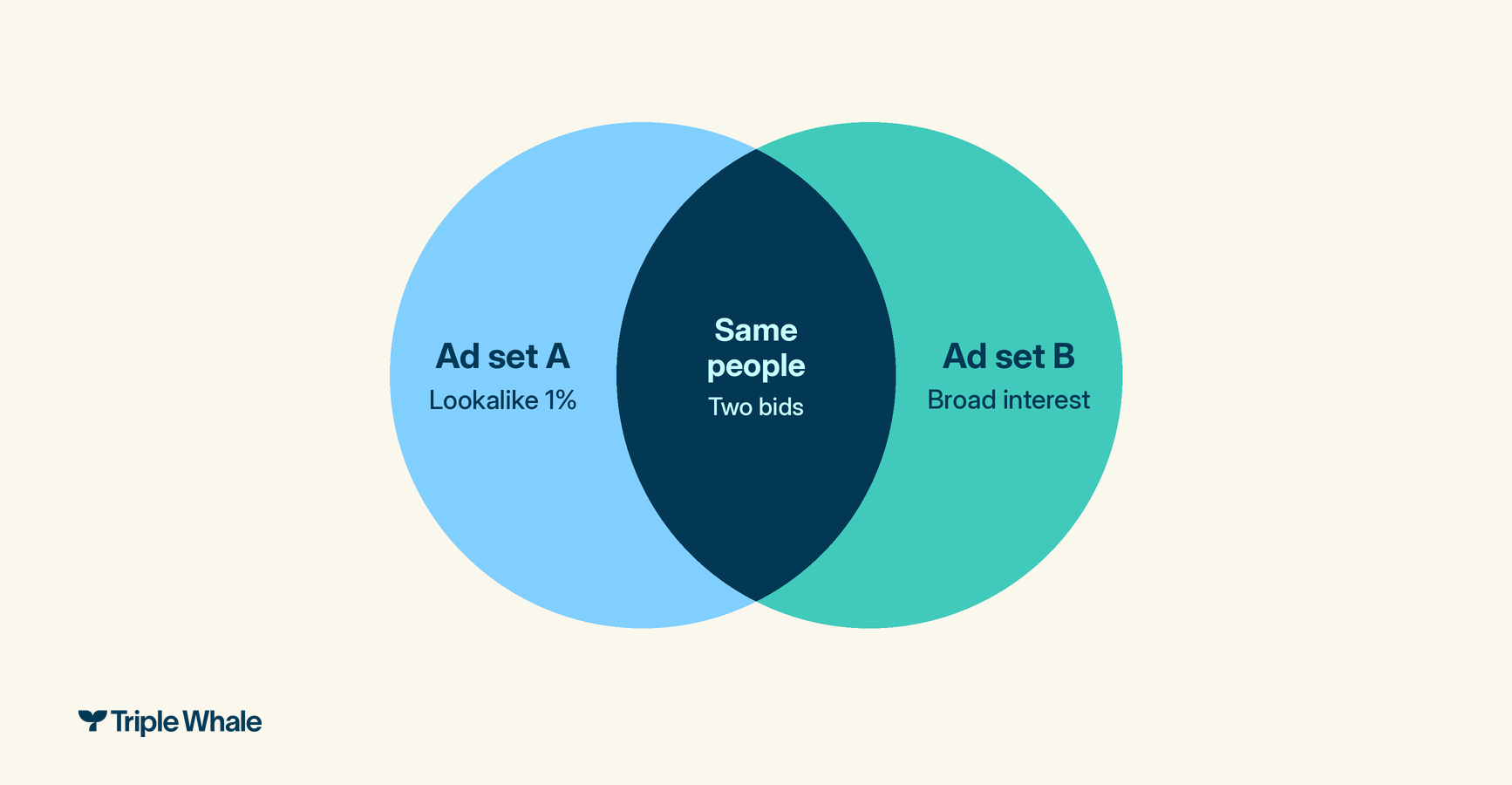
3. Creative quality and predicted engagement
TikTok’s auction factors in more than your bid. It predicts how likely someone is to watch or skip your ad, and that prediction affects your price. Weak creative that gets skipped fast makes every future impression more expensive. Strong, native-feeling creative that doesn’t read as an ad improves your standing in the auction without you touching your bid.
Triple Whale’s creative reporting breaks performance down to the individual asset. Moby, Triple Whale’s AI teammate, can flag which ones are dragging on engagement before they push your CPM higher.
Bid strategy, budget, and the learning phase
A target cost strategy keeps your average cost near a number you set, while a maximum results strategy chases as much volume as your budget allows and can push CPM up or down depending on how competitive it is.
Either way, any new or heavily edited campaign re-enters what’s called the learning phase, and CPM swings until the algorithm settles.
Placement and campaign objective
A reach campaign and a conversion campaign buy different kinds of inventory, so you shouldn't compare their CPMs directly. If you’ve manually restricted placements or added brand-safety exclusions, you’ve also narrowed your inventory pool, which raises your price per thousand.
How to lower TikTok CPM without hurting results
Once you've found the driver behind your CPM, match it to the right fix below. These six moves map to the causes above.
Refresh creative before touching bids
Creative fatigue is the most common reason CPM slowly climbs, and it’s the cheapest one to fix. Swap in a new hook or a different format, like creator-shot video, and test it against your current best performer.
Give your audience room to breathe
Check your ad sets for overlapping audiences. Loosen any exclusions that aren’t earning their keep. If your retargeting pool has shrunk down to almost nothing, widen it before you touch anything else.
Check for frequency creep
Rising frequency alongside rising CPM is a clear signal: your current audience is tapped out. The fix is to expand the audience or rotate in new creative. Raising your bid won’t solve it.
Match your bid strategy to the signal you have
A tight cost cap without enough conversion history can starve your own delivery and push your real CPM higher. If your account doesn’t have deep conversion data yet, start with a volume-based bid strategy, then switch to tighter cost control once you have the data to support it.
Move budget in small steps
A big, sudden budget jump resets the learning phase and can spike your CPM overnight. Scale spend up 20-30% every few days instead of doubling it all at once.
Judge placements by the outcome they produce
Compare automatic and manual placements by CPA and revenue. A pricier placement that converts well is earning its cost, while a cheap placement that never converts wastes whatever discount it offered.
How Triple Whale helps you get TikTok CPM under control
Triple Whale is built to be your single source of truth, connecting your TikTok spend to real Shopify orders so CPM never stands alone. It's always paired with CPA, ROAS, and media efficiency ratio (MER) for the same campaign, and you can set TikTok next to Meta, Google, and every other channel you run, all in one place, to catch the moment a CPM increase starts costing you real money.
Moby, Triple Whale's AI teammate, watches this for you. Ask it whether your latest CPM change moved your acquisition cost, and it checks your real orders to answer. Book a demo today or get started with a free account.
TikTok CPM: FAQs
What's a good CPM for TikTok ads in 2026?
There's no single good number. The blended median across live TikTok advertiser accounts is $4.07, but it ranges from about $3.58 in Sports and Outdoors to $6.70 in Travel Accessories and Luggage. Use your own industry's median as the comparison point.
Which TikTok ad format has the lowest CPM?
In-feed ads typically run lowest since they compete in the standard auction, while TopView and Brand Takeover are reserved, flat-rate placements priced above it. Spark Ads can also undercut the account average when the boosted organic post already has strong engagement.
Why is my TikTok CPM (cost per mille) so high?
Usually one of the causes covered above: narrow or overlapping audiences, stale creative, or running in a thinner, less competitive industry.
How often should I refresh TikTok ad creative?
Every two to four weeks as a baseline, sooner if frequency climbs alongside CPM.
How do I calculate TikTok CPM?
Divide your total ad spend by your total impressions, then multiply by 1,000. Say you spend $1,200 and get 250,000 impressions. $1,200 ÷ 250,000 = $0.0048, and $0.0048 × 1,000 gives you a CPM of $4.80. You can find both numbers in TikTok Ads Manager. To get one CPM across several campaigns, add up all the spend and all the impressions first. Don’t average the separate CPMs.