Selecting an AI model can feel like a game of roulette. New models ship every few weeks, each with its own trade-offs in speed, intelligence, and cost.
It doesn’t have to be a gamble. This article breaks down the latest models from OpenAI, Anthropic, Google, and more, so you can pick the right one for the job.
What is an AI model?
An artificial intelligence (AI) model is a program trained on a large dataset to recognize patterns and generate outputs.
You may have heard of the concept of left-brain versus right-brain. Your left brain is logical, sensible, good at logical analysis, math, and little details. Your right brain is creative, intuitive, good at music, processing emotions, and big-picture imagination.
LLMs don't have brains. Still, a reasoning model behaves like the stereotypical left hemisphere: it plans, checks its logic, and works through a problem step by step.
Text models, also known as large language models (LLMs), sit on the left side.
They read and write language, which makes them the models you turn to for answering questions, analyzing data, summarizing reports, and drafting copy. When you type a question into a chatbot and get a written answer back, you’re using a text model.
The left side breaks down further into two types: direct (sometimes called instant or non-reasoning) and reasoning. Both work with text. The difference is how much thinking happens before the answer.
Creative models cover the right side of the brain. When the job calls for something new to exist, such as product imagery, ad video, voiceover, or music, this is the bucket. Prompts look like “Give me a lifestyle shot of my best-selling mug on a sunlit kitchen counter” or “Cut a 15-second UGC-style spot for TikTok.”
With the categories mapped out, let’s go deeper into each one and look at which models to choose.
Reasoning models, explained
Direct models are fast and automatic. As OpenAI puts it, “They’re a good default when the task is straightforward and you mainly want momentum: turn notes into a message, polish wording, generate options, or extract key points.”
For an ecommerce brand using AI, that’s a question like “What’s my ROAS this week?” You’ve checked it a thousand times, and pulling the number takes little thought. For Triple Whale users, it’s already on a dashboard. You’re asking AI to retrieve it.
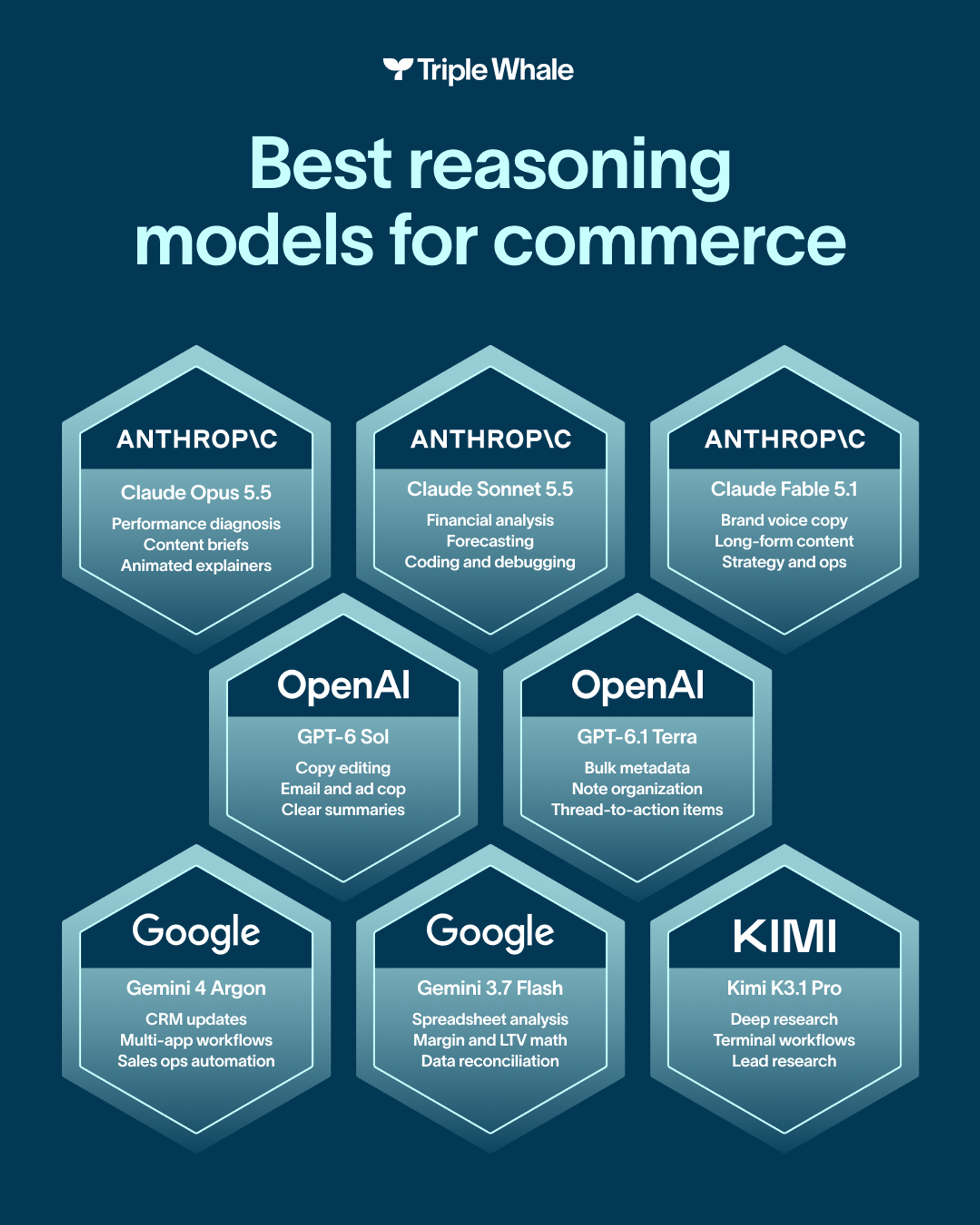
Reasoning models are slower and methodical. They plan, check their logic, and work through a problem step by step, which makes them the right fit for questions with many moving parts.
Ask “Why did my blended ROAS drop from 3.2 to 2.4 last month?” and the model has to work through ad spend by channel, product mix, discount stacking, seasonality, and attribution shifts.
Best for:
- Quick lookups: “What was my revenue last week?” or “How many orders did we ship in October?”
- Writing and editing: Product descriptions, email subject lines, ad copy variations, or a polished customer support reply.
- Summaries and extraction: Turning a pile of customer reviews into five recurring themes, or a long Slack thread into action items.
- Everyday questions: “What’s the difference between ROAS and MER?” Fast, factual, done.
What is “thinking effort?”
Many reasoning models also let you set a thinking effort level, often low, medium, or high. Higher effort gives the model more time to work through the problem, which improves accuracy on hard tasks and adds to the wait and the bill. For simpler analysis, a lower setting usually gets you there faster.
Please note that effort or thinking levels and their names vary by provider, and some models offer only a few settings.
- Low: Light analysis where speed still matters. Use it to compare two campaigns side by side, sanity-check a calculation, or reorganize data into a cleaner format.
- Medium: A solid default for everyday analysis. Use it to spot trends in a weekly performance report, diagnose a dip in conversion rate, or draft a promo calendar from past sales data.
- High: Multi-step problems with several variables. Use it to figure out why blended ROAS dropped across channels, plan inventory reorders ahead of Black Friday, or model the impact of shifting budget from Meta to Google.
- Xhigh: The hardest, highest-stakes work, where a wrong answer costs more than a long wait. Use it for annual budget planning, pricing strategy across a full catalog, or a deep audit of attribution and spend before a major investment decision.
Creative models, explained
A creative model generates something original, such as an image, a video, a voice track, a piece of music. Instead of retrieving an answer, you’re describing what you want to exist.
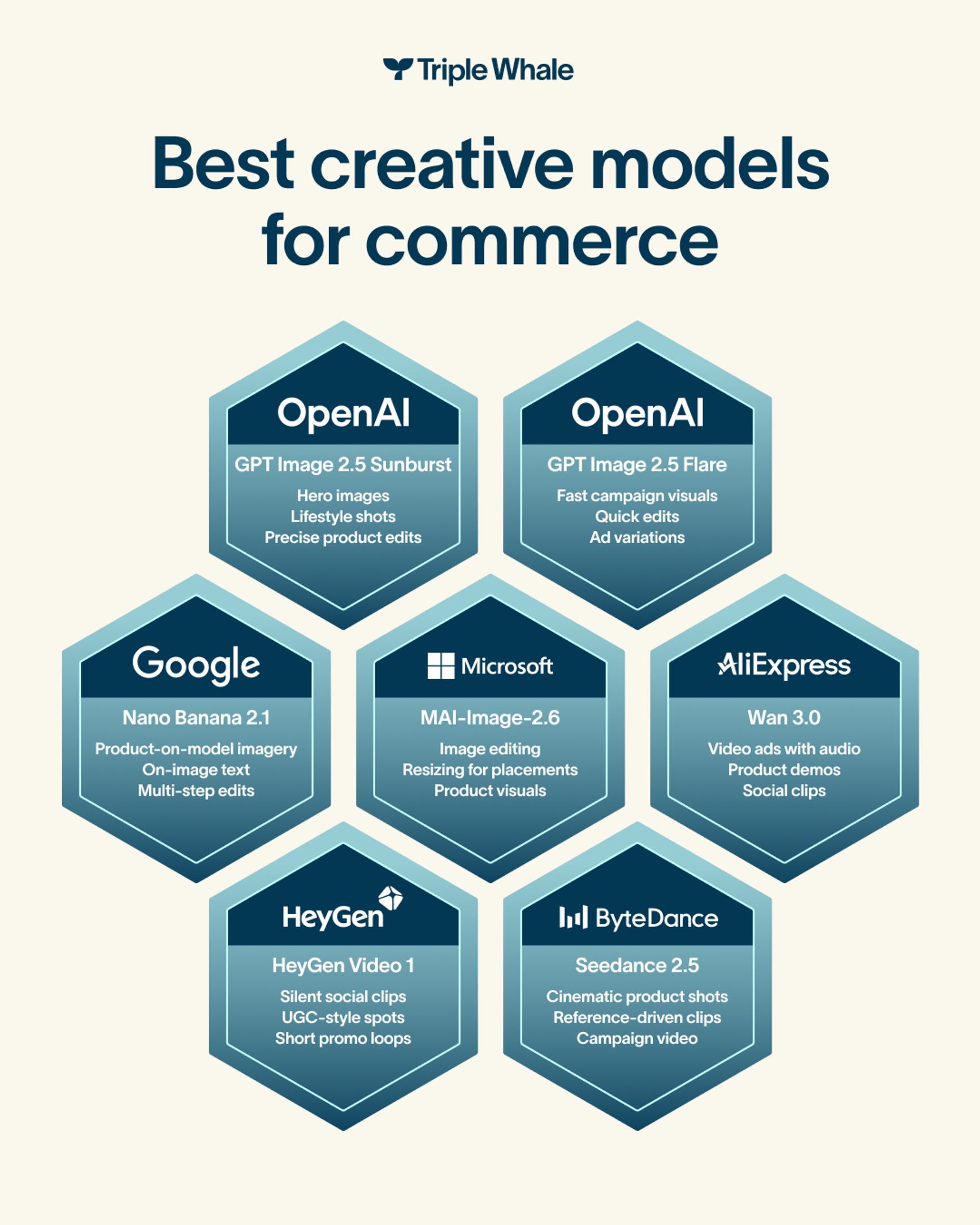
It’s good to know that creative models are incredibly specialized. The model that paints a beautiful product shot is not the one that renders a smooth 10-second video, so you’ll want to become familiar with which models handle each format best. We’ll cover the top picks below.
Best for:
- Product visuals: Lifestyle shots, clean background removals, and on-model imagery without a studio budget.
- Ad creative: Static and video ads in multiple formats and aspect ratios, so you can test more angles faster.
- Audio: Voiceovers in different voices and languages, plus original music beds for your videos.
- Iteration: Turning one winning ad concept into a dozen variants for testing.
What model to choose: Match the task to the model
Picking the right model means starting with the task, then weighing speed, accuracy, and cost against what the job requires.
Below, we break down the best AI for the tasks ecommerce teams run every day, from writing product copy and analyzing performance data to generating ad creative. Each pick is based on independent benchmarks from Artificial Analysis, which tests models on quality and speed.
For each one, you’ll see which models lead, what type they are (direct, reasoning, or creative), and when the tradeoffs are worth it.
Best AI for writing
Product descriptions, email campaigns, landing page copy, and brand voice guides. For copy with personality, Claude Fable 5.1 ranks highest on Artificial Analysis’ expressiveness index, which measures rich, varied, well-crafted language. For tight copy with no padding, GPT-6 Sol ranks lowest on the slop index, which tracks filler and generic language.
| Model | Developer | Type | |
|---|---|---|---|
| Claude Fable 5.1 | Anthropic | Reasoning | #1 on expressiveness |
| GPT-6 Sol | OpenAI | Reasoning | Least filler and generic language |
| Claude Haiku 5.5 | Anthropic | Direct | Fast drafts at volume |
Best AI for SEO
Keyword clustering, content briefs, meta descriptions, and refreshing older posts. SEO blends research and writing, so use a high-intelligence model for briefs and drafts, then a fast model for bulk metadata across hundreds of pages.
| Model | Developer | Type | |
|---|---|---|---|
| Claude Opus 5.5 | Anthropic | Reasoning | #1 on the Intelligence Index |
| Claude Fable 5.1 | Anthropic | Reasoning | Strongest long-form writing voice |
| GPT-6.1 Terra | OpenAI | Reasoning | Fast output for bulk metadata |
Best AI for research
Competitor analysis, market sizing, and synthesizing dozens of sources into one summary. Claude Opus 5.5 ranks #1 on the Artificial Analysis LLM Leaderboard with an Intelligence Index score of 58, followed by Claude Sonnet 5.5 at 56 and Kimi K3.1 Pro at 55.
| Model | Developer | Type | |
|---|---|---|---|
| Claude Opus 5.5 | Anthropic | Reasoning | Intelligence Index: 58 |
| Claude Sonnet 5.5 | Anthropic | Reasoning | Intelligence Index: 56 |
| Kimi K3.1 Pro | Kimi | Reasoning | Intelligence Index: 55 |
Best AI for math
Margin modeling, LTV calculations, and pulling answers from messy spreadsheets. Artificial Analysis tests this on AA-AnalystAgent, which measures how well AI agents work with spreadsheets and documents to answer the quantitative questions a business or data analyst faces day to day. Gemini 3.7 Flash leads at 60%, followed by Claude Sonnet 5.5 and Claude Fable 5.1, each at 57.5%.
| Model | Developer | Type | |
|---|---|---|---|
| Claude Opus 5.5 | Anthropic | Reasoning | Intelligence Index: 58 |
| Claude Sonnet 5.5 | Anthropic | Reasoning | Intelligence Index: 56 |
| Kimi K3.1 Pro | Kimi | Reasoning | Intelligence Index: 55 |
Best AI for coding
Building Shopify theme customizations, writing scripts to clean order data, or debugging a checkout integration. On FrontierCode, which tests whether code changes are good enough for maintainers to merge, Claude Opus 5.5 holds the top three spots across its medium, high, and xhigh effort settings. For terminal-based work, Kimi K3.1 Pro leads Terminal-Bench 4.0 at 67.2%, followed by Claude Sonnet 5.5 at 63.6%.
| Claude Opus 5.5 | Anthropic | Reasoning | #1 on FrontierCode (57.1%) |
| Kimi K3.1 Pro | Kimi | Reasoning | #1 on Terminal-Bench 4.0 (67.2%) |
| Claude Sonnet 5.5 | Anthropic | Reasoning | #2 on Terminal-Bench 4.0 (63.6%) |
Best AI for business
Diagnosing a revenue dip, evaluating a new channel, or building a quarterly plan. Artificial Analysis scores models by business domain, and Claude Opus 5.5 ranks first in all six capability indexes, including Finance & Accounting and Strategy & Ops.
| Model | Developer | Type | |
|---|---|---|---|
| Claude Opus 5.5 | Anthropic | Reasoning | #1 in Finance and Strategy & Ops |
| Claude Fable 5.1 | Anthropic | Reasoning | #2 in Strategy & Ops |
| Claude Sonnet 5.5 | Anthropic | Reasoning | #2 in Finance & Accounting |
Best AI for marketing
Campaign planning, ad copy testing, audience segmentation, and creative briefs. Marketing teams usually need a stack: a text model for strategy and copy, plus creative models for visuals and video. Pull the top pick from each relevant category.
| Model | Developer | Type | |
|---|---|---|---|
| Claude Opus 5.5 | Anthropic | Reasoning | Campaign strategy and briefs |
| Claude Fable 5.1 | Anthropic | Reasoning | Ad and email copy |
| GPT Image 2.5 Sunburst | OpenAI | Creative | Static ad creative |
Best AI for productivity
Summarizing meetings, drafting replies, organizing notes, and turning a Slack thread into action items. Speed matters more than peak intelligence here. On the Artificial Analysis leaderboard, Claude Haiku 5.5 outputs 237 tokens per second, which makes it one of the quickest options for everyday tasks.
| Model | Developer | Type | |
|---|---|---|---|
| Claude Haiku 5.5 | Anthropic | Direct | |
| GPT-6.1 Terra | OpenAI | Reasoning | Quick answers with solid reasoning |
| GPT-6 Luna | OpenAI | Direct | Fast responses for simple tasks |
Best AI for sales automation
Personalized outreach, follow-up sequences, CRM updates, and lead research. AutomationBench-AA tests this directly, with 657 tasks across Finance, HR, Marketing, Operations, Sales, and Support, using simulated apps including Gmail, Google Sheets, Slack, Salesforce, Zendesk, Jira, and HubSpot. Gemini 4 Argon leads at 77.5%, followed by Kimi K3.1 Pro at 73.3% and MiniMax-M3.1-Flash at 72.5%.
| Model | Developer | Type | |
|---|---|---|---|
| Gemini 4 Argon | Reasoning | AutomationBench: 77.5% | |
| Kimi K3.1 Pro | Kimi | Reasoning | AutomationBench: 73.3% |
| MiniMax-M3.1-Flash | MiniMax | Reasoning | AutomationBench: 72.5% |
Best AI for image generation
Lifestyle shots, product-on-model imagery, and seasonal campaign visuals. GPT Image 2.5 Sunburst leads Artificial Analysis’ text-to-image leaderboard, followed by GPT Image 2.5 Flare, GPT Image 2, and Nano Banana 2.1.
| Model | Developer | Type | |
|---|---|---|---|
| GPT Image 2.5 Sunburst | OpenAI | Creative | #1 text-to-image (Elo 1222) |
| GPT Image 2.5 Flare | OpenAI | Creative | #2 text-to-image (Elo 1207) |
| Nano Banana 2.1 | Creative | #4 text-to-image (Elo 1176) |
Best AI for image editing
Background removal, swapping a product’s colorway, or adapting one hero image for multiple placements. GPT Image 2.5 Sunburst and Flare hold the top two spots on the editing leaderboard, followed by MAI-Image-2.6, Krea 3 (Ultra), and Nano Banana 2.1.
| Model | Developer | Type | |
|---|---|---|---|
| GPT Image 2.5 Sunburst | OpenAI | Creative | #1 image editing |
| MAI-Image-2.6 | Microsoft | Creative | Tied for #3 |
| Nano Banana 2.1 | Creative | Tied for #3 |
Best AI for animated video
Product explainers, animated ads, UGC-style spots, and short social clips. You have two routes. For animated motion graphics built in code, Claude Opus 5.5 leads Code2Video-AA, which evaluates how well models create short product and brand videos from design briefs. For generated footage, Wan 3.0 leads the text-to-video leaderboard, and for silent clips, HeyGen Video 1 takes the top spot.
| Model | Developer | Type | |
|---|---|---|---|
| Claude Opus 5.5 | Anthropic | Reasoning | |
| Wan 3.0 | Alibaba | Creative | |
| HeyGen Video 1 | HeyGen | Creative |
Why the model alone isn’t enough to run a business
A general-purpose model may understand commerce concepts. But it doesn’t know how your company defines revenue. It doesn’t know which attribution model you trust, what changed today, how your data relates, or what you want it to do.
That’s fine when the stakes are low. You can ask a general model for headline ideas or a first draft of a brief. But the risk grows when you ask it to explain a drop in revenue or tell you where to move budget.
A confident answer isn’t the same as a correct answer. Without business context, even a strong model can only offer a polished guess.
Why this matters for commerce
Commerce questions span marketing, customers, products, site performance, inventory, lifecycle, and finance. Useful AI needs to know what the data means, how it connects, and what it signals. Access to numbers isn’t enough. The system needs to know what the numbers mean.
What is Moby?
Moby is the AI harness for commerce. It connects an AI model to the data and capabilities it needs to complete real work for your store.
Inside Triple Whale, Moby works as your chief of staff. It pulls numbers, diagnoses performance, builds plans, and creates the assets you need to act on them.
To make sure every customer gets consistent results from their included Moby usage, Triple Whale manages which model runs based on your plan:
- Foundation and Legacy plans run Moby on Triple Whale’s recommended models, pre-selected for your plan and usage allotment.
- Automate and Enterprise plans include full access to Triple Whale’s model library, including new frontier models as they’re released.
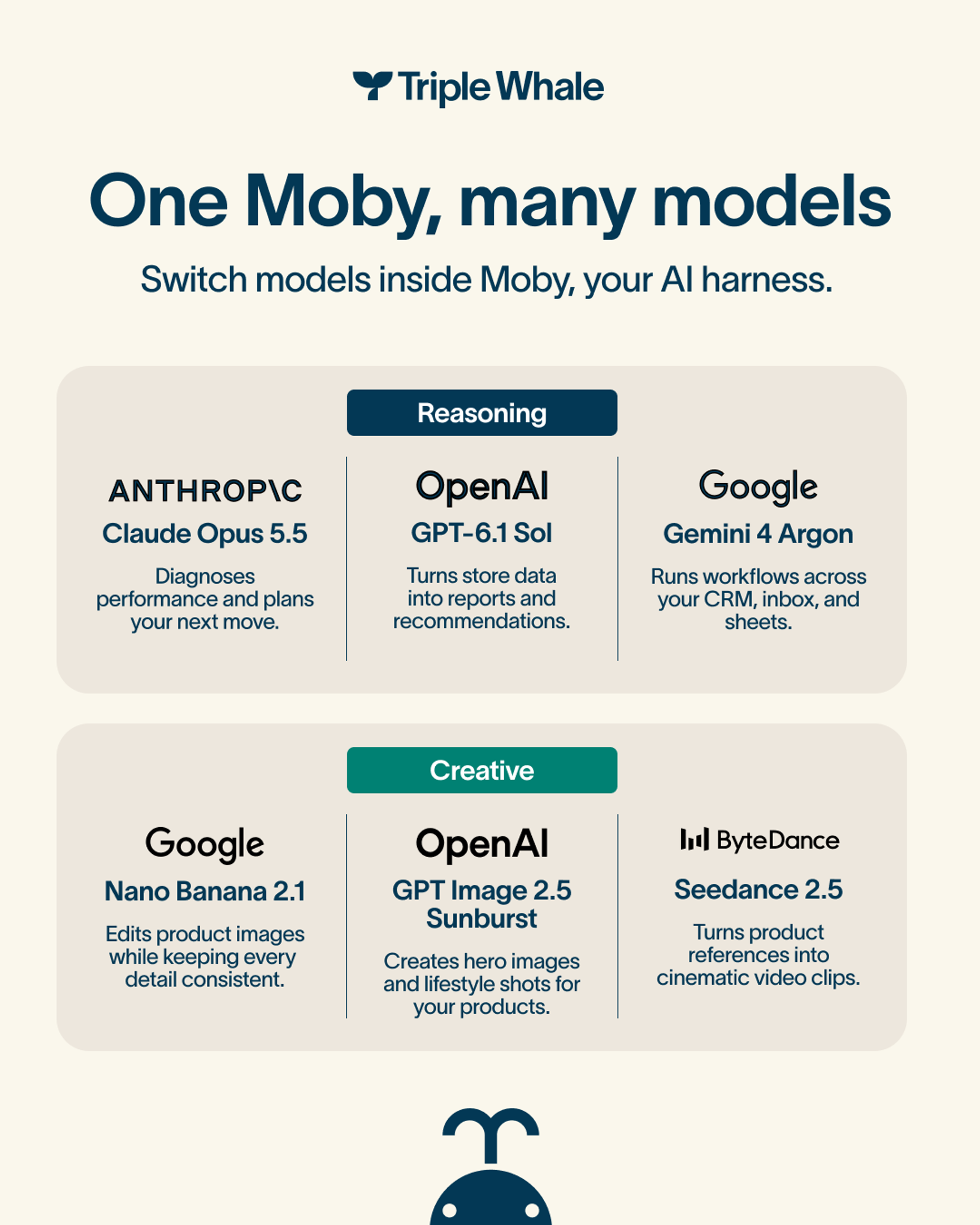
On Automate and Enterprise, the model behind the chat is yours to choose. Switch to a reasoning model like GPT-6.1 Sol when the task turns analytical, or a creative model when it turns visual. You match the model to the task, while the tooling and your store data stay the same.
AI models in Moby
Reasoning models:
- OpenAI: GPT-6 Astra, GPT-6.1 Sol, GPT-6 Luna
- Anthropic: Claude Opus 5.5, Claude Sonnet 5.5, Claude Haiku 5.5
- Google: Gemini 4 Argon
- xAI: Grok 4.7
- Deepseek: V4.1 Flash
- Z.ai: GLM-5.3 Flash
Creative models:
- Google: Nano Banana 2.1, Nano Banana Pro, Veo
- OpenAI: GPT Image 2.5 Sunburst, GPT Image 2.5 Flare
- ByteDance: Dola Seedream 5.0 Pro, Seedance 2.5
- xAI: Grok Imagine Image 2.0, Grok Imagine Video 1.5 Preview
- Bytedance: Omni, Omni 1.5
Built-in capabilities:
These run automatically when a task calls for them, with no model selection needed.
- Text-to-speech: ElevenLabs voices, searchable by language, accent, gender, age, and use case
- Speech generation: The Grok voice lineup from xAI
- Transcription: Audio transcription with timestamps and speaker labels
- Music generation: Original tracks
- Background removal: Clean product cutouts
- Video stitching: Combine clips into one file
- Media analysis: Inspect video, audio, and PDF files
The choice is yours
Benchmarks measure performance on standard tasks, so the best model for your store may depend on your data and workflow. If you want help choosing, the Triple Whale team can walk you through it. Book a demo today.