So, you’re starting to hire employees who know artificial intelligence, or to build your new AI program.
Now you need to know how to tell the difference between someone who is truly AI-first and someone who’s a novice (or worse, totally bluffing). It has a lot to do with how the candidate describes their work. And the right questions can bring it out.
This article gives you eight questions to test your candidate’s knowledge — with several contributed by Triple Whale’s own recruiting team — what a strong answer sounds like, and the red flags to watch out for.
What does AI-first actually mean?
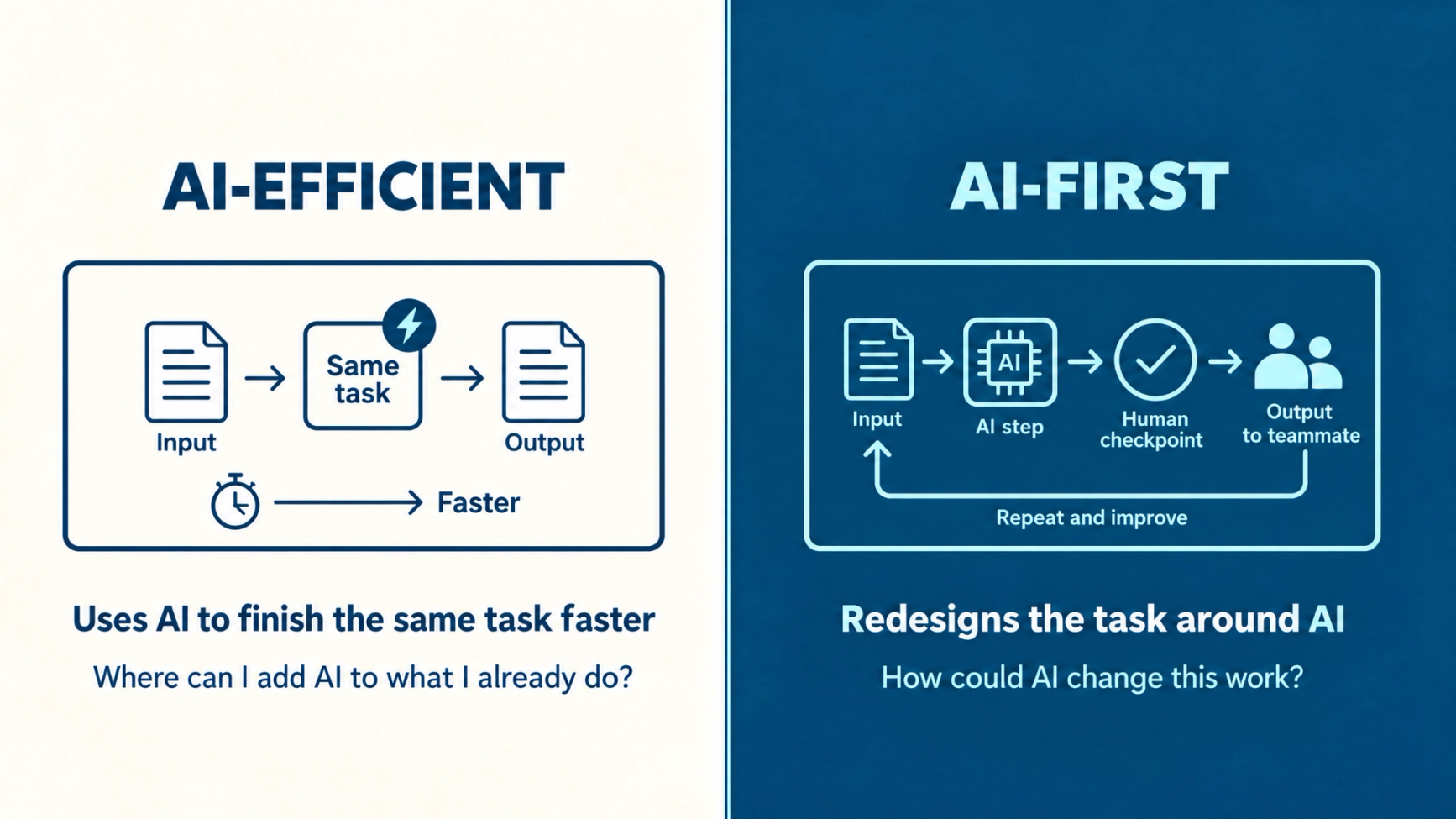
An AI-first employee doesn’t just use artificial intelligence to get their tasks done faster. An AI-first employee asks, “How could AI change this work to make it faster, better, and more efficient?” They bring that question to their role from day one, and it shapes how they plan, build, and check their work.
AI-efficient vs. AI-first
Both AI-efficient and AI-first candidates use AI at work, so their approaches can sound similar in an interview. But they’re very different. Here are the differences in how they work, what they build, and the question they start with.
| AI-efficient | AI-first | |
|---|---|---|
| How it works | Uses AI to finish the same task faster | Redesigns the task or the system around AI |
| Example | Writing ad copy quicker | A repeatable creative testing loop with AI in each step |
| Starting question | “Where can I add AI to what I already do?” | “How could AI change this work?” |
For example, a faster draft helps once. A repeatable workflow contributes to team-wide efficiency, and AI-first employees give your organization more to build on.
Traits of an AI-first candidate
When you interview candidates, look for four traits. Each one shows up in the details a candidate chooses to share about their work:
- Curiosity. Curious candidates run experiments on their own initiative. Good signs are small tests they ran and what they changed after learning something new.
- Systems thinking. They see workflows, handoffs, and inputs, not single prompts. A strong candidate can say who receives the output next and what the task needs before it starts.
- Judgment. A strong candidate knows when to trust AI and when to check it. Look for named checks, such as comparing results with source data, and a clear list of decisions kept in human hands.
- Specifics. They can describe real work with real results. Expect named tasks, numbers the candidates can explain, and honest notes on what didn’t work.
The best AI-first employees know how to use tools like Moby AI to answer questions about their data and run the same workflows on repeat.
8 AI interview questions to find AI-first employees
These eight questions assess AI-first skills, many of which come from conversations we've had with the Triple Whale recruiting team: Shirel Ozinci, Marie Deveau-Rogers, and Lauren Wondsel. Each includes why to ask it and what a good answer sounds like.
AI interview questions about curiosity and learning
1. “I’d love to hear how you’ve been exploring AI beyond just using it to make your work more efficient. What have you been experimenting with or learning about lately?”
- Why ask: Candidates who experiment on their own initiative keep learning as tools change, and that’s the habit an AI-first employee needs.
- Good answer: A recent experiment, even a small one. Maybe a candidate rebuilt how they summarize customer calls, or tried three tools on a messy spreadsheet. The follow-through matters most: what worked, what didn’t, and what came next.
2. “What’s something you’ve used AI for that most people probably wouldn’t think to try?”
- Why ask: Anyone can name the obvious uses, like drafting emails or cleaning up spreadsheets. But this question shows intellectual curiosity. A candidate who names a clear problem and explains what they did with the output AI gave them shows how AI-first they are.
- Good answer: A problem the candidate identified and what they did with AI’s answer. Say a candidate asks AI how to cover weekend shifts, tries one idea for two weeks because it worked, and drops the rest. It shows they were trying to solve a problem and act.
AI interview question about real work
3. “Can you walk me through a specific example of how you’ve incorporated AI into your day-to-day work?”
- Why ask: It’s easy to say “I use AI daily.” But real examples are harder to fake, because the details are either there or they aren’t.
- Good answer: Something like: “I used to spend Mondays pulling numbers into a deck. Now AI drafts the first pass from the export, and I spend that time checking the story.” It follows a clear path: a before, an after, and someone checking the final output.
AI interview question about evolving the role
4. “If you could automate or completely rethink one part of your current role using AI, what would it be?”
- Why ask: AI-first employees question how today’s job is built before they touch a tool. Pay attention to which task the candidate picks and how well they understand the work as it runs today.
- Good answer: The candidate picks a task and starts by questioning how it's built today. Which steps shouldn’t be there? Where does work sit waiting, and where does it get handed off? The rebuilt version then gives the AI repeatable steps and leaves judgment calls to a person.
AI interview questions about how they think in systems
5. “Pick a task you repeat every week, like a report, a review, or a creative test. How would you build a repeatable workflow for it with AI in it?”
- Why ask: Short on time? If you only ask one systems thinking question, make it this one. Building a workflow out loud is the fastest way to hear how a person plans, and whether a teammate could pick it up later.
- Good answer: Expect a walk-through that covers what data goes in, what AI does with it, where a person checks, and where the output lands. Candidates can skip a step without noticing, so ask for each one in order.
6. “Tell me about a time AI gave you a wrong or overconfident answer. How did you catch it?”
- Why ask: Most regular AI users have been burned by a confident wrong answer. What matters is whether the candidate caught it before it went out and how.
- Good answer: The best stories end with a changed habit. A candidate might describe a wrong number in an AI summary, how checking the source report exposed it, and the review step added afterward.
7. “How do you give AI the context it needs, like goals, brand voice, and data, so the output isn’t generic?”
- Why ask: Vague goals and a generic voice get generic work back. Strong candidates build their context once and keep it ready for the next task.
- Good answer: Saved brand guidelines, a few sample outputs, and a clear goal for each task. Even better is a candidate who updates that material and can say whether results improved.
8. “Which decisions would you never hand to AI, and which would you hand over with guardrails?”
- Why ask: Where a candidate draws the line is the whole answer. Listen for how they think about risk.
- Good answer: Decisions split into two groups. The first stays with a person because a mistake costs too much, whether in money, legal exposure, or a company’s trust. The second goes to AI, with limits on what it can change and a review before anything goes out.
What strong and weak AI interview answers sound like
A confident speaker can sound AI-first in an interview without actually using AI. This table compares strong and weak answers to AI interview questions, so you can tell real experience from a rehearsed pitch.
| Strong answer | Weak answer | |
|---|---|---|
| Example | A specific example from real work | No example or a made-up one that falls apart under follow-up questions |
| Results | Numbers or outcomes with a clear before and after | Vague claims like “it saves me time” |
| Process | A clear process they can walk you through step by step | A list of tool names |
| Limits | Honest about what AI gets wrong | Talks as if AI is always right |
| Checking | A plan to check the output | No way to verify the result |
Red flags to watch for in an interview
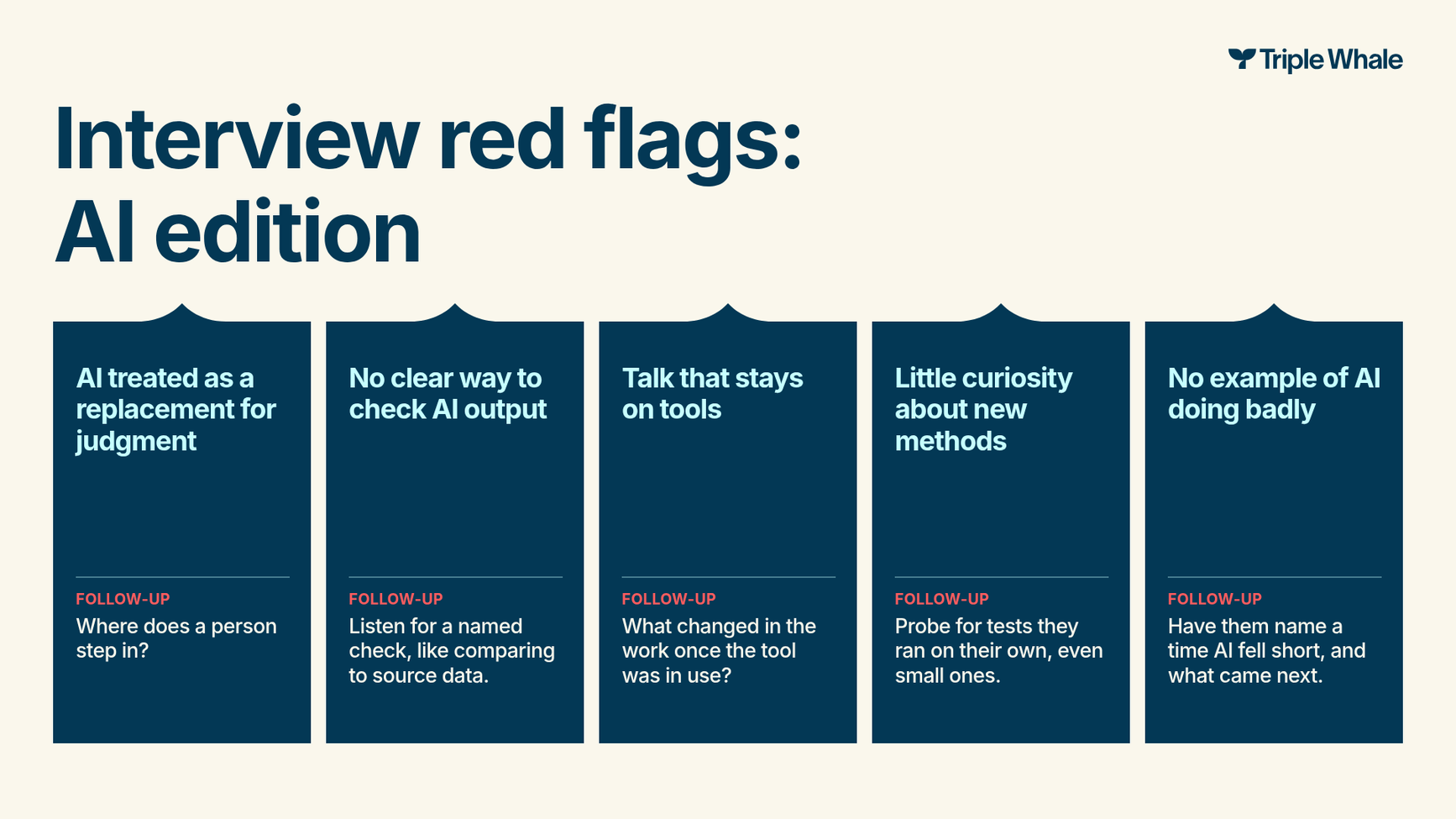
The clearest red flags when hiring for AI skills are vague, tool-heavy, or unchecked answers to AI interview questions. These warning signs of surface-level AI use will help you spot problems early and know when to ask a follow-up question.
- AI is treated as a replacement for judgment. A candidate who accepts AI output as final, or says AI makes the decisions, leaves no role for a person. Strong candidates keep people responsible for the result and can say where a human steps in.
- No clear way to check AI output. If the answer to “How would you know it was wrong?” is “It looked right,” ask for a specific check, such as comparing the output to source data or asking a colleague to review it.
- Talk that stays on tools. A long list of product names with no task, result, or before-and-after shows familiarity with software. Ask what changed in the work once the tool was in use.
- Little curiosity about new methods. Someone who has tried nothing outside assigned tasks may stop learning when the tools change. Ask what the person has tested on their own, even on a small side project.
- No example of AI doing badly. Most people who use AI for work have seen it fail. A candidate who can’t name one weak spot may have used it only lightly, or may be overselling. Ask for a task where AI fell short and what happened next.
“We’ve found that human interaction catches far more than the fraud checks in our ATS or the questions we include on an application.” — Lauren Wondsel, Head of Talent at Triple Whale
Keep the process fair
Ask each candidate the same questions, and score the answers against the same strong and weak examples. Write the scoring criteria before the first interview, so the scores reflect what candidates said and not who impressed you most in the room.
Don’t penalize people for not having used one specific tool. Tools change quickly, and a candidate who knows a different product can show the same thinking. Let the person describe the process, the result, and the check with whatever tools are familiar. How a person thinks about work is the part worth testing.
“For me, it’s less about how many AI tools a candidate is familiar with and more about how they’re actually applying them.” — Shirel Ozinci, Talent Acquisition Manager at Triple Whale
Hire the people who put AI to work
AI-first employees start from one question: how could AI change this work? That habit sets them apart from AI-efficient colleagues, who use AI to finish the same task faster. In an interview, that difference comes through as a real example, a clear process, honest limits, and a plan to check that output.
Once you hire that person, give them room to build. Moby AI, Triple Whale’s AI teammate, works from your own store data, so those habits can start paying off in the first week.
Curious how an AI teammate could fit into your workflows? Learn more about Moby AI.