
Blog
Agentic AI vs. Traditional Automation: What It Means for Ecommerce Brands

Agentic AI vs. Traditional Automation: What It Means for Ecommerce Brands

By 
Last Updated:  
August 27, 2026

Eighty-four percent of ecommerce businesses now rank AI as their top strategic priority. But “AI” gets used as a catch-all term, and two ideas keep getting lumped together that aren’t actually the same: automation and agentic AI.

For years, automation has meant setting a rule and letting it run. An abandoned cart. A restock alert. A tag that fires after someone’s third order. Set it once, and it keeps working. 

Agentic AI works differently. Instead of waiting on a rule you wrote months ago, it looks at what's happening right now and decides what to do about it. Gartner expects agentic AI to power a third of enterprise software by 2028.

That distinction matters because it changes what you can hand off and what still needs a person to make the call. 

This post breaks down traditional automation, RPA, BPA, and agentic AI, with simple ecommerce examples of where each fits.

Key Takeaways:
  • Use traditional automation for predictable work. It’s a strong fit when the trigger, steps, and outcome stay consistent.
  • Use agentic AI when the next step depends on context. It can analyze available data and choose a path within its tools, permissions, and guardrails.
  • Ecommerce teams need both. Keep routine workflows, and use Triple Whale’s Moby AI for analysis, recurring work, and supported Actions — with the operator still in control.

What is traditional automation?

Traditional automation is what most of us used before AI entered the chat. It runs on rules set in advance and follows the same predetermined path each time. It can handle the exceptions and branches built into a workflow, but it wasn’t designed to make open-ended judgment calls.

This is the world of robotic process automation (RPA) and business process automation (BPA):

  • RPA usually handles small, repetitive tasks, like copying order data from one system into another
  • BPA typically connects a bigger process across several steps, like an order that triggers an inventory update, which triggers a shipping notice, then a review request

For an ecommerce brand, that might look like sending an abandoned cart email 24 hours after checkout, or tagging a customer as a repeat buyer after their third order. The logic is fixed: if this happens, do that. 

These automations save real time. But they are limited to the conditions and exceptions built in advance. If something unexpected happens, like a supplier delay or a traffic spike, the workflow may stop, escalate, or produce the wrong result unless someone designed logic for that situation. 

What is agentic AI?

Agentic AI works toward a goal instead of following the same set of steps every time. It can take in a goal, look at available data, reason about possible next steps, and use tools to pursue that goal – closer to how a sharp teammate would think through work.

You’ve probably heard this described as an “AI agent.” The term gets defined in a lot of different ways. Some people mean a system that can complete a larger job with limited supervision. Others mean a specialized system that handles one part of a bigger process. The shared idea is that AI can reason about the next step instead of only following a fixed sequence.

Traditional automation vs. agentic AI

Here’s the difference in practice:

  • Traditional automation: “If return on ad spend (ROAS) drops below 1.5, send an alert.”
  • Agentic AI: “Review my Meta and Google performance from the last seven days. Tell me what’s underperforming, why, and what you’d do about it.”

The first is a fixed condition. The second asks the AI to investigate. An agentic system can pull the available data, spot a pattern, explain its rationale, and recommend or take a supported next step. Traditional automation follows predefined logic. Agentic AI can reason about the next step, then act within its tools and guardrails.

What actually makes AI “agentic”?

If you want to go one layer deeper, agentic AI tends to share four traits. The next part gets a little more technical, but it’s worth knowing because it explains what agentic AI can do that a fixed rule can’t:

  • It can choose a path toward a goal. Give it an objective, like “protect my profit margin this month,” and it can map out steps to get there, instead of waiting for you to define every one.
  • It can plan ahead. It may compare possible next steps before acting, rather than responding to only one condition.
  • It can adjust as conditions change. If new information appears mid-task, it can revise its plan within the context, tools, and guardrails available to it.
  • It can use context and feedback. Some agentic systems retain earlier outcomes and use that context in future work, although not every AI agent learns the same way.

A fixed rule only handles conditions and branches designed in advance. Agentic AI can interpret context and choose among possible next steps. 

Agentic AI in action: Meet Moby

At Triple Whale, Moby is how ecommerce teams put agentic AI to work. You may hear this type of technology being referred to as an AI agent. We used to talk about Moby in those terms, too. Today, we keep it simpler: you don’t manage a lineup of agents. You tell Moby what you need, and Moby uses the context of your business to get to work.

Here’s where it’s useful for ecommerce brands: chat is for work you want Moby to do now, while a Moby Automation is recurring work that runs on a schedule. 

For example, ask Moby for a daily brief on sales, spend, and new customer cost per acquisition (CPA). Refine the analysis in chat, then tell Moby how often it should run, which timezone to use, and where the result should go — such as a Moby thread, Slack, or email. 

Moby runs a kickoff first so you can review the output, then continues on the schedule you set.
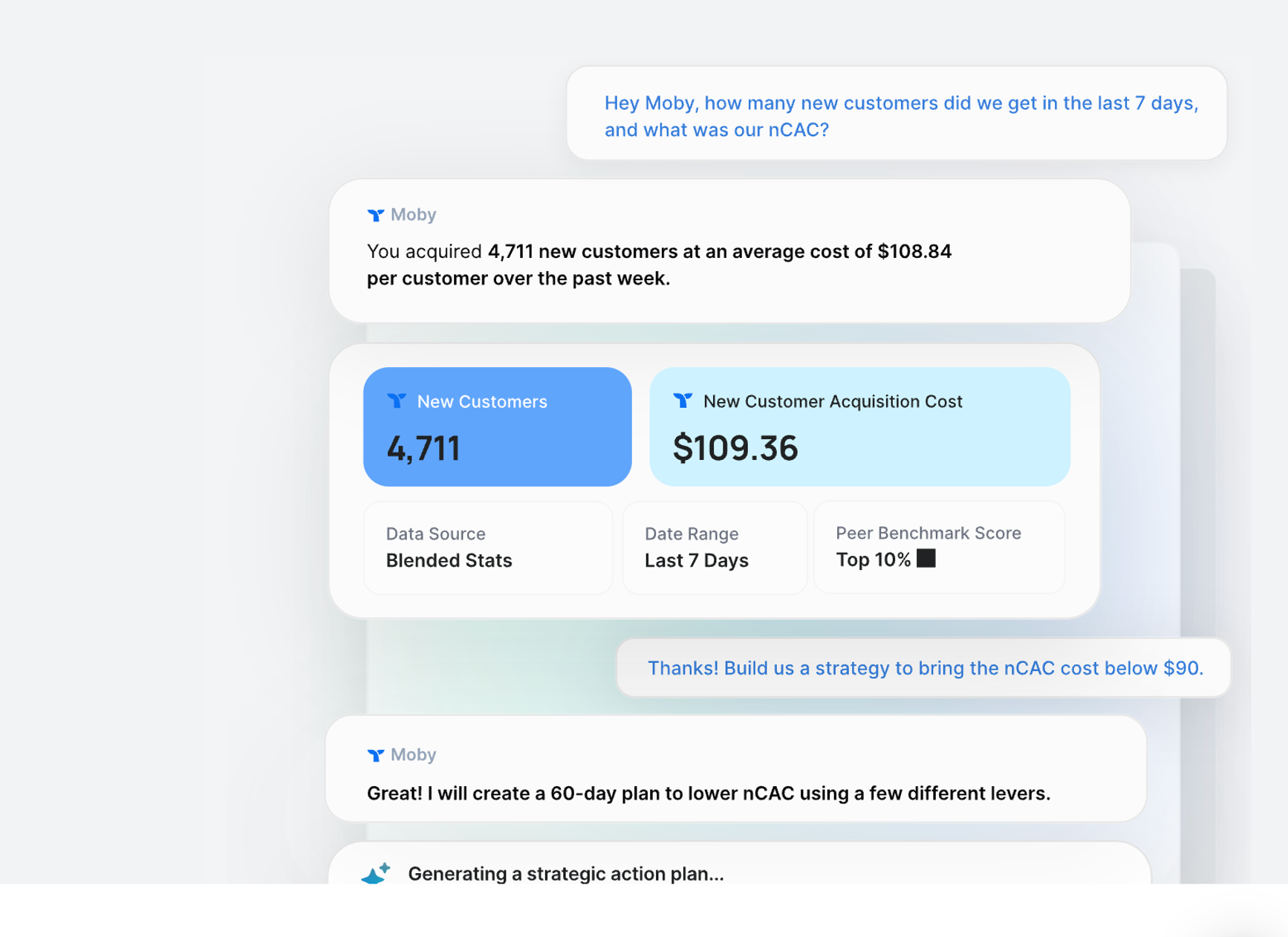
Image showing Moby and how it works

That’s a meaningful step from fixed-rule automation. Here’s how to compare the two:

Dimension Traditional Automation (RPA/BPA) Agentic AI (Moby)
How it works Follows predefined logic Reasons toward a goal using available business context
Handles change Handles the branches and exceptions designed in advance Can revise its plan within available context and guardrails
Setup Configured with rules, triggers, and workflow steps Can be described and refined in plain language
Best for Predictable, repetitive tasks Analysis, judgment-dependent work, and multi-step decisions
Output A predefined output An analysis, recommendation, or supported action with rationale

Do you still need traditional automation?

Yes. Agentic AI doesn’t retire traditional automation because it builds on it.

Traditional automation is still the right call for predictable tasks that follow stable logic, like a receipt email or a shipping confirmation. It’s fast and consistent, which is exactly what you want for that kind of work. 

Agentic AI earns its place when the next step depends on what the data shows: which campaign may be ready to scale, which one needs attention, or which SKU is at risk of selling out. The smartest setup for most ecommerce brands is not “replace automation with AI.” It’s “let each one do what it’s actually good at.”

Here’s what that split tends to look like across common ecommerce tasks:

Ecommerce Task Better Fit
Order confirmation and shipping emails Traditional Automation
Abandoned cart flow Traditional Automation
Tagging repeat customers Traditional Automation
Reviewing which ad campaigns may be ready to scale or pause Agentic AI
Flagging inventory at risk of selling out Agentic AI
Daily performance reporting with a recommendation attached Agentic AI
Investigating why a metric moved Agentic AI

There’s a noticeable pattern: if the task follows stable logic, traditional automation handles it well. If the next step changes depending on what the data shows, agentic AI may be the better fit.

Make smarter decisions faster with Moby.
Book a Demo

Why human oversight still matters

Handing decisions to AI can feel risky, especially with ad budget or inventory on the line. That’s why oversight matters just as much as the automation itself.

This is where Moby Actions comes in. Moby can use connected data and your instructions to prepare supported Actions across connected platforms. Depending on your Action settings, those Actions can wait for your review or, where supported, execute without an individual approval step:

  • Ask every time: Moby prepares the proposed Action, shows the available rationale and details, and waits for approval before execution.
  • Let Moby decide: For supported Actions, Moby can decide whether to ask for review or execute without an individual approval step. Clear goals, account scope, metrics, time windows, thresholds, budget limits, and exclusions still matter.

The Actions log records available details about what Moby proposed or executed, including status, mode, rationale, and timing.

What agentic AI needs to actually work well

Agentic AI is only as good as what it can see. Feed it messy, disconnected data, one number in Shopify, a different number in Meta, no shared definition of what “profitable” means for your brand, and it will reason with bad information.

Two things matter most before you lean on agentic AI for a real decision:

  • Reliable, connected data. If your performance data is fragmented across platforms or uses conflicting definitions, the AI may reason from an incomplete picture. Triple Whale brings business signals together on a trusted measurement foundation so Moby can work from shared context.
  • A clear goal and guardrails. “Grow the business” is generally not specific enough. “Protect a 20% contribution margin while growing new customers” gives the AI a clearer objective, while scope, permissions, thresholds, and exclusions define what it may do.

This is also why your team’s role changes rather than disappears. Someone still has to define the goal, set the guardrails, and sanity-check the recommendation. Agentic AI takes the busywork off your plate. It doesn’t remove the need for a person who understands the business.

Getting started: A simple way to blend the two

You don’t need to overhaul everything at once. A simple way to start:

  • Keep the routine automated. Order confirmations, shipping updates, and basic tags are already working. Leave them alone.
  • Use agentic AI for a first pass on judgment-dependent work. Anything where you would normally stop, check the data, and think it through may be a good candidate.
  • Start with one recurring headache. Pick the report or check you dread doing every week, and let agentic AI take the first pass.
  • Keep a human in the loop while you build trust. Start with a report-only workflow, review early outputs, and set clear guardrails before letting supported Actions run without individual approval.

The bottom line

Traditional automation handles predictable work through predefined logic. Agentic AI takes it further: it can use business context to reason about a goal, recommend a next step, and take supported action within the tools, permissions, and guardrails available to it. 

For ecommerce brands, the strongest setup uses both: fixed workflows for routine execution and agentic AI for analysis, decisions, recurring work, and supported actions — with the operator still in control.

Ready to turn your ecommerce data into decisions and action? See how Triple Whale helps ecommerce teams analyze performance and automate recurring work. Get started for free.

Make smarter decisions faster with Moby.
Book a Demo

Agentic AI vs. traditional automation: FAQs

What’s the difference between agentic AI and traditional automation?

Traditional automation, including RPA and BPA, follows predefined logic. Agentic AI takes it further by using available data and context to reason about a goal or problem. It can also suggest next steps within the tools it can access.

What do RPA and BPA stand for?

RPA stands for robotic process automation. It handles small, repetitive digital tasks, like copying data between two systems. BPA stands for business process automation. It connects a bigger process across multiple steps or tools.

Is Moby an AI agent?

Moby is Triple Whale’s AI operator for ecommerce and uses agentic capabilities to analyze and complete work. You don’t need to manage a lineup of separate “agents” — you tell Moby what you need in plain language.

Component Sales
5.32K
Artificial Intelligence

Agentic AI vs. Traditional Automation: What It Means for Ecommerce Brands

Last Updated: 
August 27, 2026

Eighty-four percent of ecommerce businesses now rank AI as their top strategic priority. But “AI” gets used as a catch-all term, and two ideas keep getting lumped together that aren’t actually the same: automation and agentic AI.

For years, automation has meant setting a rule and letting it run. An abandoned cart. A restock alert. A tag that fires after someone’s third order. Set it once, and it keeps working. 

Agentic AI works differently. Instead of waiting on a rule you wrote months ago, it looks at what's happening right now and decides what to do about it. Gartner expects agentic AI to power a third of enterprise software by 2028.

That distinction matters because it changes what you can hand off and what still needs a person to make the call. 

This post breaks down traditional automation, RPA, BPA, and agentic AI, with simple ecommerce examples of where each fits.

Key Takeaways:
  • Use traditional automation for predictable work. It’s a strong fit when the trigger, steps, and outcome stay consistent.
  • Use agentic AI when the next step depends on context. It can analyze available data and choose a path within its tools, permissions, and guardrails.
  • Ecommerce teams need both. Keep routine workflows, and use Triple Whale’s Moby AI for analysis, recurring work, and supported Actions — with the operator still in control.

What is traditional automation?

Traditional automation is what most of us used before AI entered the chat. It runs on rules set in advance and follows the same predetermined path each time. It can handle the exceptions and branches built into a workflow, but it wasn’t designed to make open-ended judgment calls.

This is the world of robotic process automation (RPA) and business process automation (BPA):

  • RPA usually handles small, repetitive tasks, like copying order data from one system into another
  • BPA typically connects a bigger process across several steps, like an order that triggers an inventory update, which triggers a shipping notice, then a review request

For an ecommerce brand, that might look like sending an abandoned cart email 24 hours after checkout, or tagging a customer as a repeat buyer after their third order. The logic is fixed: if this happens, do that. 

These automations save real time. But they are limited to the conditions and exceptions built in advance. If something unexpected happens, like a supplier delay or a traffic spike, the workflow may stop, escalate, or produce the wrong result unless someone designed logic for that situation. 

What is agentic AI?

Agentic AI works toward a goal instead of following the same set of steps every time. It can take in a goal, look at available data, reason about possible next steps, and use tools to pursue that goal – closer to how a sharp teammate would think through work.

You’ve probably heard this described as an “AI agent.” The term gets defined in a lot of different ways. Some people mean a system that can complete a larger job with limited supervision. Others mean a specialized system that handles one part of a bigger process. The shared idea is that AI can reason about the next step instead of only following a fixed sequence.

Traditional automation vs. agentic AI

Here’s the difference in practice:

  • Traditional automation: “If return on ad spend (ROAS) drops below 1.5, send an alert.”
  • Agentic AI: “Review my Meta and Google performance from the last seven days. Tell me what’s underperforming, why, and what you’d do about it.”

The first is a fixed condition. The second asks the AI to investigate. An agentic system can pull the available data, spot a pattern, explain its rationale, and recommend or take a supported next step. Traditional automation follows predefined logic. Agentic AI can reason about the next step, then act within its tools and guardrails.

What actually makes AI “agentic”?

If you want to go one layer deeper, agentic AI tends to share four traits. The next part gets a little more technical, but it’s worth knowing because it explains what agentic AI can do that a fixed rule can’t:

  • It can choose a path toward a goal. Give it an objective, like “protect my profit margin this month,” and it can map out steps to get there, instead of waiting for you to define every one.
  • It can plan ahead. It may compare possible next steps before acting, rather than responding to only one condition.
  • It can adjust as conditions change. If new information appears mid-task, it can revise its plan within the context, tools, and guardrails available to it.
  • It can use context and feedback. Some agentic systems retain earlier outcomes and use that context in future work, although not every AI agent learns the same way.

A fixed rule only handles conditions and branches designed in advance. Agentic AI can interpret context and choose among possible next steps. 

Agentic AI in action: Meet Moby

At Triple Whale, Moby is how ecommerce teams put agentic AI to work. You may hear this type of technology being referred to as an AI agent. We used to talk about Moby in those terms, too. Today, we keep it simpler: you don’t manage a lineup of agents. You tell Moby what you need, and Moby uses the context of your business to get to work.

Here’s where it’s useful for ecommerce brands: chat is for work you want Moby to do now, while a Moby Automation is recurring work that runs on a schedule. 

For example, ask Moby for a daily brief on sales, spend, and new customer cost per acquisition (CPA). Refine the analysis in chat, then tell Moby how often it should run, which timezone to use, and where the result should go — such as a Moby thread, Slack, or email. 

Moby runs a kickoff first so you can review the output, then continues on the schedule you set.

Image showing Moby and how it works

That’s a meaningful step from fixed-rule automation. Here’s how to compare the two:

Dimension Traditional Automation (RPA/BPA) Agentic AI (Moby)
How it works Follows predefined logic Reasons toward a goal using available business context
Handles change Handles the branches and exceptions designed in advance Can revise its plan within available context and guardrails
Setup Configured with rules, triggers, and workflow steps Can be described and refined in plain language
Best for Predictable, repetitive tasks Analysis, judgment-dependent work, and multi-step decisions
Output A predefined output An analysis, recommendation, or supported action with rationale

Do you still need traditional automation?

Yes. Agentic AI doesn’t retire traditional automation because it builds on it.

Traditional automation is still the right call for predictable tasks that follow stable logic, like a receipt email or a shipping confirmation. It’s fast and consistent, which is exactly what you want for that kind of work. 

Agentic AI earns its place when the next step depends on what the data shows: which campaign may be ready to scale, which one needs attention, or which SKU is at risk of selling out. The smartest setup for most ecommerce brands is not “replace automation with AI.” It’s “let each one do what it’s actually good at.”

Here’s what that split tends to look like across common ecommerce tasks:

Ecommerce Task Better Fit
Order confirmation and shipping emails Traditional Automation
Abandoned cart flow Traditional Automation
Tagging repeat customers Traditional Automation
Reviewing which ad campaigns may be ready to scale or pause Agentic AI
Flagging inventory at risk of selling out Agentic AI
Daily performance reporting with a recommendation attached Agentic AI
Investigating why a metric moved Agentic AI

There’s a noticeable pattern: if the task follows stable logic, traditional automation handles it well. If the next step changes depending on what the data shows, agentic AI may be the better fit.

Make smarter decisions faster with Moby.
Book a Demo

Why human oversight still matters

Handing decisions to AI can feel risky, especially with ad budget or inventory on the line. That’s why oversight matters just as much as the automation itself.

This is where Moby Actions comes in. Moby can use connected data and your instructions to prepare supported Actions across connected platforms. Depending on your Action settings, those Actions can wait for your review or, where supported, execute without an individual approval step:

  • Ask every time: Moby prepares the proposed Action, shows the available rationale and details, and waits for approval before execution.
  • Let Moby decide: For supported Actions, Moby can decide whether to ask for review or execute without an individual approval step. Clear goals, account scope, metrics, time windows, thresholds, budget limits, and exclusions still matter.

The Actions log records available details about what Moby proposed or executed, including status, mode, rationale, and timing.

What agentic AI needs to actually work well

Agentic AI is only as good as what it can see. Feed it messy, disconnected data, one number in Shopify, a different number in Meta, no shared definition of what “profitable” means for your brand, and it will reason with bad information.

Two things matter most before you lean on agentic AI for a real decision:

  • Reliable, connected data. If your performance data is fragmented across platforms or uses conflicting definitions, the AI may reason from an incomplete picture. Triple Whale brings business signals together on a trusted measurement foundation so Moby can work from shared context.
  • A clear goal and guardrails. “Grow the business” is generally not specific enough. “Protect a 20% contribution margin while growing new customers” gives the AI a clearer objective, while scope, permissions, thresholds, and exclusions define what it may do.

This is also why your team’s role changes rather than disappears. Someone still has to define the goal, set the guardrails, and sanity-check the recommendation. Agentic AI takes the busywork off your plate. It doesn’t remove the need for a person who understands the business.

Getting started: A simple way to blend the two

You don’t need to overhaul everything at once. A simple way to start:

  • Keep the routine automated. Order confirmations, shipping updates, and basic tags are already working. Leave them alone.
  • Use agentic AI for a first pass on judgment-dependent work. Anything where you would normally stop, check the data, and think it through may be a good candidate.
  • Start with one recurring headache. Pick the report or check you dread doing every week, and let agentic AI take the first pass.
  • Keep a human in the loop while you build trust. Start with a report-only workflow, review early outputs, and set clear guardrails before letting supported Actions run without individual approval.

The bottom line

Traditional automation handles predictable work through predefined logic. Agentic AI takes it further: it can use business context to reason about a goal, recommend a next step, and take supported action within the tools, permissions, and guardrails available to it. 

For ecommerce brands, the strongest setup uses both: fixed workflows for routine execution and agentic AI for analysis, decisions, recurring work, and supported actions — with the operator still in control.

Ready to turn your ecommerce data into decisions and action? See how Triple Whale helps ecommerce teams analyze performance and automate recurring work. Get started for free.

Make smarter decisions faster with Moby.
Book a Demo

Agentic AI vs. traditional automation: FAQs

What’s the difference between agentic AI and traditional automation?

Traditional automation, including RPA and BPA, follows predefined logic. Agentic AI takes it further by using available data and context to reason about a goal or problem. It can also suggest next steps within the tools it can access.

What do RPA and BPA stand for?

RPA stands for robotic process automation. It handles small, repetitive digital tasks, like copying data between two systems. BPA stands for business process automation. It connects a bigger process across multiple steps or tools.

Is Moby an AI agent?

Moby is Triple Whale’s AI operator for ecommerce and uses agentic capabilities to analyze and complete work. You don’t need to manage a lineup of separate “agents” — you tell Moby what you need in plain language.
Emily Kordys

Emily is a Content Writer at Triple Whale, where she creates data-driven content for ecommerce marketers. She has spent nearly a decade in content marketing across the B2B SaaS and ecommerce industries, helping brands turn complex topics into engaging, actionable content.

Body Copy: The following benchmarks compare advertising metrics from April 1-17 to the previous period. Considering President Trump first unveiled 
his tariffs on April 2, the timing corresponds with potential changes in advertising behavior among ecommerce brands (though it isn’t necessarily correlated).

Ready to make confident, data-driven decisions faster than ever?

Thank you! Your submission has been received!
Oops! Something went wrong while submitting the form.