Blog
How to optimize ecommerce ads: Secrets told from experts at Google and Snapchat

How to optimize ecommerce ads: Secrets told from experts at Google and Snapchat

By 
Last Updated:  
September 1, 2026

Brands, ad agencies, media buyers — they’re all chasing the wrong thread. They swap out creative every two weeks. They test new bid strategies every month. And they wonder why ROAS doesn’t move.

Here's the secret: the algorithm can only optimize what it can see. If your data foundation is thin, no amount of creative testing or bid tweaking will fix it. 

Google, Meta, and Snapchat have all built machine learning systems that are good at finding your best customers. In 2026, ecommerce ad optimization is about feeding the algorithm.

This post explains how to improve ecommerce ad performance by strengthening your data foundation and signal quality, auditing your current setup, and prioritizing the steps that move the needle.

What is ad signal quality, and why is it the foundation of modern ecommerce ads?

Ad signals are the data points platforms use to understand who converted, what they bought, and how they got there. Every pixel fire, every server-side event, every match ID you pass back is a signal. 

The more complete and accurate that data is, the better the platform's machine learning can find people who look like your best customers.

Reggie Panaligan, Director of Mid-Market Commerce at Google, explained at a recent Triple Whale panel: “The ad platforms themselves have gotten dramatically better, and that improvement is raising the bar on what brands need to feed them. I think that is placing more importance on signal quality."

Panaligan called out the risk, saying that brands that feed platforms low-quality data are "artificially placing caps on the machine," which slows down the platform's ability to learn what's actually working.

So what’s a brand to do? Let’s get into it.

Pixel vs CAPI: how each one strengthens your signal foundation

If you're only running a browser pixel, you're losing data. Ad blockers, iOS privacy changes, and cookie restrictions all chip away at what a pixel alone can capture. 

That's where CAPI (Conversions API) comes in. It sends conversion data directly from your server to the ad platform, bypassing the browser entirely.

Pixel and CAPI are complementary. The pixel captures browser-side behavior and on-site engagement signals. CAPI captures the conversion events a pixel might miss, especially on mobile or in privacy-restricted browsers. 

Fintan Gillespie, Global Director of Ad Partnership at Snapchat, shared the data from Snapchat's own advertiser base: "Smart brands are integrating both pixel and CAPI from the platforms. They're sharing more signals across the funnel. That's leading to a step change in performance." He shares that, looking at Snapchat's web direct-response advertisers in aggregate, brands running both saw a 20% lift in CPA.

Setting this up doesn't have to be a six-month engineering project, says Gillespie. "Most of those apps that we've built with the merchant platforms give you really strong signal strength out the gate so you can get up and running quickly." 

Check what your platform app is already sending before you assume you need custom development.

To build your pixel and CAPI foundation:

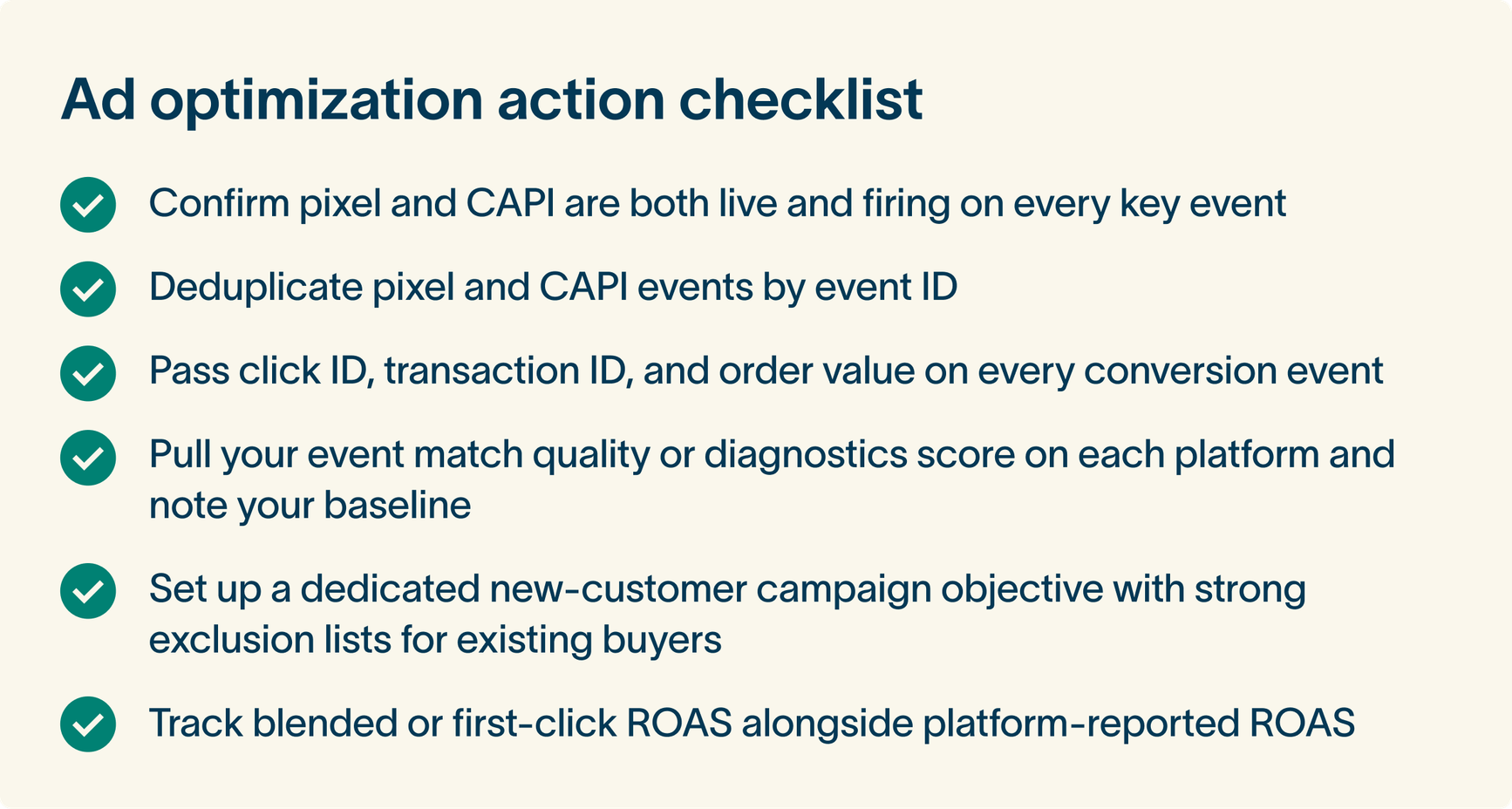
  • Confirm your pixel is firing on every key event: page view, add to cart, initiate checkout, purchase
  • Set up server-side CAPI through your ecommerce platform's native integration or a tool like Triple Whale, which passes conversion data directly to Meta and other platforms
  • Match your pixel and CAPI events by ID to avoid double-counting the same conversion
  • Test firing order and event parameters against the platform's own event testing tool before you scale spend

What is event match quality, and how do you evaluate it?

Once pixel and CAPI are live, the next question is whether your data is actually good. This is where event match quality comes in. 

Event match quality is essentially a measure of how many of the data points a platform wants — email, phone, click ID, transaction ID, IP address — you're actually sending, and how clean that data is once it arrives.

Gillespie described Snapchat's version, saying that Snapchat “gives you a gauge on a quality score for how good your signals are. And then our platform will tell you if you tweak something — like if you dedupe IDs or if you add click ID or transaction ID — you'll improve your score." 

The pattern is similar across platforms. A higher quality score correlates with better performance, because the platform has more to work with.

To audit and improve your signal quality:

  • Pull your event match quality or diagnostics score from each platform's ads manager
  • Check for duplicate events between pixel and CAPI and deduplicate by event ID
  • Add click ID (fbclid, gclid, ttclid, depending on platform) to every event you can
  • Pass transaction ID and order value on every purchase event, not just a generic conversion flag
  • Hash and pass customer email and phone where your platform's terms allow it
  • Re-check your score weekly during the first month of any signal change, since improvements compound

There's also a newer layer worth watching. Panaligan pointed to Google Tag Gateway as a way to recapture signal that would otherwise be lost to third-party cookie restrictions. "Ultimately what that creates is obviously much more visibility into conversions,” he says. “Google Tag Gateway on average will see 14% more visibility in conversions." 

If you haven't evaluated it yet, it's worth a test.

How to optimize ads for new customers (not just ROAS)

Every platform makes it easy to optimize toward the highest ROAS. But the highest ROAS campaign often isn't the one growing your business. 

Alex Stark, co-founder and CMO at Ogee, explained it this way: "Everyone wants to have the best ROAS, but the best ROAS a lot of times will hurt the business because you actually need the best first-click ROAS to bring in the new people." 

Modern retention tactics — an upfront discount, a text message ping, an email flow — are so effective at converting people once they've landed on your site that platform algorithms will gravitate toward taking credit for that easy, lower-funnel conversion if you let them.

Understanding platform ROAS vs blended ROAS is key to knowing whether your campaigns are generating incremental growth or simply claiming credit for existing demand.

Platform ROAS measures what the ad platform claims credit for, often skewed toward last-click, easy conversions. 

Blended ROAS (or true first-click ROAS) measures the full picture, including how many of those conversions were net-new customers versus people who would have converted anyway.

Fixing this requires telling the platform explicitly what you're optimizing for. Gillespie said that “it's not just about the optimization side, it's also about the exclusion side. If you can tell your platforms what you care about, such as New Customer — that makes a big difference to how we will serve ads,” he explained. 

To optimize for new customers, not just ROAS:

  • Build a new-customer campaign objective explicitly, using each platform's dedicated new-customer bidding option where available
  • Layer in customer list exclusions so existing buyers aren't served new-customer-targeted ads
  • Track first-click or blended ROAS alongside platform-reported ROAS, not instead of it
  • Use passback attribution (sending your own attribution data back to the platform) to give the algorithm a truer picture of what actually drove the sale, rather than what the platform's own last-touch model assumes

Stark's team at Ogee saw this play out. After Triple Whale started passing attribution data back to Meta, he described it as "a really big game changer for us" — driving the best new-visitor percentage and first-click ROAS numbers his team had seen from a Meta campaign in a long time.

Omnichannel signals: connecting Amazon, Target, and offline sales

Very few ecommerce brands are DTC-only anymore. Most sell across their own site, Amazon, Target, and increasingly in physical retail. But most ad platforms only see the transactions happening on your website, unless you actively feed them the rest.

Panaligan pointed to this as one of the biggest remaining gaps in most brands' signal setup. "To be able to sort of point our systems in the right direction that incorporate some of that offline sales data is key,” he says.

This is where tools built specifically for cross-channel attribution earn their place. "Brands like Triple Whale can help brands do that,” he says. “There's the cross-channel aspect of it,” he says, noting that the goal is to give each ad platform a fuller picture of who your customers are and where they actually convert, on or off your website.

To bring omnichannel signals into your ad platforms:

  • Map which of your sales channels (Amazon, Target, retail POS, wholesale) currently feed zero data back to your ad platforms
  • Set up offline conversion imports where your platform supports them, matched by email or phone hash
  • Use a unified attribution layer to reconcile cross-channel purchases with the ad exposure that likely influenced them
  • Revisit customer lifetime value calculations to include cross-channel revenue, not just DTC website revenue, when feeding value-based bidding signals

Channel-specific tactics for Google, YouTube, and Meta

Signal quality is the foundation, but each platform still has its own levers worth pulling in 2026.

Google Ads and YouTube 

Google's advantage is breadth. Panaligan pointed out that Google now runs 13 products with a billion users each, and the opportunity for advertisers is combining owned data with what those products already see.

"If you start to utilize and combine some of your own and operated data with some of the signals that you can see from, for example, YouTube views or what folks are searching for, that enhances the value of the overall signal." 

Practically, that means feeding Smart Bidding with your own first-party conversion data rather than relying purely on Google's default signals, and treating YouTube view and engagement data as a real input into your audience strategy, not a separate, disconnected channel.

Meta

On Meta, the priority is dynamic creative optimization (DCO) paired with the strongest possible CAPI setup, since Meta's algorithm leans heavily on conversion signal to decide who to show which ad. 

Passback attribution matters more here than almost anywhere else. Stark's experience shows how much a fuller attribution picture can shift what Meta optimizes toward, moving spend back toward new-customer acquisition instead of easy, lower-funnel wins.

Across both platforms, the through-line is the same. The channel-specific tactic only works as well as the signal foundation underneath it. DCO with weak conversion data still underperforms. Smart Bidding with sparse first-party data still hits a ceiling.

Building an experimentation framework for signal testing

Signal improvements aren't a one-time setup. New features like Google Tag Gateway or updated passback integrations show up regularly. Testing them requires the same discipline you'd apply to a creative or bid test.

Stark's advice on this is simple and applies broadly: "Just be willing to test things because any one of them could really change the business." 

He also pushed back on a common mindset problem. "I think a lot of times there's sort of an adversarial relationship with the ad platforms, that they're trying to trick us or do something. But I think we have a common goal. They want us to get better performance so we keep using the platform.”

That framing matters for how you test. Platforms generally want your signals to be strong, because stronger signals mean better platform performance, which means more ad spend over time. Treat new signal features as collaborative tests rather than skeptical one-off experiments.

A simple framework for testing signal changes:

  • Change one signal variable at a time (a new CAPI field, a new offline import, a new exclusion list) so you can isolate its impact
  • Give any signal change 2 to 4 weeks before judging performance, since platforms need time to relearn with new data
  • Track event match quality score alongside downstream performance metrics, not just ROAS, so you can see whether the signal itself improved
  • Document what changed and when, so a ROAS shift 3 weeks later can be traced back to its actual cause

Ready to see your own signal quality in one place? 

Triple Whale connects your pixel, CAPI, and cross-channel data so you can see event match quality, blended ROAS, and new-customer performance without stitching together five different platform dashboards. See how Triple Whale closes the signal gap.


Component Sales
5.32K
Ecommerce Strategies
Ad Platforms

How to optimize ecommerce ads: Secrets told from experts at Google and Snapchat

Last Updated: 
September 1, 2026

Brands, ad agencies, media buyers — they’re all chasing the wrong thread. They swap out creative every two weeks. They test new bid strategies every month. And they wonder why ROAS doesn’t move.

Here's the secret: the algorithm can only optimize what it can see. If your data foundation is thin, no amount of creative testing or bid tweaking will fix it. 

Google, Meta, and Snapchat have all built machine learning systems that are good at finding your best customers. In 2026, ecommerce ad optimization is about feeding the algorithm.

This post explains how to improve ecommerce ad performance by strengthening your data foundation and signal quality, auditing your current setup, and prioritizing the steps that move the needle.

What is ad signal quality, and why is it the foundation of modern ecommerce ads?

Ad signals are the data points platforms use to understand who converted, what they bought, and how they got there. Every pixel fire, every server-side event, every match ID you pass back is a signal. 

The more complete and accurate that data is, the better the platform's machine learning can find people who look like your best customers.

Reggie Panaligan, Director of Mid-Market Commerce at Google, explained at a recent Triple Whale panel: “The ad platforms themselves have gotten dramatically better, and that improvement is raising the bar on what brands need to feed them. I think that is placing more importance on signal quality."

Panaligan called out the risk, saying that brands that feed platforms low-quality data are "artificially placing caps on the machine," which slows down the platform's ability to learn what's actually working.

So what’s a brand to do? Let’s get into it.

Pixel vs CAPI: how each one strengthens your signal foundation

If you're only running a browser pixel, you're losing data. Ad blockers, iOS privacy changes, and cookie restrictions all chip away at what a pixel alone can capture. 

That's where CAPI (Conversions API) comes in. It sends conversion data directly from your server to the ad platform, bypassing the browser entirely.

Pixel and CAPI are complementary. The pixel captures browser-side behavior and on-site engagement signals. CAPI captures the conversion events a pixel might miss, especially on mobile or in privacy-restricted browsers. 

Fintan Gillespie, Global Director of Ad Partnership at Snapchat, shared the data from Snapchat's own advertiser base: "Smart brands are integrating both pixel and CAPI from the platforms. They're sharing more signals across the funnel. That's leading to a step change in performance." He shares that, looking at Snapchat's web direct-response advertisers in aggregate, brands running both saw a 20% lift in CPA.

Setting this up doesn't have to be a six-month engineering project, says Gillespie. "Most of those apps that we've built with the merchant platforms give you really strong signal strength out the gate so you can get up and running quickly." 

Check what your platform app is already sending before you assume you need custom development.

To build your pixel and CAPI foundation:

  • Confirm your pixel is firing on every key event: page view, add to cart, initiate checkout, purchase
  • Set up server-side CAPI through your ecommerce platform's native integration or a tool like Triple Whale, which passes conversion data directly to Meta and other platforms
  • Match your pixel and CAPI events by ID to avoid double-counting the same conversion
  • Test firing order and event parameters against the platform's own event testing tool before you scale spend

What is event match quality, and how do you evaluate it?

Once pixel and CAPI are live, the next question is whether your data is actually good. This is where event match quality comes in. 

Event match quality is essentially a measure of how many of the data points a platform wants — email, phone, click ID, transaction ID, IP address — you're actually sending, and how clean that data is once it arrives.

Gillespie described Snapchat's version, saying that Snapchat “gives you a gauge on a quality score for how good your signals are. And then our platform will tell you if you tweak something — like if you dedupe IDs or if you add click ID or transaction ID — you'll improve your score." 

The pattern is similar across platforms. A higher quality score correlates with better performance, because the platform has more to work with.

To audit and improve your signal quality:

  • Pull your event match quality or diagnostics score from each platform's ads manager
  • Check for duplicate events between pixel and CAPI and deduplicate by event ID
  • Add click ID (fbclid, gclid, ttclid, depending on platform) to every event you can
  • Pass transaction ID and order value on every purchase event, not just a generic conversion flag
  • Hash and pass customer email and phone where your platform's terms allow it
  • Re-check your score weekly during the first month of any signal change, since improvements compound

There's also a newer layer worth watching. Panaligan pointed to Google Tag Gateway as a way to recapture signal that would otherwise be lost to third-party cookie restrictions. "Ultimately what that creates is obviously much more visibility into conversions,” he says. “Google Tag Gateway on average will see 14% more visibility in conversions." 

If you haven't evaluated it yet, it's worth a test.

How to optimize ads for new customers (not just ROAS)

Every platform makes it easy to optimize toward the highest ROAS. But the highest ROAS campaign often isn't the one growing your business. 

Alex Stark, co-founder and CMO at Ogee, explained it this way: "Everyone wants to have the best ROAS, but the best ROAS a lot of times will hurt the business because you actually need the best first-click ROAS to bring in the new people." 

Modern retention tactics — an upfront discount, a text message ping, an email flow — are so effective at converting people once they've landed on your site that platform algorithms will gravitate toward taking credit for that easy, lower-funnel conversion if you let them.

Understanding platform ROAS vs blended ROAS is key to knowing whether your campaigns are generating incremental growth or simply claiming credit for existing demand.

Platform ROAS measures what the ad platform claims credit for, often skewed toward last-click, easy conversions. 

Blended ROAS (or true first-click ROAS) measures the full picture, including how many of those conversions were net-new customers versus people who would have converted anyway.

Fixing this requires telling the platform explicitly what you're optimizing for. Gillespie said that “it's not just about the optimization side, it's also about the exclusion side. If you can tell your platforms what you care about, such as New Customer — that makes a big difference to how we will serve ads,” he explained. 

To optimize for new customers, not just ROAS:

  • Build a new-customer campaign objective explicitly, using each platform's dedicated new-customer bidding option where available
  • Layer in customer list exclusions so existing buyers aren't served new-customer-targeted ads
  • Track first-click or blended ROAS alongside platform-reported ROAS, not instead of it
  • Use passback attribution (sending your own attribution data back to the platform) to give the algorithm a truer picture of what actually drove the sale, rather than what the platform's own last-touch model assumes

Stark's team at Ogee saw this play out. After Triple Whale started passing attribution data back to Meta, he described it as "a really big game changer for us" — driving the best new-visitor percentage and first-click ROAS numbers his team had seen from a Meta campaign in a long time.

Omnichannel signals: connecting Amazon, Target, and offline sales

Very few ecommerce brands are DTC-only anymore. Most sell across their own site, Amazon, Target, and increasingly in physical retail. But most ad platforms only see the transactions happening on your website, unless you actively feed them the rest.

Panaligan pointed to this as one of the biggest remaining gaps in most brands' signal setup. "To be able to sort of point our systems in the right direction that incorporate some of that offline sales data is key,” he says.

This is where tools built specifically for cross-channel attribution earn their place. "Brands like Triple Whale can help brands do that,” he says. “There's the cross-channel aspect of it,” he says, noting that the goal is to give each ad platform a fuller picture of who your customers are and where they actually convert, on or off your website.

To bring omnichannel signals into your ad platforms:

  • Map which of your sales channels (Amazon, Target, retail POS, wholesale) currently feed zero data back to your ad platforms
  • Set up offline conversion imports where your platform supports them, matched by email or phone hash
  • Use a unified attribution layer to reconcile cross-channel purchases with the ad exposure that likely influenced them
  • Revisit customer lifetime value calculations to include cross-channel revenue, not just DTC website revenue, when feeding value-based bidding signals

Channel-specific tactics for Google, YouTube, and Meta

Signal quality is the foundation, but each platform still has its own levers worth pulling in 2026.

Google Ads and YouTube 

Google's advantage is breadth. Panaligan pointed out that Google now runs 13 products with a billion users each, and the opportunity for advertisers is combining owned data with what those products already see.

"If you start to utilize and combine some of your own and operated data with some of the signals that you can see from, for example, YouTube views or what folks are searching for, that enhances the value of the overall signal." 

Practically, that means feeding Smart Bidding with your own first-party conversion data rather than relying purely on Google's default signals, and treating YouTube view and engagement data as a real input into your audience strategy, not a separate, disconnected channel.

Meta

On Meta, the priority is dynamic creative optimization (DCO) paired with the strongest possible CAPI setup, since Meta's algorithm leans heavily on conversion signal to decide who to show which ad. 

Passback attribution matters more here than almost anywhere else. Stark's experience shows how much a fuller attribution picture can shift what Meta optimizes toward, moving spend back toward new-customer acquisition instead of easy, lower-funnel wins.

Across both platforms, the through-line is the same. The channel-specific tactic only works as well as the signal foundation underneath it. DCO with weak conversion data still underperforms. Smart Bidding with sparse first-party data still hits a ceiling.

Building an experimentation framework for signal testing

Signal improvements aren't a one-time setup. New features like Google Tag Gateway or updated passback integrations show up regularly. Testing them requires the same discipline you'd apply to a creative or bid test.

Stark's advice on this is simple and applies broadly: "Just be willing to test things because any one of them could really change the business." 

He also pushed back on a common mindset problem. "I think a lot of times there's sort of an adversarial relationship with the ad platforms, that they're trying to trick us or do something. But I think we have a common goal. They want us to get better performance so we keep using the platform.”

That framing matters for how you test. Platforms generally want your signals to be strong, because stronger signals mean better platform performance, which means more ad spend over time. Treat new signal features as collaborative tests rather than skeptical one-off experiments.

A simple framework for testing signal changes:

  • Change one signal variable at a time (a new CAPI field, a new offline import, a new exclusion list) so you can isolate its impact
  • Give any signal change 2 to 4 weeks before judging performance, since platforms need time to relearn with new data
  • Track event match quality score alongside downstream performance metrics, not just ROAS, so you can see whether the signal itself improved
  • Document what changed and when, so a ROAS shift 3 weeks later can be traced back to its actual cause

Ready to see your own signal quality in one place? 

Triple Whale connects your pixel, CAPI, and cross-channel data so you can see event match quality, blended ROAS, and new-customer performance without stitching together five different platform dashboards. See how Triple Whale closes the signal gap.

Kaleena Stroud

Kaleena Stroud is a content writer at Triple Whale, bringing data stories to life. She spent many years running an online copywriting business, where she helped brands launch and revamp their Shopify stores. Her work has been featured in Practical Ecommerce, Convert, and Create & Cultivate.

Body Copy: The following benchmarks compare advertising metrics from April 1-17 to the previous period. Considering President Trump first unveiled 
his tariffs on April 2, the timing corresponds with potential changes in advertising behavior among ecommerce brands (though it isn’t necessarily correlated).

Ready to make confident, data-driven decisions faster than ever?

Thank you! Your submission has been received!
Oops! Something went wrong while submitting the form.