
Attribution you can trust to scale profitably
Get full-funnel visibility into your marketing performance. Triple Whale’s multi-touch attribution models show the real impact of every touchpoint — so you can optimize in real time.
Models built for real marketing decisions
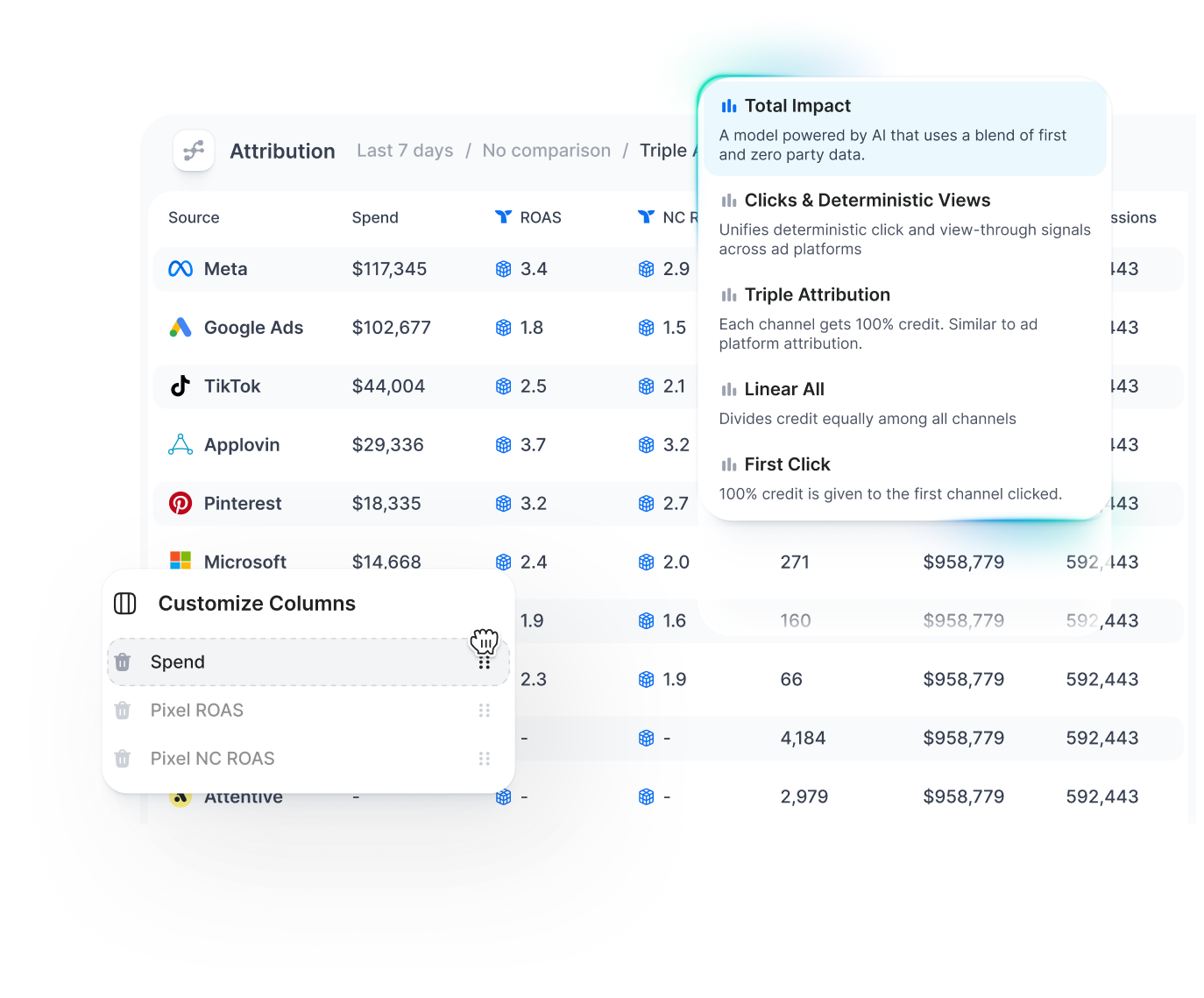
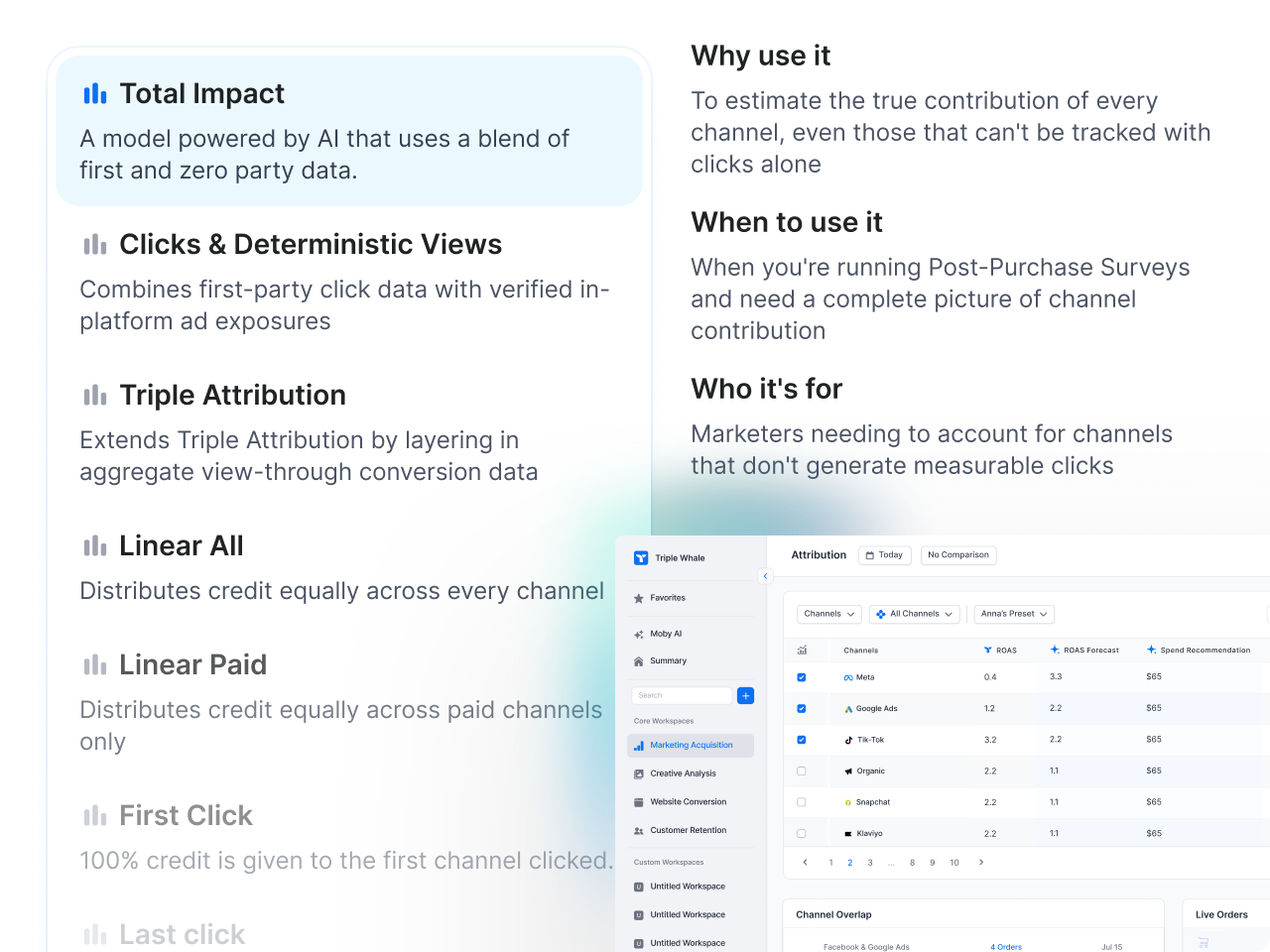
No single attribution model answers every question. That’s why Triple Whale offers seven attribution models, including first-touch, last-touch, and multi-touch attribution, allowing you to evaluate full funnel influence on revenue for smarter marketing decisions.
Measure the true impact of every ad — clicked and seen.
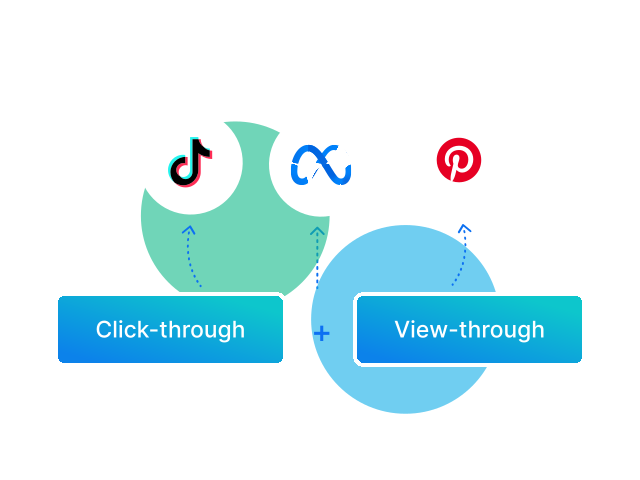
Clicks & Deterministic Views attribution captures both clicks and verified ad impressions, giving you a complete view of how clicks and views drive purchases.

Attribution that includes post-purchase surveys. Only at Triple Whale.
Some conversions can’t be tied directly to a click or view. Our Total Impact model combines multi-touch attribution with Post-Purchase Survey responses to capture the influence of channels like influencers, podcasts, and word-of-mouth drive on revenue.


Capture the data others miss
Triple Pixel’s advanced tracking technology captures more first-party customer journey data than standard tracking solutions, connecting marketing touchpoints to conversions with greater accuracy. More signal means more reliable attribution—and clearer decisions about where to scale spend.
Move faster with ready-to-use insights
Spend less time analyzing data and more time scaling what works. Pre-built attribution dashboards help you quickly evaluate performance across channels, campaigns, ad sets, and creative.
.webp)
.webp)
net profit increase YoY

Putting the attribution back was a no-brainer. And then it went further, finding out that we were more profitable than Facebook through TW reporting, even vs pre-iOS 14. We were getting a better look into our performance

Growth in client's YoY net profit

With the Triple Pixel, we were able to have the full transparency we really wanted. It created a source of truth that enabled us to make decisions confidently like we did before the iOS changes.


Ready to make confident, data-driven decisions faster than ever?
Frequently asked questions
Multi-Touch Attribution (MTA) distributes conversion credit across multiple touchpoints in a customer's journey before purchase. Unlike models that attribute all credit to one interaction, Triple Whale's MTA acknowledges that customers typically engage with several marketing channels before converting. This provides a more accurate picture of how each marketing effort contributes to your conversions, helping you optimize your marketing investments.
Single-touch models (first-click or last-click) assign 100% of conversion credit to just one touchpoint. First-click credits the initial interaction, while last-click credits the final touchpoint before purchase. These models oversimplify complex customer journeys. MTA, in contrast, distributes credit across multiple touchpoints, recognizing the contribution of different channels throughout the funnel—from awareness to consideration to conversion.
Total Impact Attribution combines multi-touch attribution data with Post-Purchase Survey responses to provide a comprehensive view of what drives conversions. By integrating what customers tell you influenced their purchase with tracked digital touchpoints, it captures influences that traditional tracking might miss, such as word-of-mouth or offline interactions. This holistic approach enables more accurate budget allocation decisions based on true marketing impact.
Triple Whale's attribution offers advantages over platform-reported data:
- Cross-channel visibility instead of siloed platform views
- Advanced identity resolution via Triple Pixel that captures more customer behavior
- Consistent methodology across all channels for fair comparison
- Customizable models to align with your business goals
- Integration of customer-reported data through post-purchase surveys
- Unbiased measurement not incentivized to show any particular platform's value
Triple Whale provides value beyond platform attribution by:
- Eliminating platform bias and overlapping conversion claims
- Creating a single source of truth for all marketing channels
- Capturing more accurate data with Triple Pixel technology
- Offering flexible attribution modeling to match your business strategy
- Providing pre-built dashboards for quick insights across your marketing mix
- Incorporating post purchase survey customer data to validate what actually influenced purchases
Triple Whale offers seven attribution models to fit various marketing strategies:
- Total Impact: An AI-powered model that blends first-party and zero-party data, providing the most comprehensive view of marketing performance.
- Clicks & Deterministic Views: Unifies deterministic clicks and view-through conversations for a complete cross-channel view of the entire customer journey.
- Triple Attribution: Gives each channel 100% credit for conversions they touched, similar to how ad platforms report attribution.
- Triple Attribution + Platform Views: Extends Triple Attribution by also including view-through sales in measurement.
- Linear All: Divides conversion credit equally among all channels that touched the customer journey.
- Linear Paid: Divides conversion credit equally, but only among paid channels.
- First Click: Assigns 100% credit to the first channel a customer clicked, ideal for understanding which channels drive initial awareness.
- Last Click: Gives 100% credit to the final channel clicked before conversion, useful for identifying which channels close sales.
These diverse models allow you to select the attribution approach that best aligns with your specific marketing goals and business needs.
Clicks & Deterministic Views attribution measures conversions driven by both ad clicks and verified ad views. It uses deterministic click and view-through data, meaning it tracks platform-verified impressions tied directly to an actual user who later converted—no statistical modeling or guesswork involved.
It captures purchases from customers who either clicked an ad before converting or saw an ad and later converted without clicking. By including both interactions, this model provides a more complete view of how your channels and campaigns contribute to revenue.
Deterministic view-through conversions occur when a user views an ad and later converts, and the ad platform can verify that impression as part of the customer’s journey. Because these signals are reported directly by ad platforms, Clicks & Deterministic Views attribution reflects real, observed interactions rather than modeled estimates.
Consumers engage with brands across multiple ad platforms, making it critical to measure the full customer journey. Click-only attribution overlooks the impact of ads customers saw before they convert without clicking it. This is common with prospecting campaigns, video ads, and upper-funnel marketing. If you rely only on click-based attribution, these conversions are missed, leading you to underestimate the true impact of your campaigns and underfund channels driving growth.

Loved & Trusted


.webp)

.webp)
